Overview
Chopta Chandrashila — The Mini Switzerland of Garhwal
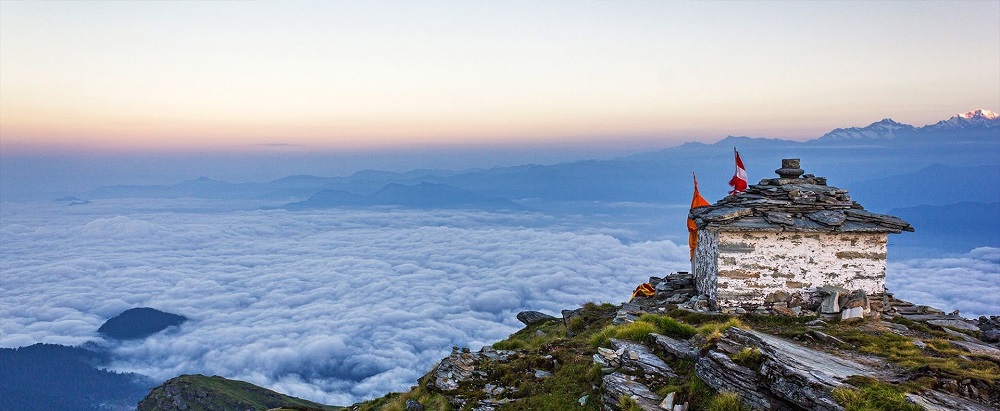
Chopta Chandrashila is the most popular summit trek in Garhwal — and for good reason. In four short days from Haridwar you walk to Chandrashila summit (13,000 ft / 3,962 m) via Tungnath, the highest Shiva temple in the world, and arrive at a viewpoint that delivers one of the broadest panoramas in India. The summit looks across the entire Garhwal Himalayan crest: Nanda Devi (25,646 ft), Trishul (23,360 ft), Chaukhamba (23,419 ft), Kedarnath Dome, Neelkanth, Bandarpoonch (20,719 ft), and Kalanag (Black Peak). The combination of low difficulty, short duration, and exceptional summit views makes it one of the few Indian treks that genuinely earns the "highest reward-to-effort ratio" claim.
Why this trek is special
Three things set Chopta Chandrashila apart. First, Tungnath temple at 12,073 ft — the highest of the Panch Kedar (five Shiva temples in Garhwal) — sits directly on the trail, an 800-year-old stone shrine where Lord Shiva is said to have shown himself as a part of his bull form. Second, the trek sees its peak season in winter (December-March) when the entire route is under snow and the summit becomes a winter Mecca with microspikes and wool-cap photo-ops. Third, the trail starts and ends in Chopta meadow, often called the "Mini Switzerland of India" — a high-altitude grassland surrounded by deodar and rhododendron forest with year-round road access, a small cluster of cafes, and resident Himalayan monals (the state bird of Uttarakhand).
The route from Sari village
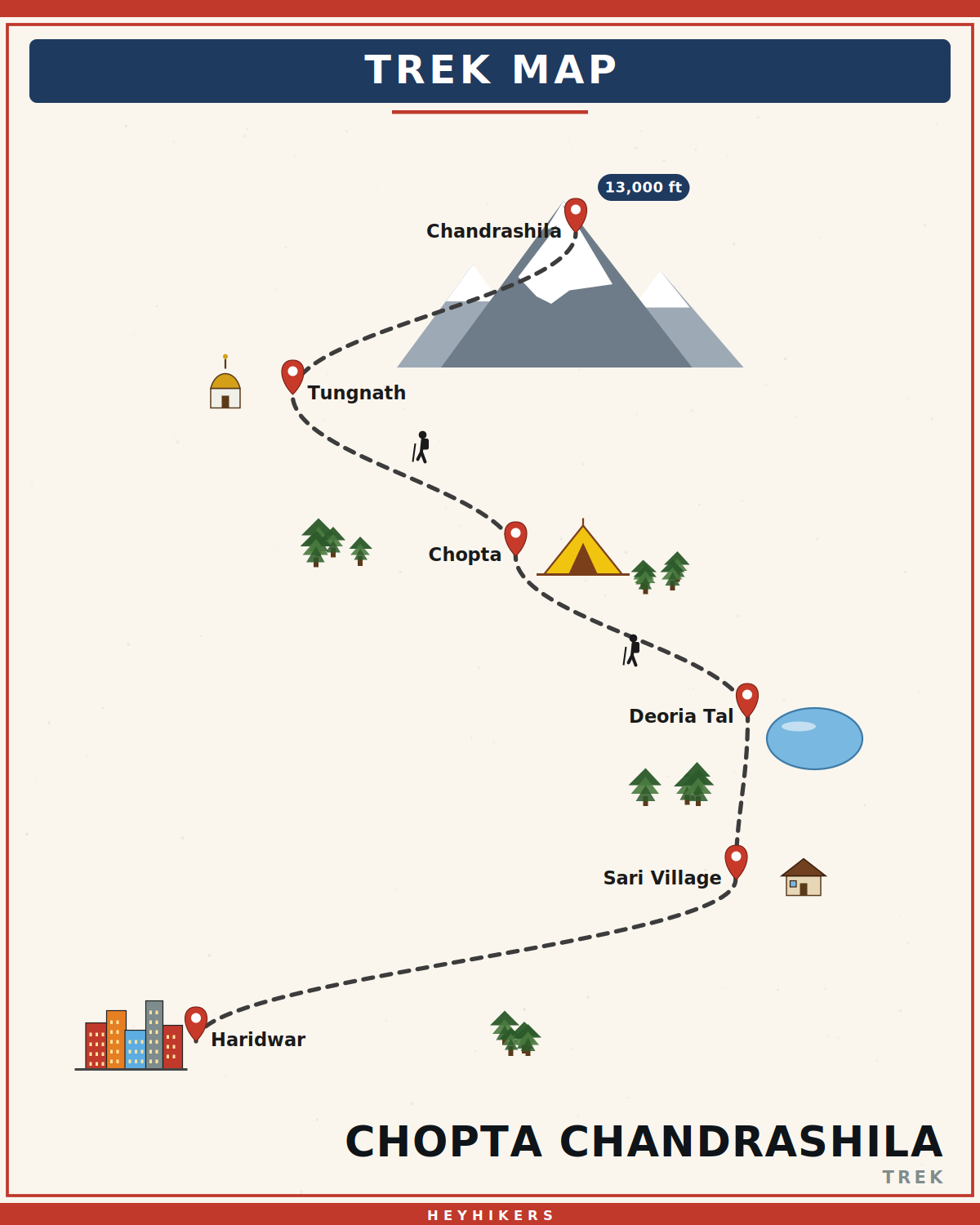
The trek begins at Sari village (6,560 ft), a 9-hour drive from Haridwar. Day 2 includes the famous warm-up hike to Deoria Tal (8,300 ft) — a small lake known for its mirror-perfect reflection of the Chaukhamba peaks at sunrise, mentioned in the Mahabharata as the lake where the Pandavas first met the Yaksha. After Deoria Tal we drive to Chopta (8,800 ft), the basecamp for the summit. Day 3 is summit day: a 4 km steep paved trail to Tungnath temple at 12,073 ft (the path is paved because of pilgrim traffic), then a 1.5 km dirt scramble to Chandrashila summit at 13,000 ft. Most groups summit by 8 AM, descend to Chopta by 1 PM, and drive to Sari for the night. Day 4 drives back to Haridwar.
Tungnath temple — the highest Shiva shrine
The Tungnath temple is the third (and highest) of the five Panch Kedar shrines, attributed to the Pandavas in the Mahabharata. The current stone structure dates to roughly the 8th century, restored multiple times by the Adi Shankaracharya tradition. The temple is closed in winter (November to mid-April) when the deity is moved down to Mukkumath village; the temple structure remains accessible to trekkers. Inside, a natural rock outcrop is worshipped as a part of Lord Shiva's bull form (the bull broke into five pieces, each landing at one of the Panch Kedar). Even non-pilgrims usually pause here — the architecture is striking, the bell-ringing tradition is fun, and the panorama from the temple courtyard is itself worth the climb.
Best season
Chopta Chandrashila is a year-round trek with three distinct seasons. March to mid-June: rhododendron bloom (full red canopy across the trail in April), warm days, occasional snow patches. Mid-September to November: post-monsoon, golden meadows, clearest summit views. December to early March: winter snow trek — 1-3 feet of snow on the upper trail, microspikes essential, frosty meadows, Chopta becomes a winter playground. Many regulars prefer the winter version. The monsoon (July-August) is closed — leeches, slippery trail, and views fully clouded.
Difficulty and who it's for
This is a graded easy trek with a single moderately hard summit-day section. The summit climb gains 4,200 ft from Chopta over 5.5 km, which is intense per kilometre but mitigated by the paved Tungnath path. Sleeping altitudes are moderate (8,800 ft at Chopta, 6,560 ft at Sari). Suitable for first-time Himalayan trekkers, families with children 10+, and retirees with reasonable fitness. We see school groups, couples, and solo travellers on every batch. The trek is ideal as a first Himalayan summit experience.
Camping and infrastructure
No camping required — we use guesthouses in Sari and at Chopta, both with hot food, electricity, and basic plumbing. Chopta has a cluster of small lodges and Forest Department huts; we book rooms (or larger dorms for groups) on a confirmed basis. Mobile network (BSNL/Jio) is intermittent at Sari and Chopta; nonexistent on the summit ridge.
What you'll see — wildlife and bird spotting
Chopta is one of the best bird-watching destinations in Uttarakhand. The Himalayan monal (the state bird) is regularly seen in the Tungnath section — males with iridescent green-purple-blue plumage are unmistakable. Other species include the Himalayan griffon vulture, lammergeier, koklass pheasant, and various warblers. Mammals include musk deer (rare, mostly heard than seen), Himalayan tahr, and the occasional langur troupe in the lower forests. The trek passes through the Kedarnath Wildlife Sanctuary — Forest Department permits are included in our package.
Itinerary
Map
What trekkers say
"I'd never camped in snow before. The HeyHikers team made me feel safe every single step. The summit sunrise — standing at 12,500 ft watching peaks turn gold — I cried. Not from the cold. From the beauty."
PS
Priya Sharma
Kedarkantha, Dec 2025
"Seven lakes, each more unreal than the last. The logistics were flawless — the food at 13,000 ft was better than most restaurants I know. Our guide Farooq knew every stone on the trail. Doing Goechala with them next."
AM
Arjun Mehta
Kashmir Great Lakes, Aug 2025
Inclusion
- All meals during the trek (vegetarian, freshly cooked)
- Camping gear — tents, sleeping bags, mats
- Certified trek leader and support guides
- Forest department permits and entry fees
- First-aid kit and supplemental oxygen
- Basecamp accommodation on twin/triple sharing
Exclusion
- Travel to and from the basecamp pickup point
- Personal trekking gear and clothing
- Travel insurance covering high-altitude trekking
- Tips, personal expenses, and meals during travel days
- Anything not explicitly listed under inclusions
Things to Carry
- Trekking shoes (high-ankle, broken-in)
- 40-50L backpack with rain cover
- Two pairs of trek pants
- Three full-sleeve t-shirts (synthetic, not cotton)
- Fleece jacket and a heavier down/insulated jacket
- Thermal innerwear (top + bottom)
- Waterproof outer shell (jacket + pants)
- Woollen cap, sun cap, balaclava
- Two pairs of warm gloves (inner liner + outer)
- UV-rated sunglasses
- Headlamp with spare batteries
- Reusable water bottles (2L total) or hydration bladder
- Personal medical kit and prescription medicines
- Sunscreen (SPF 50+) and lip balm
- Toiletries and quick-dry towel
- Original photo ID (mandatory at forest checkposts)
How to Reach
Reach Haridwar. Our shared transport leaves at 6:00 AM on Day 1 and reaches Sari village (the gateway to Deoria Tal and Chopta) in 9 hours via Rudraprayag and Ukhimath.
Safety & Security
- Acclimatize properly — never skip rest days at altitude.
- Drink at least 4 litres of water per day above 9,000 ft.
- Tell your trek leader immediately if you feel headache, nausea, or breathlessness — early AMS signs are treatable, ignored ones are not.
- Stay close to the group; do not take shortcuts off the marked trail.
- Avoid alcohol and smoking for the entire duration of the trek.
- Keep a buffer day for travel — Himalayan roads can close without notice.
- Carry travel insurance that explicitly covers high-altitude trekking and helicopter evacuation.
Cancellation Policy
Cancellations must be requested in writing.
- More than 30 days before the trek start date: 90% refund. - 21–30 days before: 50% refund. - 11–20 days before: 25% refund. - 10 days or fewer: no refund, but you may transfer your slot to another trekker or to any future batch within 12 months at no extra charge.
Refunds are processed to the original payment method within 7-10 working days. Trip cancellations triggered by us (weather, force majeure, government restrictions) are refunded in full or moved to an alternate batch at your option.
Meet your trek leader
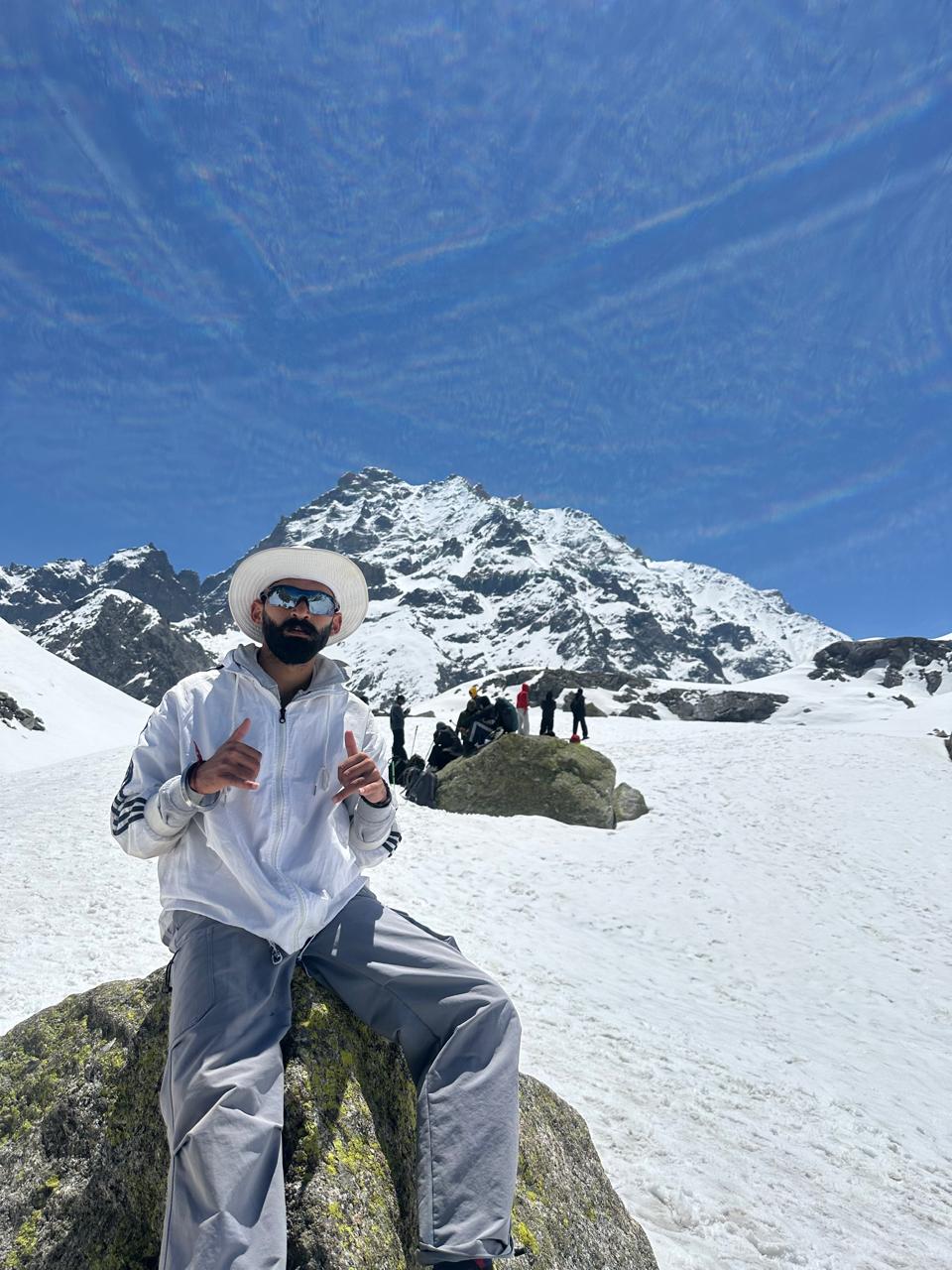
Akhil Deruwan
NIM Uttarkashi certified · 9 yrs experience
Akhil grew up in the foothills of the Garhwal Himalayas and has spent nearly a decade navigating its most demanding trails. He has led over 150 batches across Uttarakhand and Himachal Pradesh, with a strong focus on technical high-altitude routes and safety management. His calm under pressure and deep knowledge of local terrain make him a trusted leader for both beginner and advanced trekkers.
- Wilderness First Responder
- High Altitude Medicine
- Technical Route Navigation
- Search & Rescue
FAQ
Why Trek With Us
Travel Safe
Certified Team
Easy Cancellation
Well Equipped Campsite
Experienced Guide
No Hidden Charges