Overview
Hampta Pass — A Five-Day Crossover from Green Kullu to Desert Lahaul
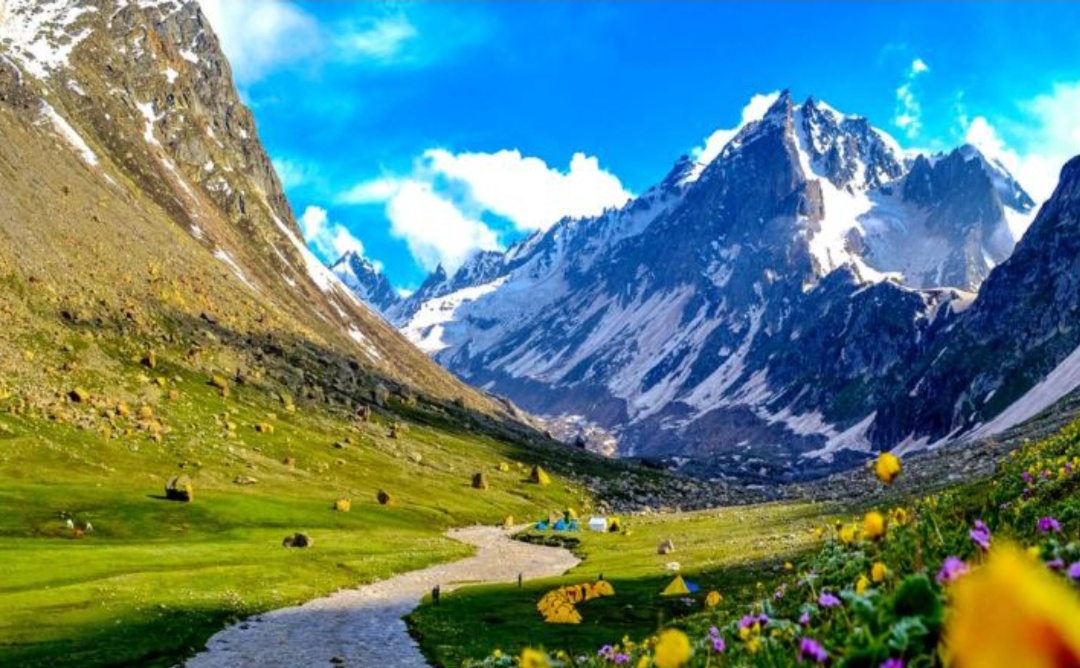
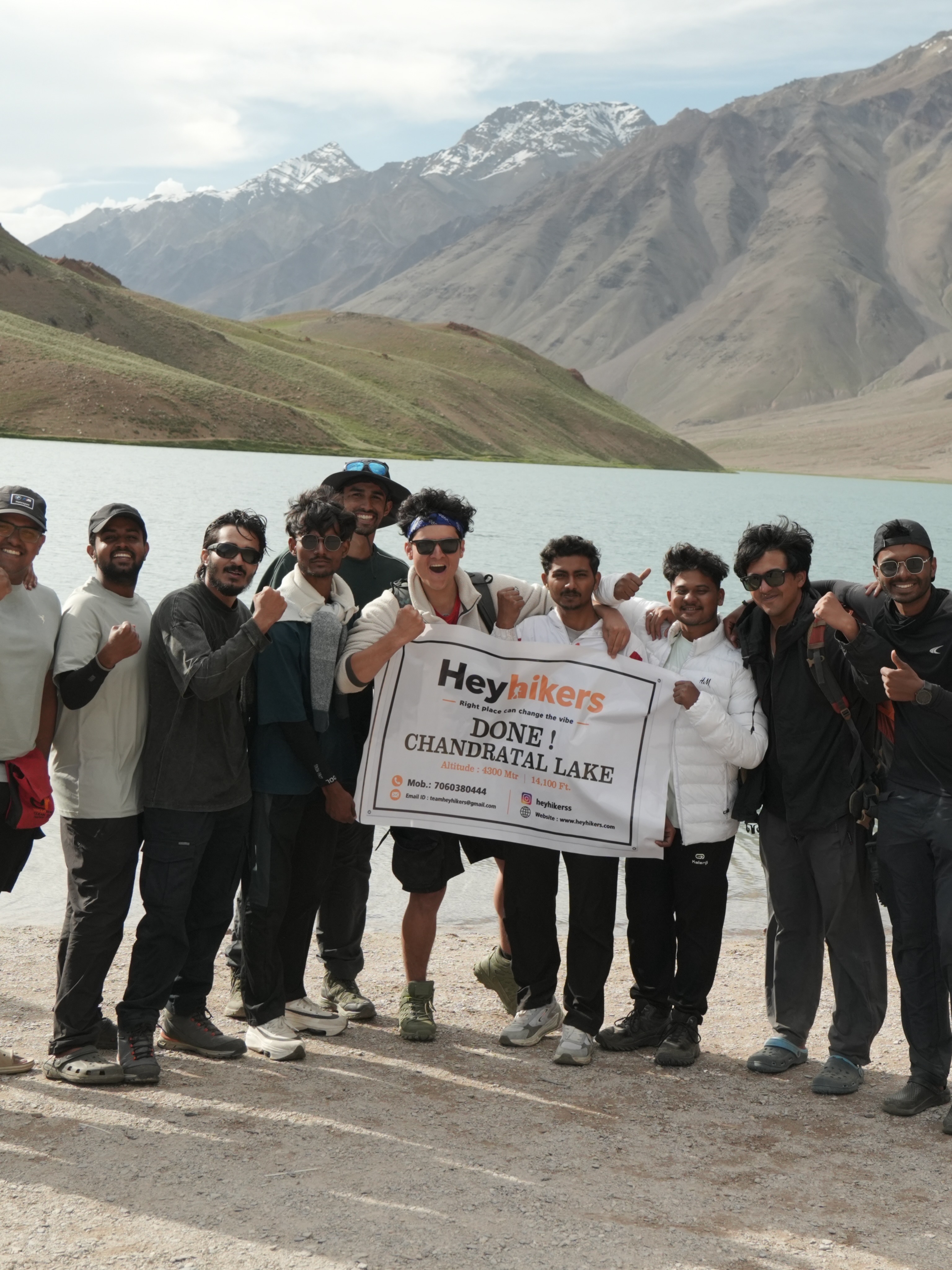
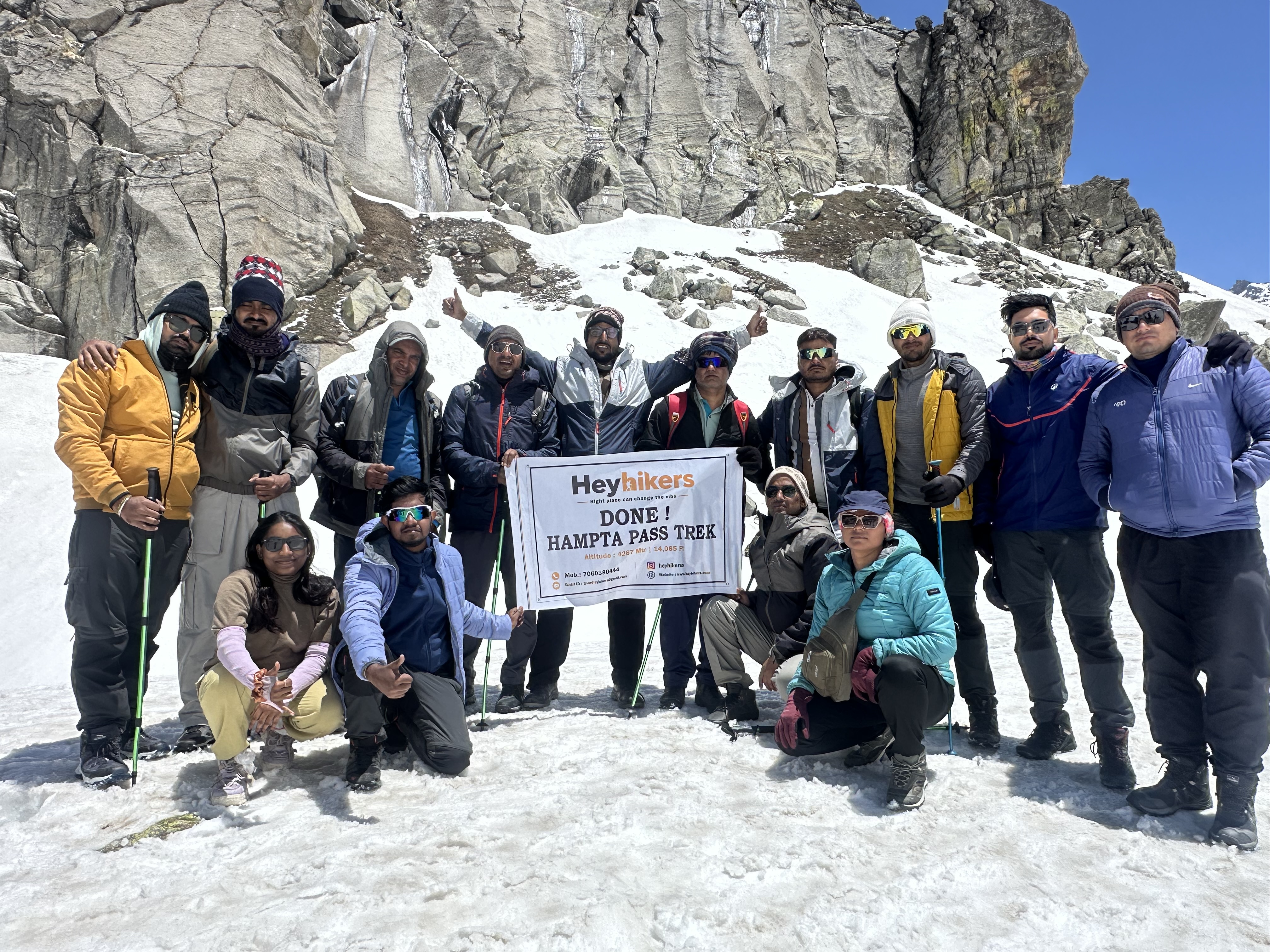
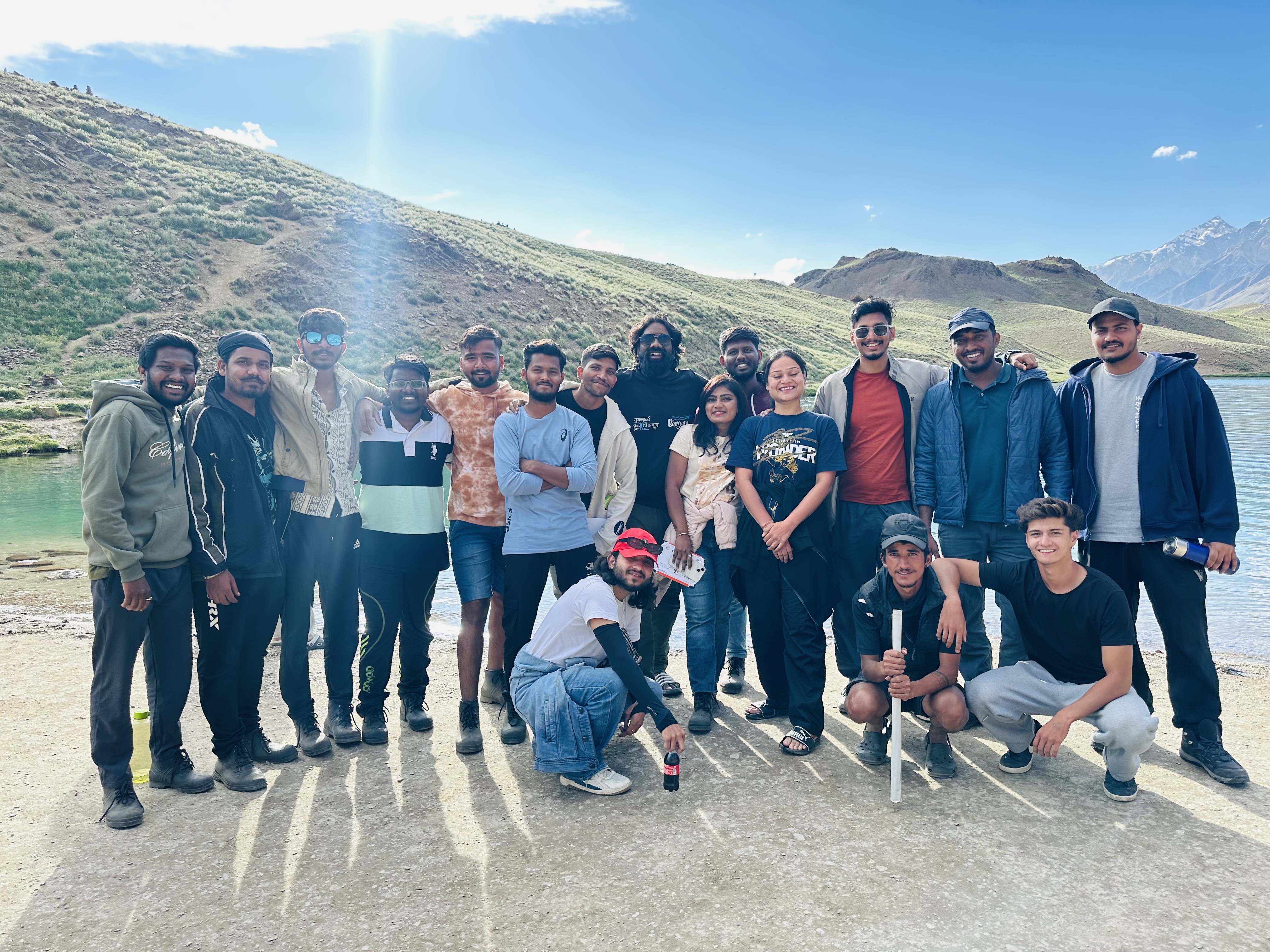
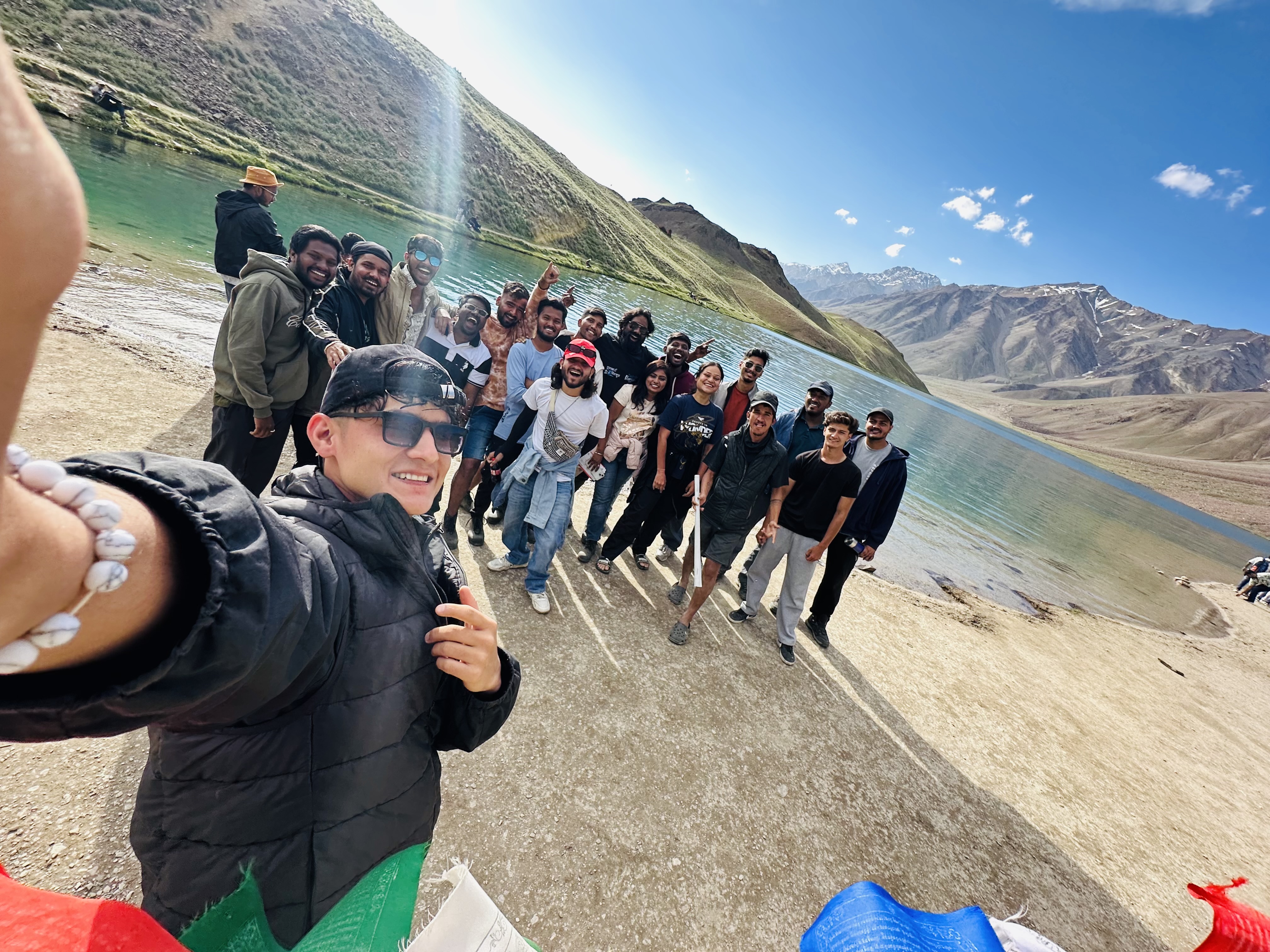
Hampta Pass at 14,100 ft (4,300 m) is the most accessible crossover trek in the Indian Himalayas. In five days the trail walks you out of the alpine forests of Kullu, over a narrow saddle in the Pir Panjal range, and down into the cold, treeless desert of Lahaul — a transition between two completely different climates and ecosystems that ordinarily takes a 12-hour road journey via the Atal Tunnel. The trek pairs naturally with an optional drive extension to Chandratal Lake (14,100 ft), the moon-shaped sacred lake of Spiti, making it one of the highest-density itineraries in Indian trekking.
The geography of the crossing
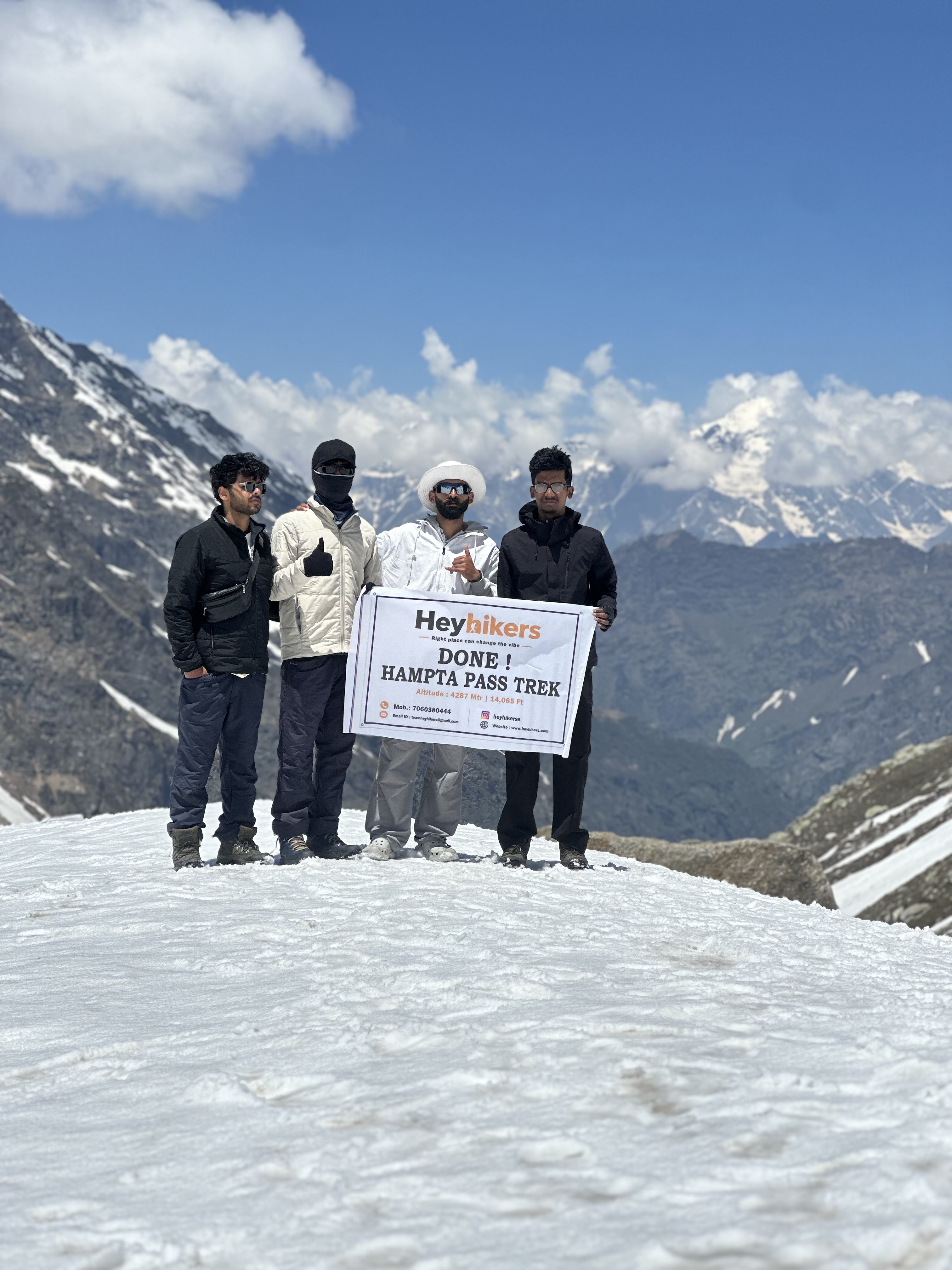
The Pir Panjal is the southernmost main range of the Indian Himalayas, separating the lush, monsoon-watered Kullu valley from the rain-shadow desert of Lahaul-Spiti. Hampta Pass sits on the main Pir Panjal crest at the head of the Hampta nala, a tributary of the Beas river. On the southern (Kullu) side you have rhododendron forest, alpine flowers, and a roaring snowmelt stream. On the northern (Lahaul) side you have brown, treeless valleys, scattered yak pastures, and the white wall of the Chandra Bhaga peaks dominating the horizon. The pass is a narrow notch — barely 30 metres wide — and the moment of crossing is one of the most striking visual transitions on any Indian trek.
The route from Jobra
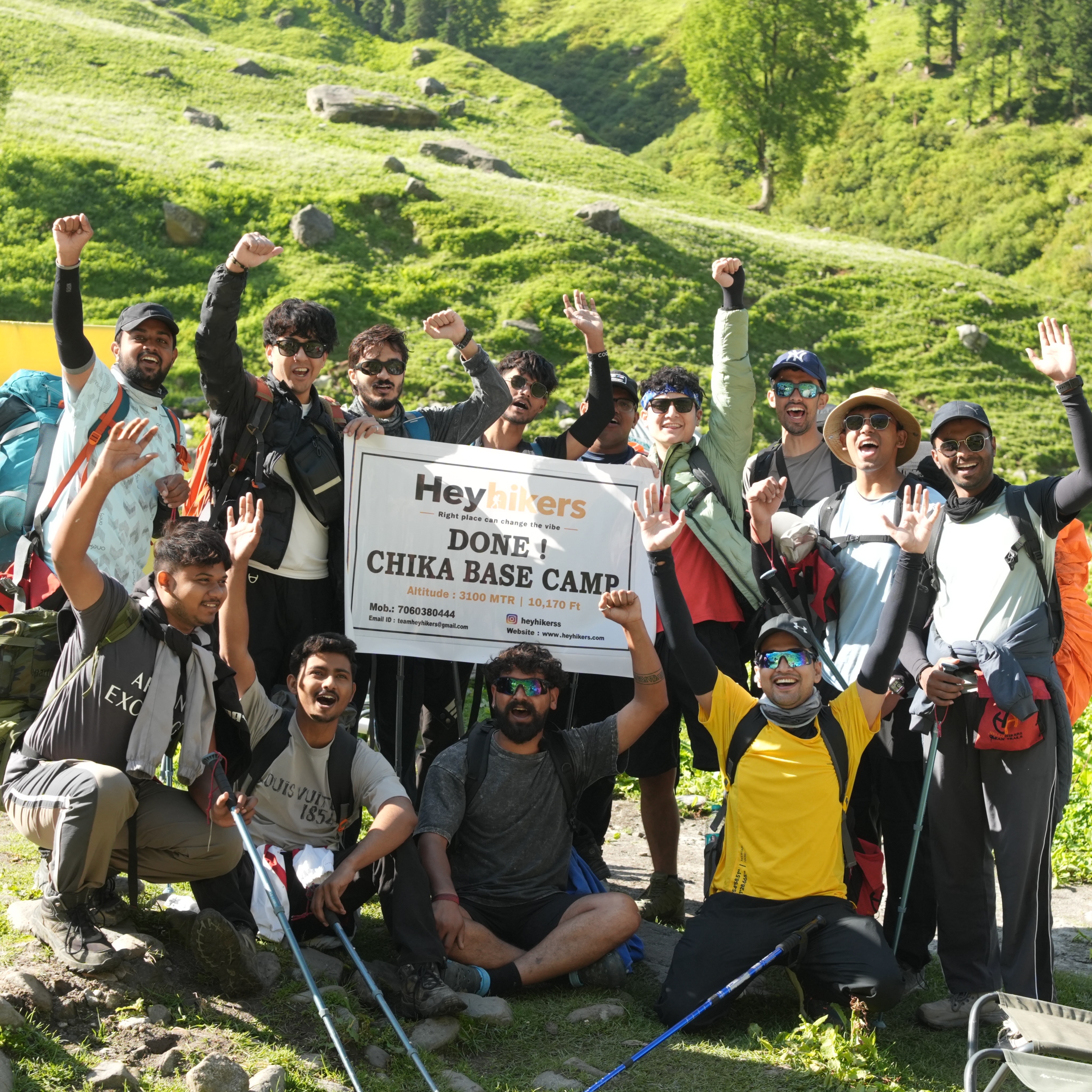
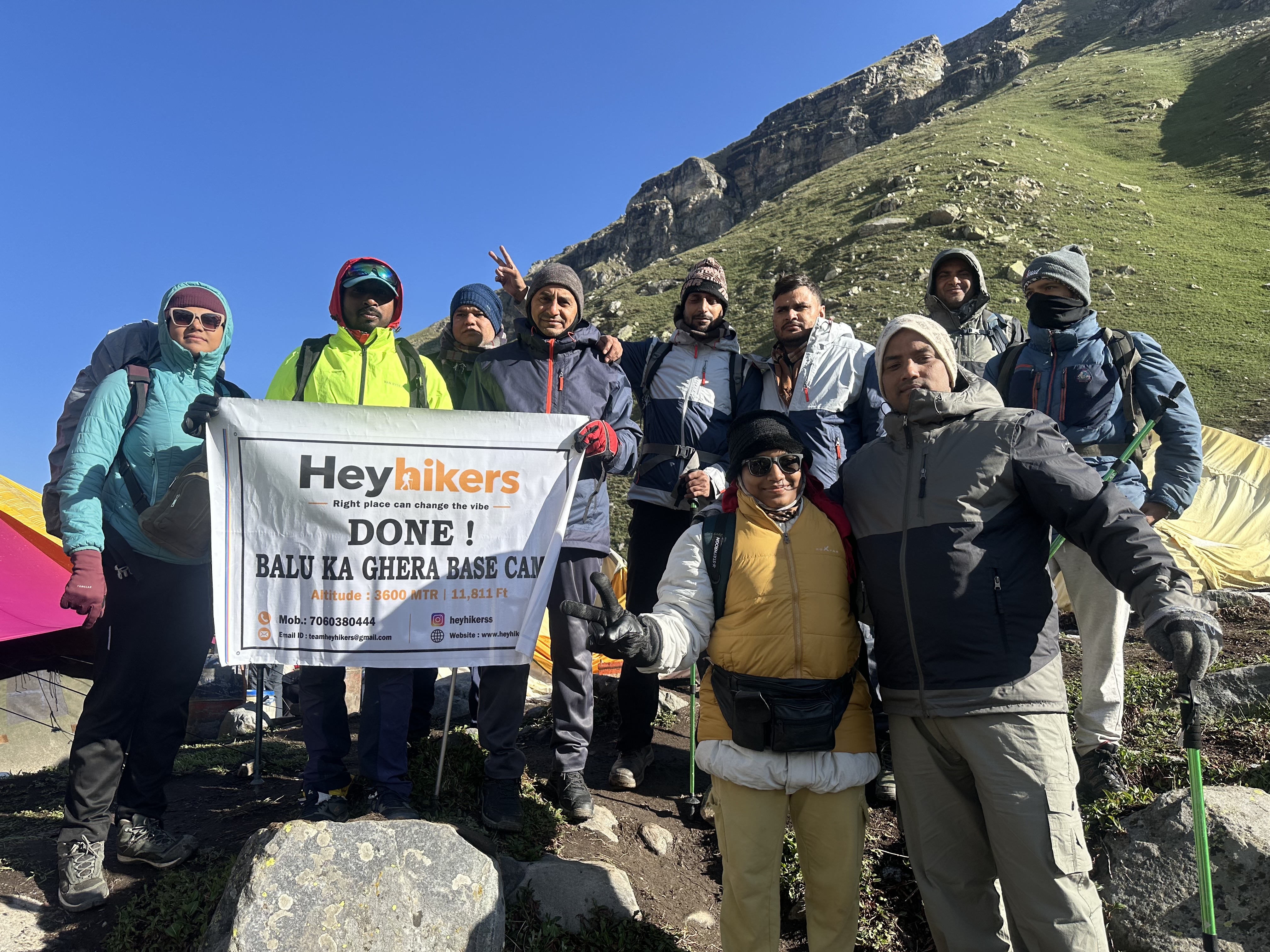
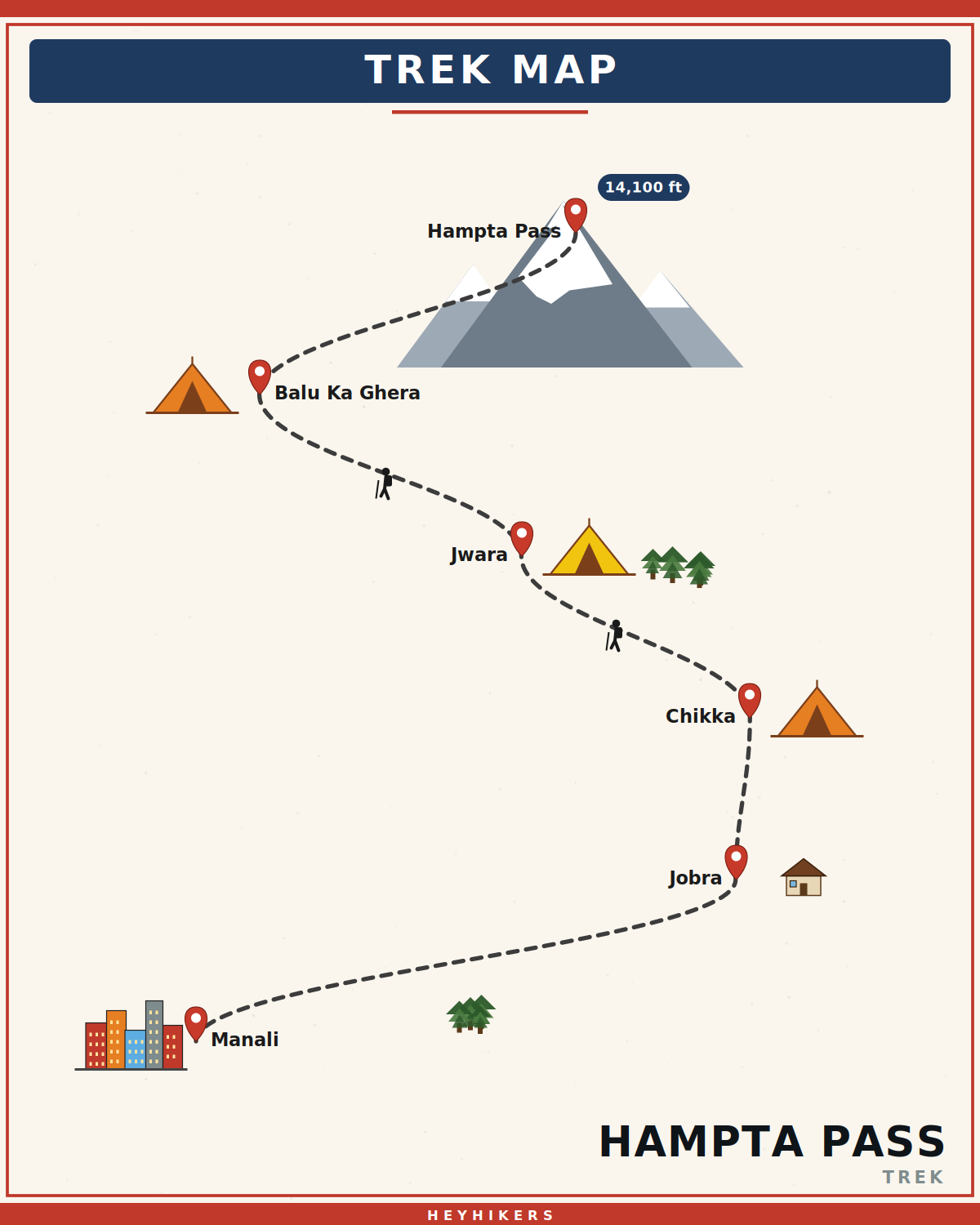
The trek begins at Jobra (9,800 ft), the road head reached by a one-hour drive from Manali via the Allain Duhangan hydroelectric road. Day 1 walks an easy 4 km through pine and silver birch to Chika camp (10,400 ft), set on a wide grassy meadow beside the Hampta nala. Day 2 climbs through alpine meadows splashed with primula, geranium, and yellow Himalayan poppy to Balu Ka Ghera (12,400 ft) — literally "bed of sand", a wide glacial outwash plain where the river splits into braided channels. Day 3 is summit day: a 4 AM start, 1,700 ft of climb to the pass, the dramatic crossing onto the Lahaul side, and a steep 2,000 ft snow-and-scree descent to Shea Goru (12,800 ft), the first Lahaul-side camp. Day 4 descends through the desert valley to Chatru (10,800 ft), the road head on the Manali-Spiti highway.
The pass day itself
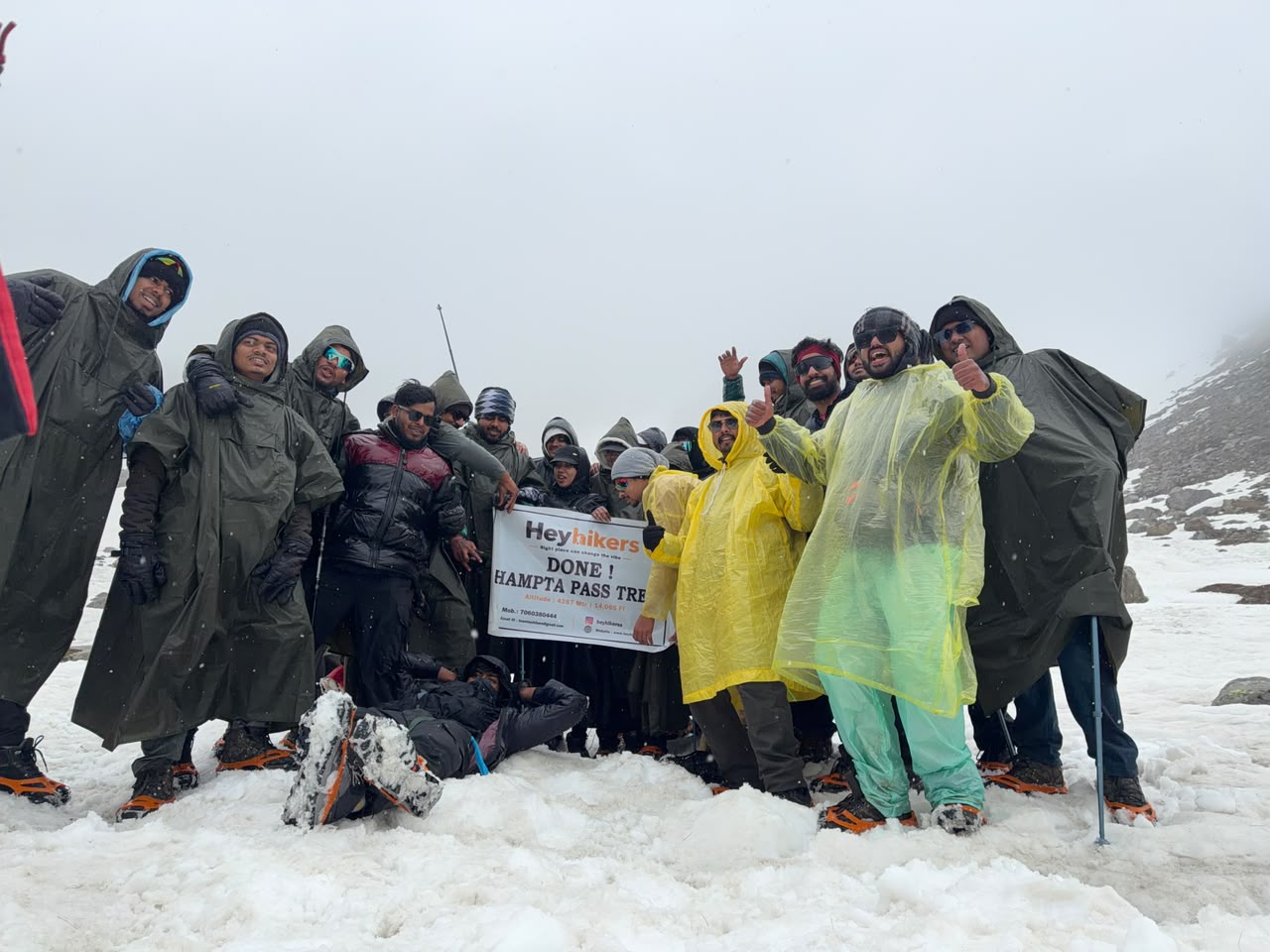
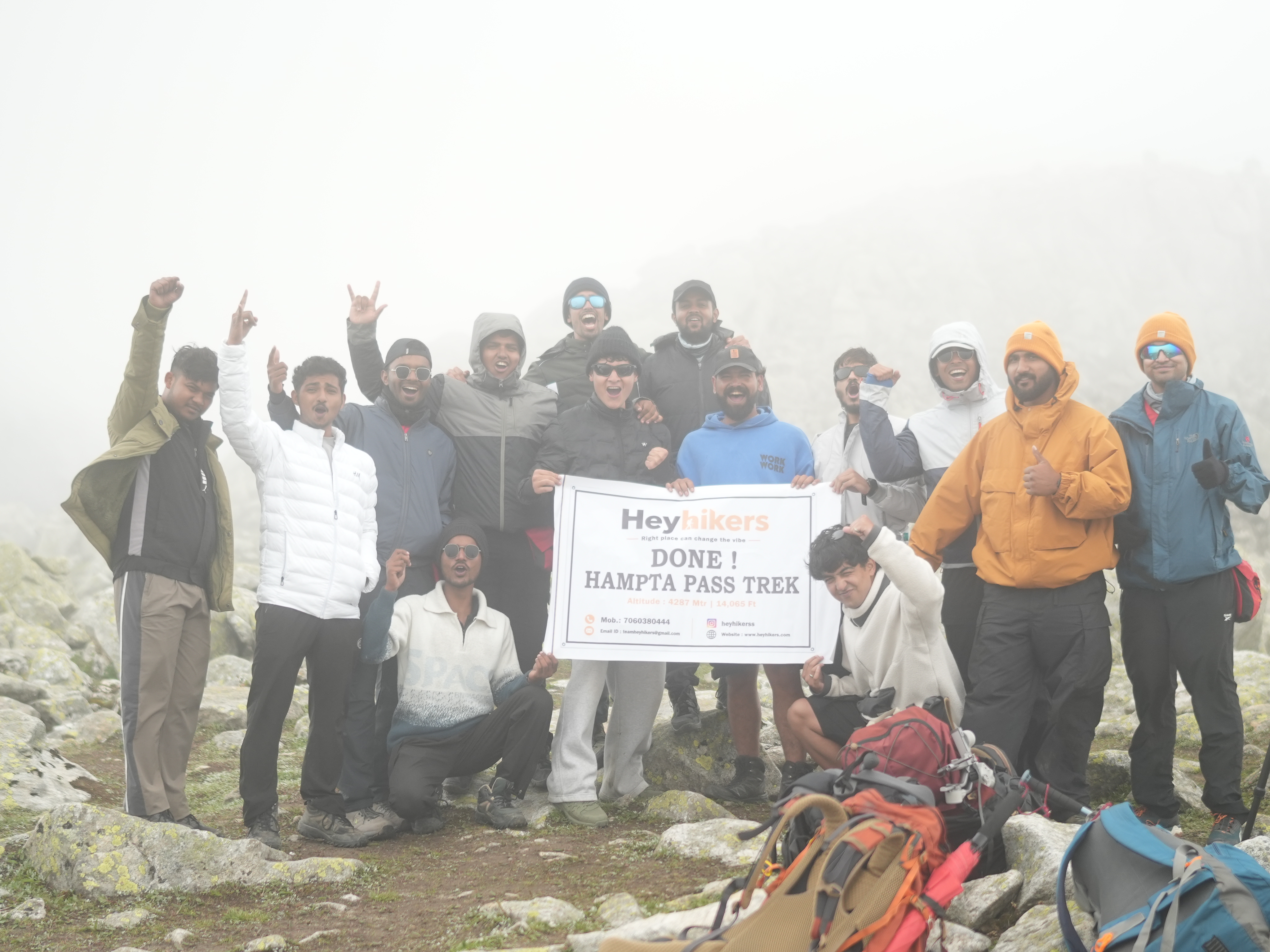
Pass day is the centrepiece. The climb from Balu Ka Ghera is sustained but not technical — a 35-degree snow ramp in May-June, a moraine-and-grass slope in September. We issue microspikes and trekking poles. The pass is reached typically by 9 AM. The descent on the Lahaul side is the dramatic moment: the trail drops sharply down a snow chute (often glissaded for the first 200 metres) onto the moraine bench above Shea Goru. The view opening up below — the brown valley, the white Chandra Bhaga wall, the absence of all green — is the defining image of the trek.
Best season and weather
Hampta Pass runs from mid-June to mid-September, the only window when the pass is snow-clear enough to cross. June has the most snow on the pass-day descent (and the most dramatic glissade). July-August coincides with monsoon on the Kullu side — rain on Days 1-2, but the Lahaul side stays dry due to the rain shadow. September is the photographic prime: clearest air, autumn yellow on the Kullu meadows, snow-dusting on the high peaks. The pass closes by mid-October as winter snow returns.
Camping and infrastructure
HeyHikers operates two-person tents, sleeping bags rated to -10°C, communal kitchen, and pit toilets at Chika, Balu Ka Ghera, and Shea Goru. Mules carry the bulk gear up to Balu Ka Ghera; above the pass, gear is portered. Mobile network ends at Jobra and resumes at Chatru. Trekkers carry only daypacks of 5-7 kg. The Chandratal extension is an additional one-day drive from Chatru via Batal — well worth the add-on for the moonlit lake.
Difficulty and prerequisites
Hampta is a graded moderate trek. Required: ability to run 5 km in 35 minutes and to climb 2,000 ft in a day with a 5 kg pack. No prior Himalayan experience is required, but a one-day fitness hike (Triund, Nag Tibba) within the previous month is recommended. The pass-day total is 8-9 hours and is genuinely demanding; the rest of the trek is comfortable.
Cultural and historical context
Hampta Pass was a working trade route between the Kullu villagers and the Lahauli traders of the Chandra valley until the early 1980s, when the Manali-Leh highway was opened and the foot trail became redundant. Local Kullvi shepherds (called Gaddi) still walk their flocks of sheep and goats over the pass each June and back in late September — you will likely meet a flock or two on the trail. The Lahaul-side villages of Chatru and Khoksar are Tibetan-Buddhist; you will see your first prayer flags and chortens on Day 4. Chandratal, an hour's drive from Chatru, is a sacred lake in both Hindu and Buddhist traditions and is one of two High Altitude Wetlands of India listed under the Ramsar Convention.
Photos
Itinerary
Map
What trekkers say
"I'd never camped in snow before. The HeyHikers team made me feel safe every single step. The summit sunrise — standing at 12,500 ft watching peaks turn gold — I cried. Not from the cold. From the beauty."
PS
Priya Sharma
Kedarkantha, Dec 2025
"Seven lakes, each more unreal than the last. The logistics were flawless — the food at 13,000 ft was better than most restaurants I know. Our guide Farooq knew every stone on the trail. Doing Goechala with them next."
AM
Arjun Mehta
Kashmir Great Lakes, Aug 2025
Inclusion
- All meals
- Camping gear
- Trek leader & support staff
- Transport from Manali to Jobra and Chatru to Manali
- Forest permits
- First aid kit
Exclusion
- Travel to/from Manali
- Personal gear
- Chandratal camping (optional add-on)
- Insurance
- Tips
Things to Carry
- Trekking shoes (high-ankle, broken-in)
- 40-50L backpack with rain cover
- Two pairs of trek pants
- Three full-sleeve t-shirts (synthetic, not cotton)
- Fleece jacket and a heavier down/insulated jacket
- Thermal innerwear (top + bottom)
- Waterproof outer shell (jacket + pants)
- Woollen cap, sun cap, balaclava
- Two pairs of warm gloves (inner liner + outer)
- UV-rated sunglasses
- Headlamp with spare batteries
- Reusable water bottles (2L total) or hydration bladder
- Personal medical kit and prescription medicines
- Sunscreen (SPF 50+) and lip balm
- Toiletries and quick-dry towel
- Original photo ID (mandatory at forest checkposts)
How to Reach
Manali is the basecamp. Reach by overnight Volvo from Delhi (12 hours, multiple daily departures from Majnu Ka Tila and Kashmere Gate) or by air to Bhuntar (Kullu) airport followed by a 1.5 hour cab.
Our team meets you at the Old Manali pickup point at 9:30 AM on Day 1 and shuttles you to the trailhead at Jobra. After the trek you are dropped back to Manali around 1 PM on Day 5.
Safety & Security
- Acclimatize properly — never skip rest days at altitude.
- Drink at least 4 litres of water per day above 9,000 ft.
- Tell your trek leader immediately if you feel headache, nausea, or breathlessness — early AMS signs are treatable, ignored ones are not.
- Stay close to the group; do not take shortcuts off the marked trail.
- Avoid alcohol and smoking for the entire duration of the trek.
- Keep a buffer day for travel — Himalayan roads can close without notice.
- Carry travel insurance that explicitly covers high-altitude trekking and helicopter evacuation.
Cancellation Policy
Cancellations must be requested in writing.
- More than 30 days before the trek start date: 90% refund. - 21–30 days before: 50% refund. - 11–20 days before: 25% refund. - 10 days or fewer: no refund, but you may transfer your slot to another trekker or to any future batch within 12 months at no extra charge.
Refunds are processed to the original payment method within 7-10 working days. Trip cancellations triggered by us (weather, force majeure, government restrictions) are refunded in full or moved to an alternate batch at your option.
Meet your trek leader
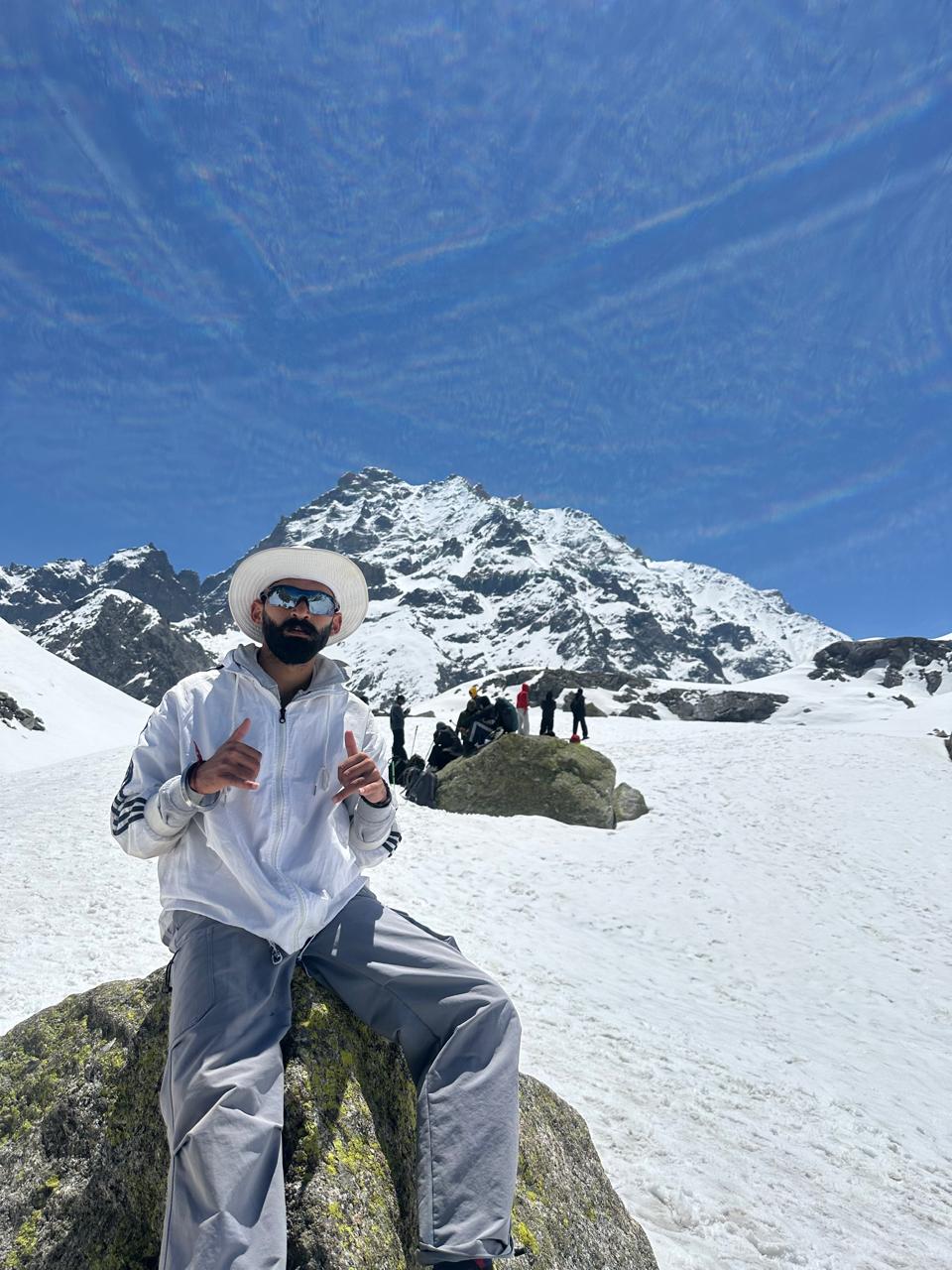
Akhil Deruwan
NIM Uttarkashi certified · 9 yrs experience
Akhil grew up in the foothills of the Garhwal Himalayas and has spent nearly a decade navigating its most demanding trails. He has led over 150 batches across Uttarakhand and Himachal Pradesh, with a strong focus on technical high-altitude routes and safety management. His calm under pressure and deep knowledge of local terrain make him a trusted leader for both beginner and advanced trekkers.
- Wilderness First Responder
- High Altitude Medicine
- Technical Route Navigation
- Search & Rescue
FAQ
Why Trek With Us
Travel Safe
Certified Team
Easy Cancellation
Well Equipped Campsite
Experienced Guide
No Hidden Charges