Overview
Triund — Dharamkot's Iconic Dhauladhar Ridge
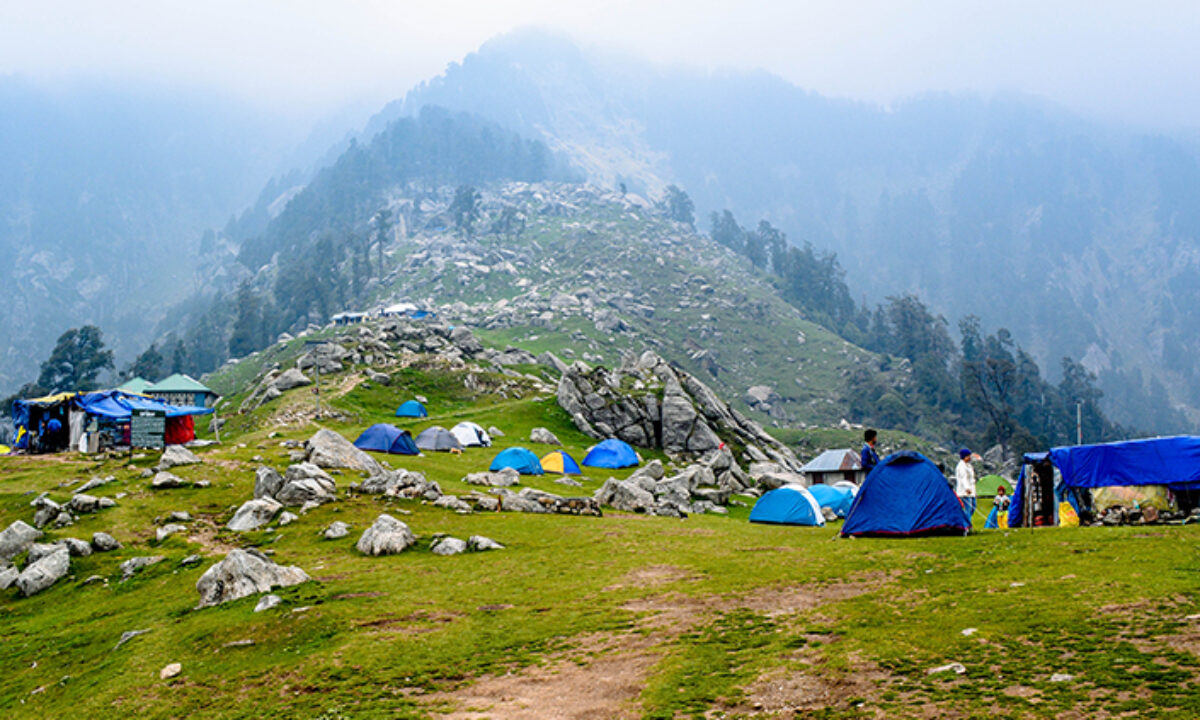
Triund is the most photographed trekking ridge in Himachal Pradesh — a flat, grassy crescent at 9,430 ft (2,875 m) directly beneath the southern Dhauladhar wall. From this single ledge above McLeodganj, the entire range of granite spires that separates Kangra from Lahaul rises five vertical kilometres above your tent. It is the kind of view that you usually have to walk a week for, delivered in seven kilometres of well-graded trail.
The geography that makes it special
The Dhauladhar (literally "white ridge" in Sanskrit) is one of the steepest mountain walls on Earth — climbing from the 1,200 ft Kangra valley to 17,000 ft summits in a single horizontal span of fifteen kilometres. Triund is the natural shelf where this wall pauses before its final ascent. Geologists call this kind of formation a glacial bench: a flat platform left behind by a retreating glacier ten thousand years ago. The ridge is roughly half a kilometre long, ending in a small saddle that drops sharply into the Lahesh cave route to the Indrahar Pass.
The route from Dharamkot
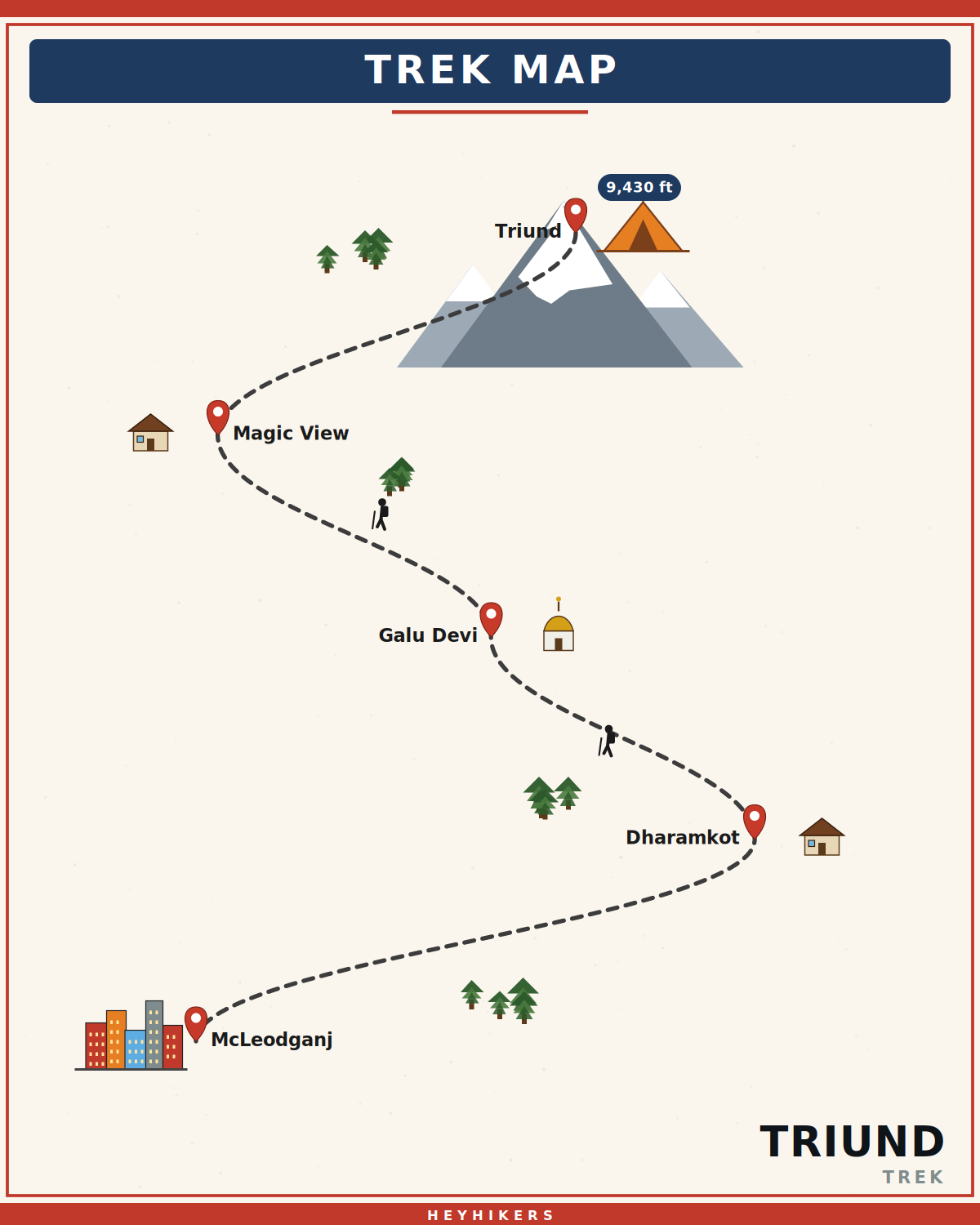
The classical trail begins in Dharamkot, an Israeli-traveller-friendly hamlet five minutes uphill from McLeodganj. The trek opens through deodar and rhododendron forest, climbs past the Galu Devi temple at 7,200 ft (a popular early stop with chai stalls), and traverses the Bhagsu valley before turning into a series of well-known landmarks: Magic View Cafe, Best View Cafe, and Snow Line at the ridge edge. The total ascent is just under 1,000 metres of elevation across nine kilometres — gentle enough that families with children above eight regularly complete it. The final hour is a switchback climb to the ridge and the moment you arrive is theatrical: the trail emerges abruptly onto the meadow and the entire Dhauladhar is suddenly above you.
What to do on the ridge
Once at Triund, the day is yours. Most trekkers walk the half-kilometre length of the ridge to the eastern lookout, watch paragliders launch from Bir-Billing on the horizon, and lie on the grass photographing the snow wall. The peaks visible from the ridge include Mun Peak (15,830 ft), Camel Peak, Slab Peak, and the Indrahar Pass notch (14,245 ft). On exceptionally clear days you can see the dust haze of the Punjab plains stretching south to the horizon. Sunrise and sunset are the two cinematic windows — both turn the granite walls gold for fifteen minutes.
Best time to trek
Triund runs almost year-round. The best windows are March to early June (wildflowers, snow patches, mild days) and September to mid-November (post-monsoon clarity, golden meadows, frosty nights). July and August are monsoon — the trail becomes slippery and views are usually clouded, though the meadow is at its lushest green. December to February sees deep snow on the upper slopes; the trek is still possible but requires gaiters, microspikes, and a willingness to wade. Many regulars prefer winter Triund for the white meadow and the quieter trail.
Camping and infrastructure
Triund's popularity means it is well-served. There are a handful of small cafes near the top serving Maggi, eggs, and chai (including the famous Snow Line cafe a half-hour above the ridge). Camping is regulated by the forest department and HeyHikers operates a designated campsite with two-person tents, sleeping bags rated to -5°C, and dinner around a communal fire. You should expect a basic but comfortable night — pit toilets, no plumbing, and stars that are unbelievably bright.
Extensions and side trips
Triund is also the launch point for harder treks: Snowline (10,300 ft) and Laka Got (11,200 ft) are reachable as day hikes; the technical Indrahar Pass crossing (14,245 ft) takes another two days into the Ravi valley; and Mun Peak (15,830 ft) is a serious mountaineering objective from Lahesh cave. We can extend the standard 2-day Triund into a 3-day Snowline trek or a 5-day Indrahar crossing on request.
Who this trek is for
Triund is the textbook first Himalayan trek. If you can comfortably climb 1,000 metres of elevation in a day on stairs, you can do Triund. We see schoolchildren, retirees, solo travellers, and families on this trail every season. The ridge is forgiving — most of the gain is moderate gradient through forest. It is also one of the very few treks in India where the view-to-effort ratio is genuinely better than what you get on multi-day expeditions.
Itinerary
Map
What trekkers say
"I'd never camped in snow before. The HeyHikers team made me feel safe every single step. The summit sunrise — standing at 12,500 ft watching peaks turn gold — I cried. Not from the cold. From the beauty."
PS
Priya Sharma
Kedarkantha, Dec 2025
"Seven lakes, each more unreal than the last. The logistics were flawless — the food at 13,000 ft was better than most restaurants I know. Our guide Farooq knew every stone on the trail. Doing Goechala with them next."
AM
Arjun Mehta
Kashmir Great Lakes, Aug 2025
Inclusion
- All meals during the trek (vegetarian, freshly cooked)
- Camping gear — tents, sleeping bags, mats
- Certified trek leader and support guides
- Forest department permits and entry fees
- First-aid kit and supplemental oxygen
- Basecamp accommodation on twin/triple sharing
Exclusion
- Travel to and from the basecamp pickup point
- Personal trekking gear and clothing
- Travel insurance covering high-altitude trekking
- Tips, personal expenses, and meals during travel days
- Anything not explicitly listed under inclusions
Things to Carry
- Trekking shoes (high-ankle, broken-in)
- 40-50L backpack with rain cover
- Two pairs of trek pants
- Three full-sleeve t-shirts (synthetic, not cotton)
- Fleece jacket and a heavier down/insulated jacket
- Thermal innerwear (top + bottom)
- Waterproof outer shell (jacket + pants)
- Woollen cap, sun cap, balaclava
- Two pairs of warm gloves (inner liner + outer)
- UV-rated sunglasses
- Headlamp with spare batteries
- Reusable water bottles (2L total) or hydration bladder
- Personal medical kit and prescription medicines
- Sunscreen (SPF 50+) and lip balm
- Toiletries and quick-dry towel
- Original photo ID (mandatory at forest checkposts)
How to Reach
Reach Dharamshala by overnight Volvo from Delhi (12 hours) or by air to Gaggal. From McLeodganj, Dharamkot is a 15-minute taxi ride.
Safety & Security
- Acclimatize properly — never skip rest days at altitude.
- Drink at least 4 litres of water per day above 9,000 ft.
- Tell your trek leader immediately if you feel headache, nausea, or breathlessness — early AMS signs are treatable, ignored ones are not.
- Stay close to the group; do not take shortcuts off the marked trail.
- Avoid alcohol and smoking for the entire duration of the trek.
- Keep a buffer day for travel — Himalayan roads can close without notice.
- Carry travel insurance that explicitly covers high-altitude trekking and helicopter evacuation.
Cancellation Policy
Cancellations must be requested in writing.
- More than 30 days before the trek start date: 90% refund. - 21–30 days before: 50% refund. - 11–20 days before: 25% refund. - 10 days or fewer: no refund, but you may transfer your slot to another trekker or to any future batch within 12 months at no extra charge.
Refunds are processed to the original payment method within 7-10 working days. Trip cancellations triggered by us (weather, force majeure, government restrictions) are refunded in full or moved to an alternate batch at your option.
Meet your trek leader
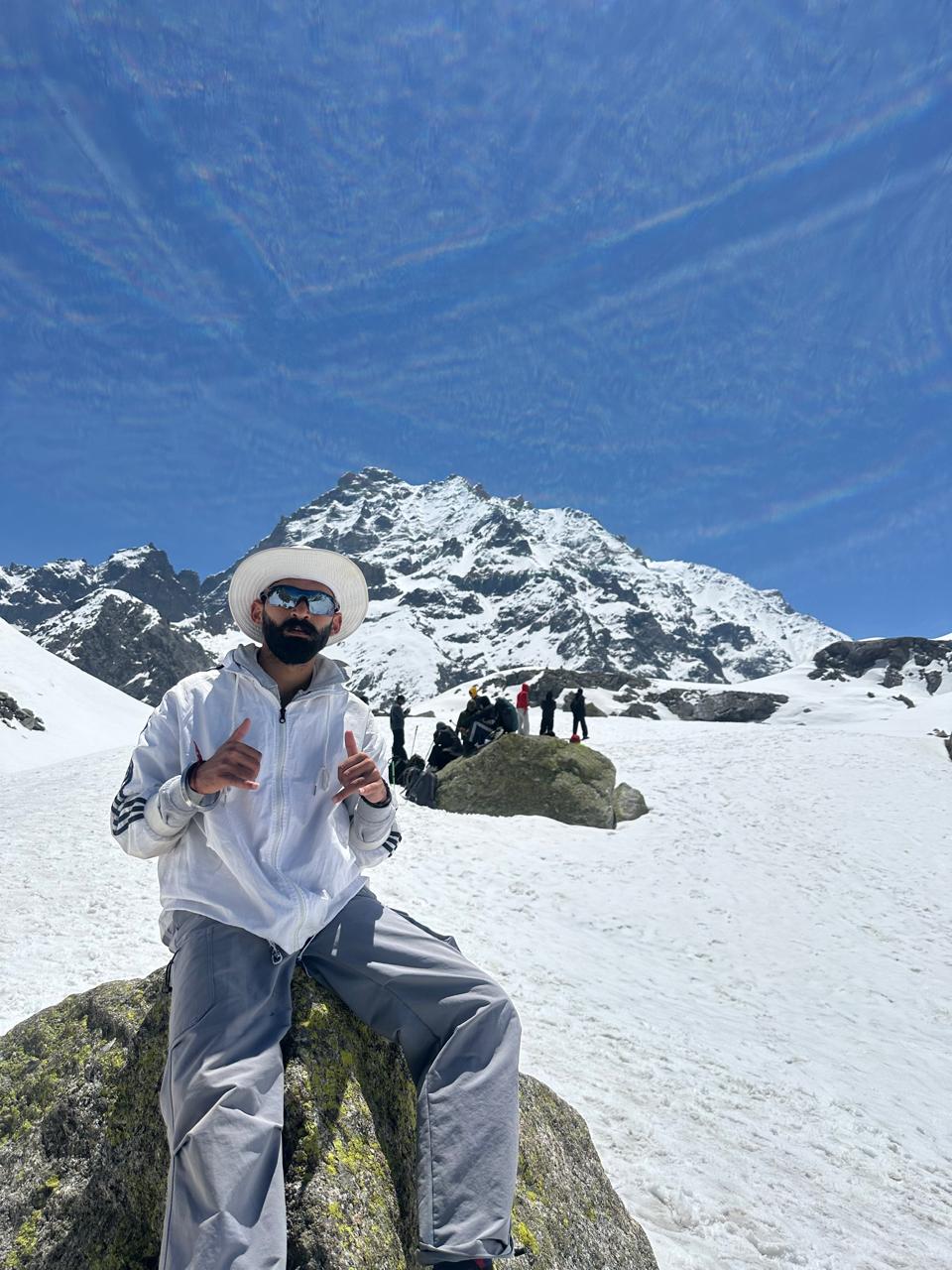
Akhil Deruwan
NIM Uttarkashi certified · 9 yrs experience
Akhil grew up in the foothills of the Garhwal Himalayas and has spent nearly a decade navigating its most demanding trails. He has led over 150 batches across Uttarakhand and Himachal Pradesh, with a strong focus on technical high-altitude routes and safety management. His calm under pressure and deep knowledge of local terrain make him a trusted leader for both beginner and advanced trekkers.
- Wilderness First Responder
- High Altitude Medicine
- Technical Route Navigation
- Search & Rescue
FAQ
Why Trek With Us
Travel Safe
Certified Team
Easy Cancellation
Well Equipped Campsite
Experienced Guide
No Hidden Charges