Overview
Kuari Pass — Lord Curzon's Garhwal Trail
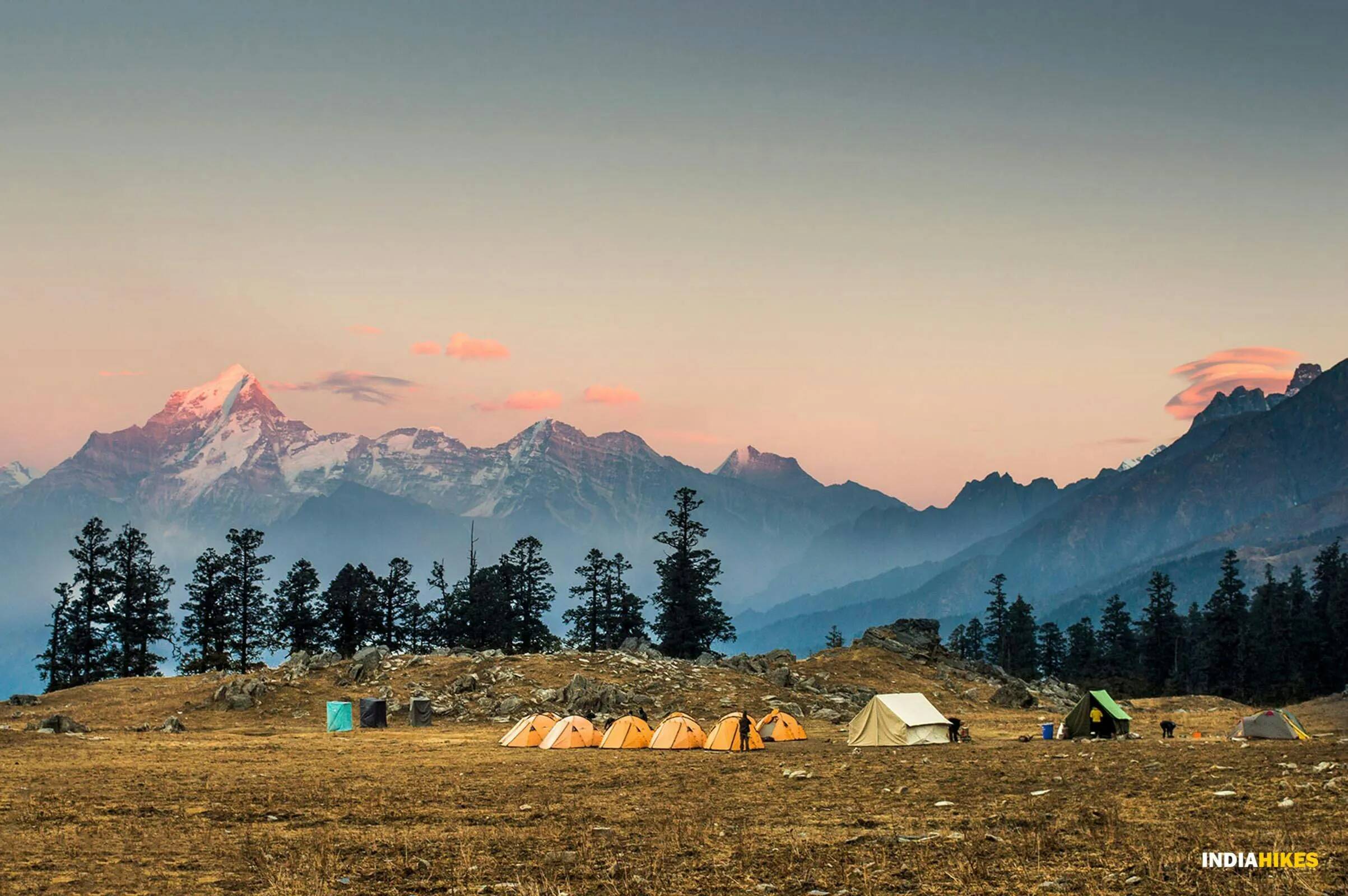
Kuari Pass is arguably the highest reward-to-effort ratio in Indian trekking. At 12,516 ft (3,815 m), the pass sits on a forested ridge above Joshimath in Uttarakhand's Chamoli district and offers one of the most expansive panoramas of the Garhwal Himalaya available from any non-technical trail. From a single saddle you can see Nanda Devi (25,646 ft), Kamet (25,446 ft), Dronagiri (23,184 ft), Chaukhamba (23,419 ft), Hathi-Ghoda, Trishul, and Nanda Ghunti — a near-continuous arc of 6,000 m+ peaks. The trail was first popularised by Lord Curzon, Viceroy of India from 1899-1905, who walked it in 1905 and is said to have called the panorama unmatched in the British Empire.
Why this trek is unique
Most Garhwal treks force a choice between low effort and big views. Kuari delivers both. The route runs through Joshimath, the winter seat of the Badrinath deity, and threads ancient Bhotiya villages, oak-and-rhododendron forest, and the vast Gorson Bugyal before topping out at the pass itself. Unlike harder objectives like Pangarchulla or Bali Pass, Kuari requires no rope-work, no glacier travel, and no technical skill — just a moderate fitness baseline. It is also one of the few high-altitude treks in India that can be done in early winter (October-March) when most other Uttarakhand routes are snowbound and impassable.
The route from Joshimath
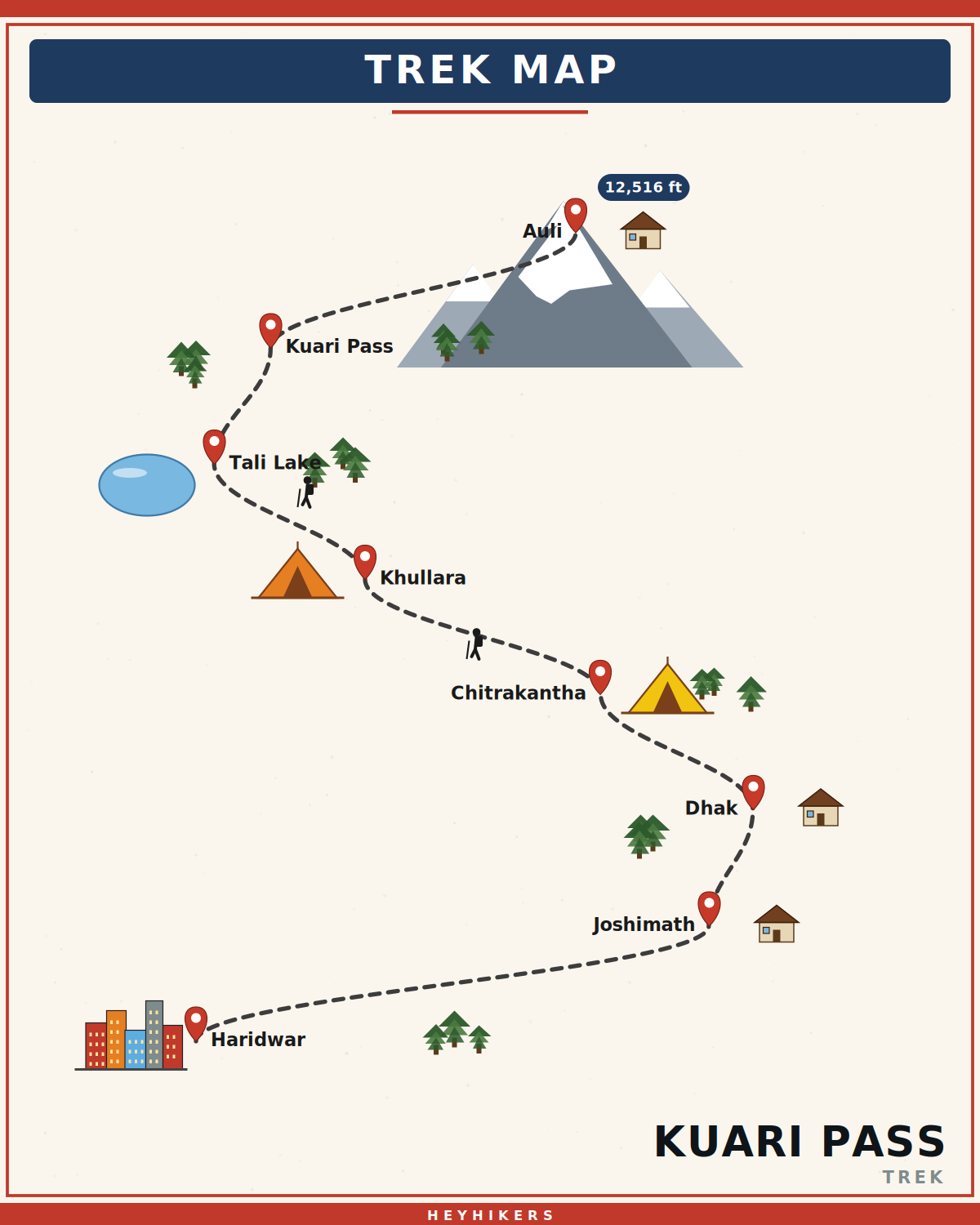
The trail begins at Dhak village (6,800 ft) — a 12 km drive from Joshimath — and climbs through apple orchards and walnut groves to Tugasi, a tiny Bhotiya hamlet of stone-roofed houses with prayer flags strung across the lanes. Day 2 ends at Chitrakantha (Gulling) campsite at 9,500 ft, set among rhododendrons that bloom in April-May. Day 3 traverses to Khullara meadow at 11,200 ft — the visual moment of the trek where the wall of peaks first reveals itself — and continues to Tali Lake (11,000 ft), a small near-circular pond used by shepherds and ringed by junipers. Day 4 is summit day: a steep snow-and-grass climb to the pass, a long traverse across Gorson Bugyal, and a forest descent to Auli (9,800 ft).
What you'll see at the pass
The Kuari Pass is a wide grassy saddle, not a sharp notch — its name in Garhwali literally means "doorway." From it the panorama unfurls across roughly 270°. Nanda Devi, India's second-highest peak and a goddess in the Garhwali tradition, dominates the eastern frame; the closer Hathi-Ghoda (literally "Elephant-Horse," named after its twin summits) sits directly across the valley; and to the west Chaukhamba rises behind the Auli ridgeline. On clear winter mornings you can see Kamet and Mana Peak on the Tibetan border. The pass also looks straight onto the upper Dhauliganga valley, the route to the Niti Pass that Bhotiya traders used to walk to Tibet until the 1962 Sino-Indian war closed the border.
Best season and conditions
Kuari is one of India's few year-round high-altitude treks. April-June brings rhododendron bloom, snow-melt streams, and clear skies. July-August is monsoon and the trail closes (slippery oak forest, low visibility, leech infested). September-November is the post-monsoon golden window — clearest views of the year, golden meadows, frost on the tents. December-March is the snow season — the trek transforms into a winter snow trek with 1-3 feet of snow on the upper sections, requiring microspikes, gaiters, and a willingness to wade. Many regulars prefer the winter version for the white meadows and the empty trail.
Camping and infrastructure
Camps are pitched at Chitrakantha and Tali Lake; the final night is in a Joshimath hotel. HeyHikers operates designated forest-department-permitted campsites with two-person tents, sleeping bags rated to -10°C, kitchen tents, and pit toilets. Mules ferry the group gear; you carry only a 5-7 kg daypack. Joshimath has reasonable hotels, a hospital, ATMs, and BSNL/Jio mobile network. Auli has the Auli ski resort with its 4 km gondola and a few mid-range hotels — many trekkers extend a night here for skiing.
Who this trek is for
Kuari is the textbook second Himalayan trek — one step beyond Triund or Kedarkantha, but well below the demands of Roopkund or Pangarchulla. If you have done one moderate Himalayan trek and can comfortably climb 1,000 m of elevation in a day, you are ready. We see school groups (14+), couples in their 50s, retirees, and solo first-timers on this trail every season. The forest stretches give you altitude-acclimatisation cover, the gradients are forgiving, and Joshimath sits at a moderate 6,150 ft so the approach is gentle.
Cultural and historical context
Joshimath is one of the four Mathas (monastic seats) founded by Adi Shankaracharya in the 8th century — alongside Sringeri, Puri, and Dwarka. The town houses the Narsingh temple where the Badrinath idol is shifted in winter when Badrinath shrine closes for snow. The 1,200-year-old Kalpvriksha mulberry tree under which Shankaracharya is said to have meditated still stands in the lower town. The trail itself was a working route for Bhotiya traders carrying salt, wool, and borax from Tibet through the Niti Pass into the Indian plains, and the village of Tugasi still has descendants of these trader families. Kuari is a living trail — worth pausing for at every chai stop.
Itinerary
Map
What trekkers say
"I'd never camped in snow before. The HeyHikers team made me feel safe every single step. The summit sunrise — standing at 12,500 ft watching peaks turn gold — I cried. Not from the cold. From the beauty."
PS
Priya Sharma
Kedarkantha, Dec 2025
"Seven lakes, each more unreal than the last. The logistics were flawless — the food at 13,000 ft was better than most restaurants I know. Our guide Farooq knew every stone on the trail. Doing Goechala with them next."
AM
Arjun Mehta
Kashmir Great Lakes, Aug 2025
Inclusion
- All meals
- Camping gear
- Trek leader
- Permits
- First aid
- Transport from Haridwar
Exclusion
- Personal gear
- Insurance
- Tips
- Auli activities
Things to Carry
- Trekking shoes (high-ankle, broken-in)
- 40-50L backpack with rain cover
- Two pairs of trek pants
- Three full-sleeve t-shirts (synthetic, not cotton)
- Fleece jacket and a heavier down/insulated jacket
- Thermal innerwear (top + bottom)
- Waterproof outer shell (jacket + pants)
- Woollen cap, sun cap, balaclava
- Two pairs of warm gloves (inner liner + outer)
- UV-rated sunglasses
- Headlamp with spare batteries
- Reusable water bottles (2L total) or hydration bladder
- Personal medical kit and prescription medicines
- Sunscreen (SPF 50+) and lip balm
- Toiletries and quick-dry towel
- Original photo ID (mandatory at forest checkposts)
How to Reach
Reach Haridwar by train or road (most overnight trains from Delhi work). Our shared transport leaves Haridwar Railway Station at 6:00 AM on Day 1 and reaches Joshimath in 10-12 hours via Rishikesh, Devprayag, and Rudraprayag.
Safety & Security
- Acclimatize properly — never skip rest days at altitude.
- Drink at least 4 litres of water per day above 9,000 ft.
- Tell your trek leader immediately if you feel headache, nausea, or breathlessness — early AMS signs are treatable, ignored ones are not.
- Stay close to the group; do not take shortcuts off the marked trail.
- Avoid alcohol and smoking for the entire duration of the trek.
- Keep a buffer day for travel — Himalayan roads can close without notice.
- Carry travel insurance that explicitly covers high-altitude trekking and helicopter evacuation.
Cancellation Policy
Cancellations must be requested in writing.
- More than 30 days before the trek start date: 90% refund. - 21–30 days before: 50% refund. - 11–20 days before: 25% refund. - 10 days or fewer: no refund, but you may transfer your slot to another trekker or to any future batch within 12 months at no extra charge.
Refunds are processed to the original payment method within 7-10 working days. Trip cancellations triggered by us (weather, force majeure, government restrictions) are refunded in full or moved to an alternate batch at your option.
Meet your trek leader
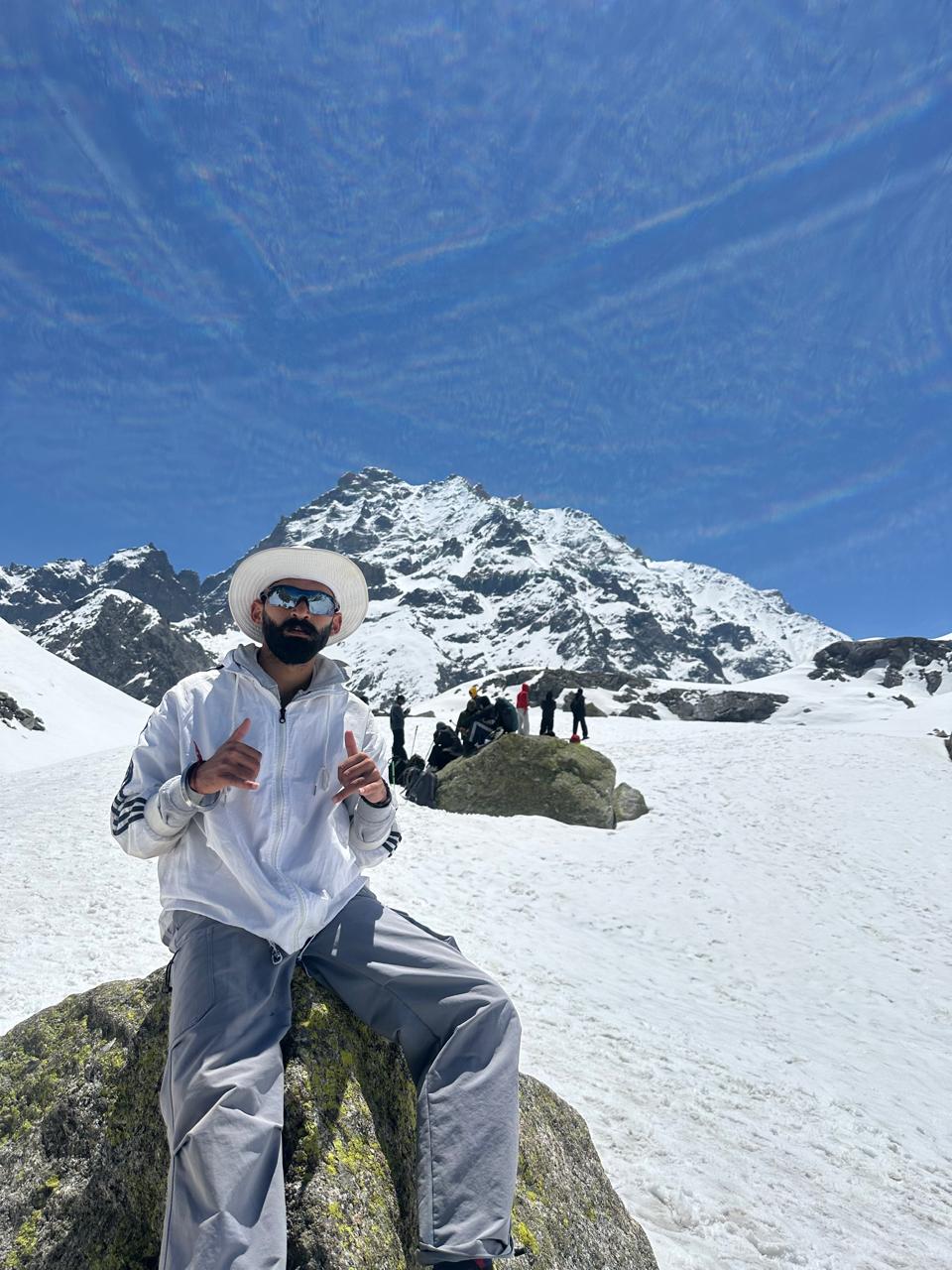
Akhil Deruwan
NIM Uttarkashi certified · 9 yrs experience
Akhil grew up in the foothills of the Garhwal Himalayas and has spent nearly a decade navigating its most demanding trails. He has led over 150 batches across Uttarakhand and Himachal Pradesh, with a strong focus on technical high-altitude routes and safety management. His calm under pressure and deep knowledge of local terrain make him a trusted leader for both beginner and advanced trekkers.
- Wilderness First Responder
- High Altitude Medicine
- Technical Route Navigation
- Search & Rescue
FAQ
Why Trek With Us
Travel Safe
Certified Team
Easy Cancellation
Well Equipped Campsite
Experienced Guide
No Hidden Charges