Overview
Roopkund — The Mystery Lake of Skeletons Beneath Trishul
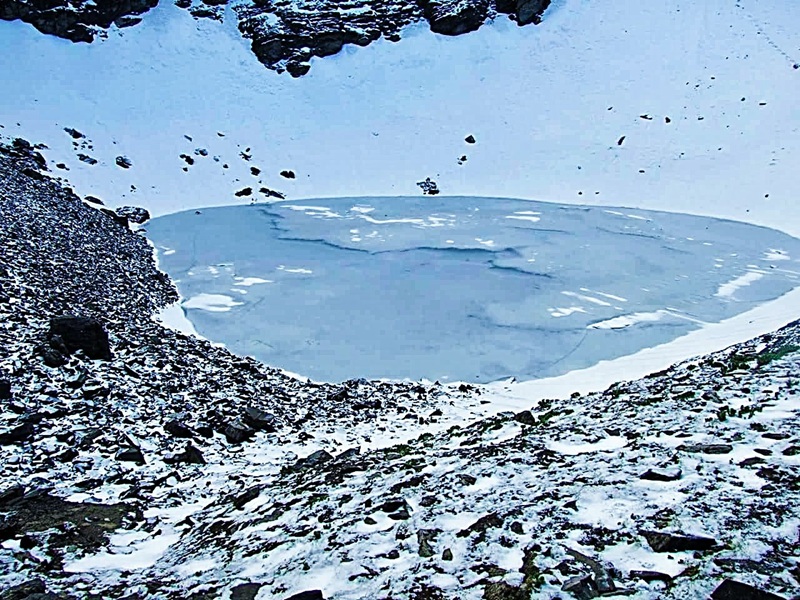
Roopkund at 16,499 ft (5,029 m) is the most enigmatic destination in the Indian Himalayas. The eight-day route from Lohajung in Uttarakhand's Chamoli district climbs through some of the largest alpine meadows in Asia — Ali Bugyal and Bedni Bugyal — past the south face of Mt. Trishul (23,360 ft), over the Kalu Vinayak shoulder, and finally to a small glacial lake whose mud and ice contain the skeletal remains of an estimated 600 medieval Hindu pilgrims who died here in a single catastrophic event around the 9th century AD. DNA studies published in 2019 found that the bones belong to people of Indian, Mediterranean, and South-East Asian ancestry, suggesting the site received pilgrim groups from across the medieval Indian Ocean trade network. Note: trail subject to Forest Department restrictions in some seasons; access must be confirmed at booking time.
Why this trek matters
Roopkund is one of the few treks in the world where the destination is itself a recognised archaeological mystery. The skeletons were first reported by a forest ranger named H.K. Madhwal in 1942, when wartime patrols of the upper Pindar valley accidentally encountered the lake. Initial speculation ran from a Japanese invasion party to a lost army of General Zorawar Singh; subsequent radiocarbon dating placed the bones in two distinct groups — one large group from around 800 AD, a smaller group from the 17th-19th centuries. The 2019 study (published in Nature Communications by Eadaoin Harney et al.) sequenced 38 of the remains and identified the major event as a sudden hailstorm catastrophe consistent with the local Garhwali oral tradition that names the disaster as a curse from Nanda Devi on a pilgrim party that had committed sacrilege at Bedni Bugyal during the Nanda Raj Jat yatra.
The geography and the meadows
The trek runs along the southern flank of the Trishul-Nanda Ghunti massif in the upper Pindar river drainage. The two meadows that the trail crosses — Ali Bugyal at 11,000 ft and Bedni Bugyal at 11,500 ft — are claimed by some sources to be the largest contiguous high-altitude meadows in Asia. Bedni in particular is a vast undulating grassland with a small sacred kund (lake) at its centre and a 9th-century stone temple to Nanda Devi on its eastern edge — the site of the triennial Nanda Raj Jat pilgrimage, one of the oldest continuously observed pilgrimages in the Indian Himalayas. The Roopkund lake itself is a small glacial pool roughly 40 metres across, set in a moraine bowl just below the Junargali pass (17,000 ft) on Trishul's southern shoulder.
The route from Lohajung
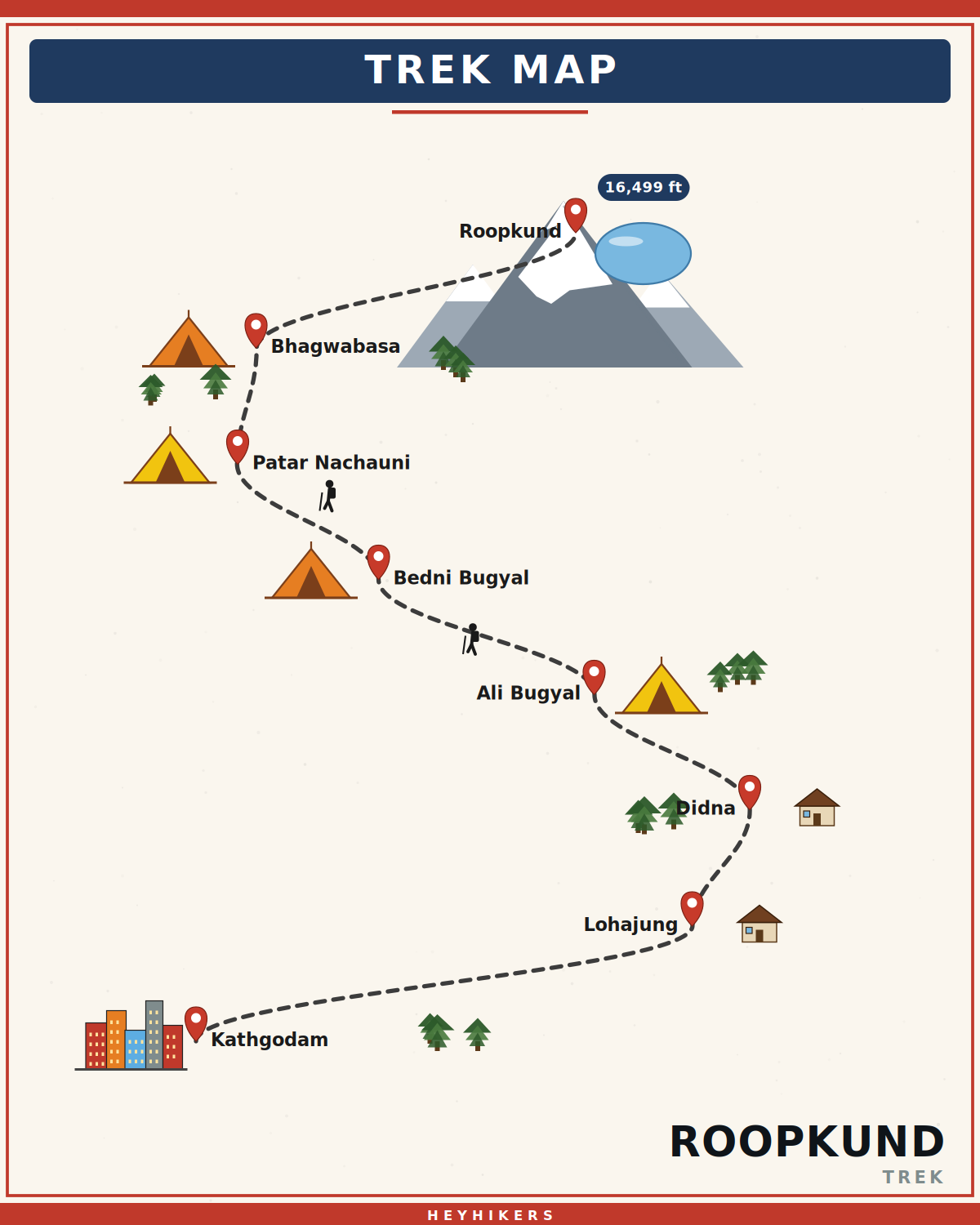
The trek begins at Lohajung (7,600 ft), a small ridge-top village reached by a 10-hour drive from Kathgodam via Almora, Kausani, and Gwaldam. Day 2 is a gentle walk to Didna village (8,000 ft), a Garhwali hamlet of stone-and-slate houses. Day 3 climbs through old-growth oak to Ali Bugyal and Bedni Bugyal, often called the day of the bugyals — eight kilometres of continuous meadow walking. Day 4 climbs to Patar Nachauni (12,800 ft) beneath Trishul. Day 5 crosses the Kalu Vinayak pass (14,200 ft) with its small Ganesh shrine and reaches the high camp at Bhagwabasa (14,500 ft). Day 6 is summit day: a pre-dawn climb on hard snow and moraine to Roopkund (16,499 ft), photography and a brief halt, then a long descent back to Bedni. Days 7-8 retrace the descent through Wan to Lohajung and the drive back to Kathgodam.
The Nanda Raj Jat yatra
The cultural overlay of this trek is the Nanda Raj Jat — a pilgrimage held once every twelve years (next due in 2026 or 2027 depending on astrologer consultation) that traces the path of the goddess Nanda from her birth-village of Nauti in the lower Pindar valley to her marital home on the Homkund glacier above Roopkund. The pilgrimage is led by a four-horned ram (chosen by ritual) and traverses the same route trekkers walk to Roopkund. The 2014 yatra had over 50,000 participants and is considered the longest religious procession in India. The Bedni Bugyal stone temple is one of the principal stations of the yatra; the goddess is believed to be embodied in Trishul (23,360 ft) itself.
Best season and conditions
Roopkund has historically been a May-June and September-October trek. May-June brings firm snow on the upper sections (microspikes and gaiters required), clear skies, and the meadows in spring bloom. September-October is post-monsoon — the bones are most visible in late September as the snowpack retreats — with crisp golden meadows and the clearest Trishul views. The monsoon (July-August) is closed due to slippery trails and clouded views. November onwards the upper sections snow over.
Access restrictions and permits
Important: The Indian government has periodically restricted access to Roopkund to protect the archaeological site from disturbance and to limit waste accumulation at the lake. The most recent restriction was the National Green Tribunal order in 2018 that limited overnight camping above Bedni Bugyal. Permit availability varies by season and political context; we coordinate with the Uttarakhand Forest Department on each batch and confirm access at the time of booking. Some batches may operate as a Bedni Bugyal trek with no Roopkund summit if access is denied.
Difficulty and prerequisites
Roopkund is graded difficult. The summit-day altitude (16,499 ft) and the cumulative climb from Bhagwabasa make this the trek's defining challenge. We require prior trekking experience above 14,000 ft (Hampta Pass, Buran Ghati, or Kuari Pass + Pangarchulla minimum) and cardiovascular fitness equivalent to running 5 km in 30 minutes. The Day 6 summit-day total is 18 km with a 2,000 ft climb and 5,000 ft descent — the longest single day on the trek and harder than most pass-day pushes elsewhere. Anyone with a history of pulmonary issues, untreated hypertension, or knee instability should not attempt this trek.
Camping and infrastructure
HeyHikers operates designated forest-department-permitted campsites at Didna, Bedni Bugyal, Patar Nachauni, and Bhagwabasa with four-season tents, sleeping bags rated to -10°C, kitchen tents, and pit toilets. Mules carry group gear from Lohajung to Bedni; above that the load is portered. The Bhagwabasa campsite at 14,500 ft is exposed and windy; we set up a windbreak of stacked stones and tighten guy-lines on every tent. Mobile network ends at Lohajung.
Itinerary
Map
What trekkers say
"I'd never camped in snow before. The HeyHikers team made me feel safe every single step. The summit sunrise — standing at 12,500 ft watching peaks turn gold — I cried. Not from the cold. From the beauty."
PS
Priya Sharma
Kedarkantha, Dec 2025
"Seven lakes, each more unreal than the last. The logistics were flawless — the food at 13,000 ft was better than most restaurants I know. Our guide Farooq knew every stone on the trail. Doing Goechala with them next."
AM
Arjun Mehta
Kashmir Great Lakes, Aug 2025
Inclusion
- All meals during the trek (vegetarian, freshly cooked)
- Camping gear — tents, sleeping bags, mats
- Certified trek leader and support guides
- Forest department permits and entry fees
- First-aid kit and supplemental oxygen
- Basecamp accommodation on twin/triple sharing
Exclusion
- Travel to and from the basecamp pickup point
- Personal trekking gear and clothing
- Travel insurance covering high-altitude trekking
- Tips, personal expenses, and meals during travel days
- Anything not explicitly listed under inclusions
Things to Carry
- Trekking shoes (high-ankle, broken-in)
- 40-50L backpack with rain cover
- Two pairs of trek pants
- Three full-sleeve t-shirts (synthetic, not cotton)
- Fleece jacket and a heavier down/insulated jacket
- Thermal innerwear (top + bottom)
- Waterproof outer shell (jacket + pants)
- Woollen cap, sun cap, balaclava
- Two pairs of warm gloves (inner liner + outer)
- UV-rated sunglasses
- Headlamp with spare batteries
- Reusable water bottles (2L total) or hydration bladder
- Personal medical kit and prescription medicines
- Sunscreen (SPF 50+) and lip balm
- Toiletries and quick-dry towel
- Original photo ID (mandatory at forest checkposts)
How to Reach
Reach Kathgodam by overnight train from Delhi. Our shared transport leaves at 7:00 AM and reaches Lohajung in 10 hours via Almora and Gwaldam.
Safety & Security
- Acclimatize properly — never skip rest days at altitude.
- Drink at least 4 litres of water per day above 9,000 ft.
- Tell your trek leader immediately if you feel headache, nausea, or breathlessness — early AMS signs are treatable, ignored ones are not.
- Stay close to the group; do not take shortcuts off the marked trail.
- Avoid alcohol and smoking for the entire duration of the trek.
- Keep a buffer day for travel — Himalayan roads can close without notice.
- Carry travel insurance that explicitly covers high-altitude trekking and helicopter evacuation.
Cancellation Policy
Cancellations must be requested in writing.
- More than 30 days before the trek start date: 90% refund. - 21–30 days before: 50% refund. - 11–20 days before: 25% refund. - 10 days or fewer: no refund, but you may transfer your slot to another trekker or to any future batch within 12 months at no extra charge.
Refunds are processed to the original payment method within 7-10 working days. Trip cancellations triggered by us (weather, force majeure, government restrictions) are refunded in full or moved to an alternate batch at your option.
Meet your trek leader
Akhil Deruwan
NIM Uttarkashi certified · 9 yrs experience
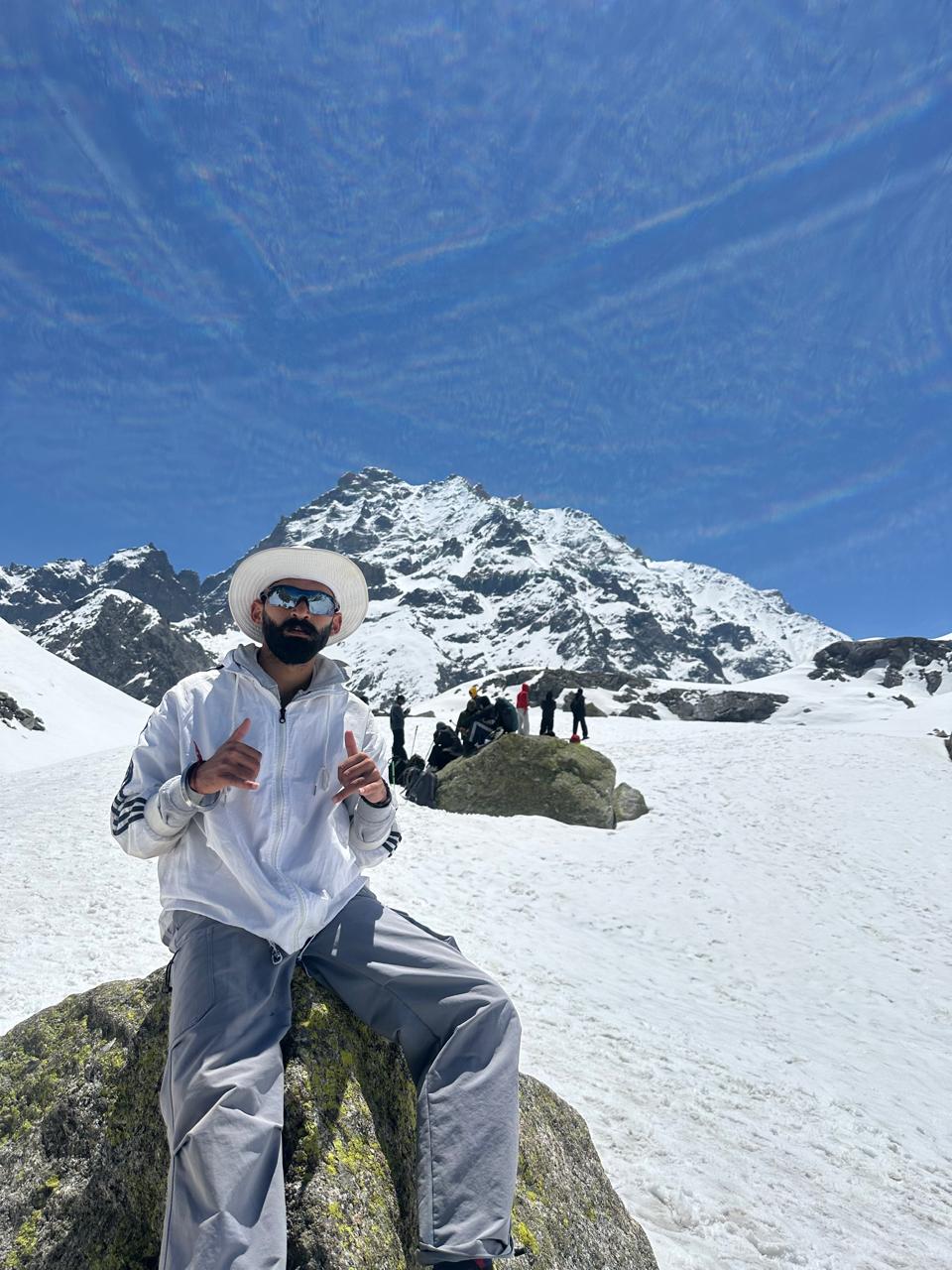
Akhil grew up in the foothills of the Garhwal Himalayas and has spent nearly a decade navigating its most demanding trails. He has led over 150 batches across Uttarakhand and Himachal Pradesh, with a strong focus on technical high-altitude routes and safety management. His calm under pressure and deep knowledge of local terrain make him a trusted leader for both beginner and advanced trekkers.
- Wilderness First Responder
- High Altitude Medicine
- Technical Route Navigation
- Search & Rescue
FAQ
Why Trek With Us
Travel Safe
Certified Team
Easy Cancellation
Well Equipped Campsite
Experienced Guide
No Hidden Charges