Overview
Dayara Bugyal — The Carpet Meadow Above the Bhagirathi
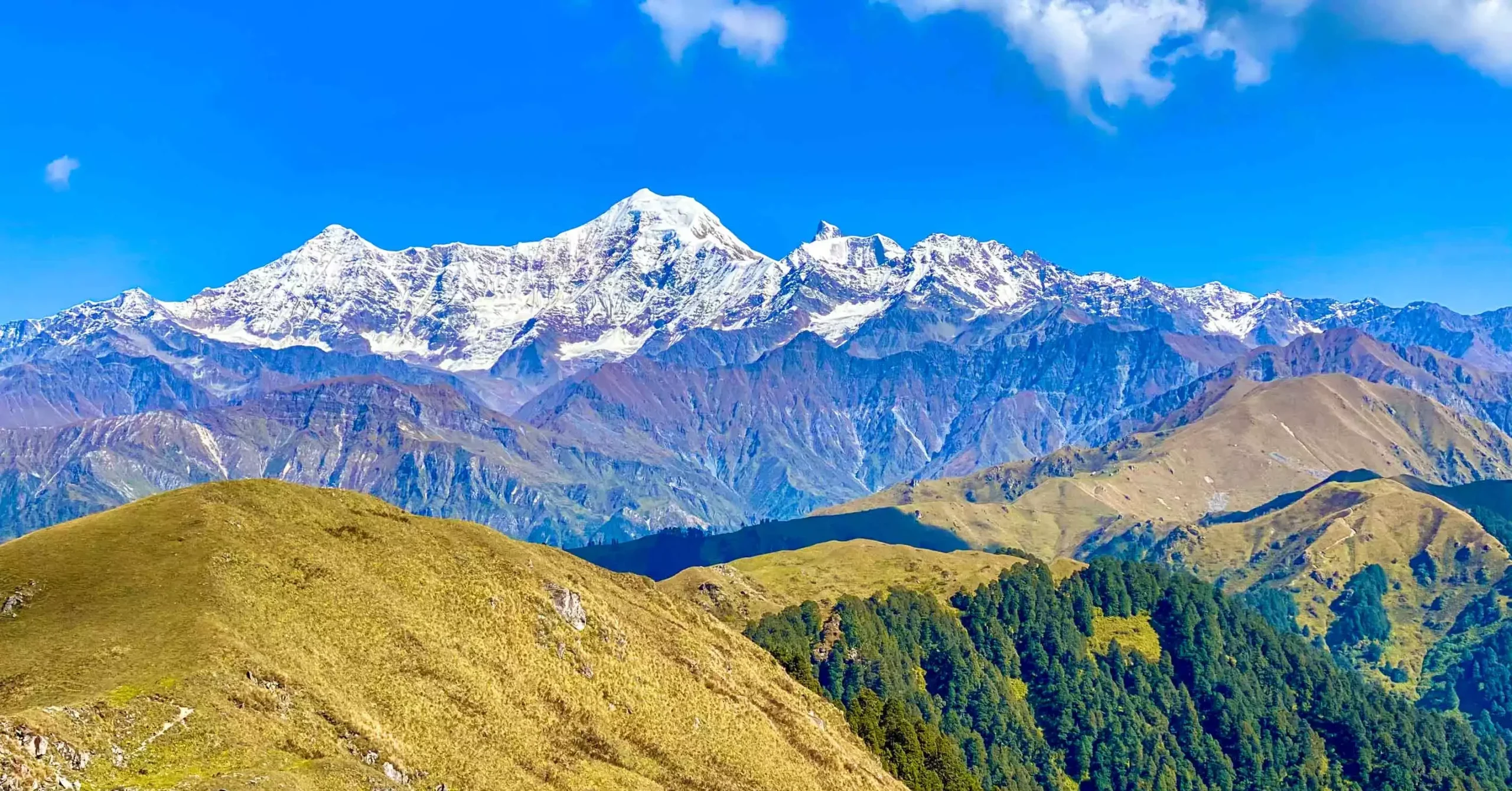
Dayara Bugyal at 12,100 ft (3,690 m) is the most expansive single high-altitude meadow in Uttarakhand and one of the broadest in the Indian Himalayas. The Garhwali word bugyal means alpine grassland, and Dayara is the textbook example: a rolling 28-square-kilometre carpet of grass on the south-facing flank of the Bandarpoonch range, used as summer pasture by Garhwali shepherds for at least four hundred years and still grazed by sheep, goats, and the occasional pack of pack ponies in season. Five days from Dehradun, an easy gradient, and a panorama that takes in Bandarpoonch, Black Peak, the Gangotri group, and Srikanth — Dayara is the rare trek that delivers a genuine high-altitude experience without the cost of effort or risk.
The geography of the meadow
The bugyal sits on a high lateral bench above the Bhagirathi river, about 60 kilometres east of Uttarkashi in the Tehri-Garhwal-Uttarkashi border country. The bench was carved by a retreating glacier ten thousand years ago and has weathered into a series of gentle undulations rather than a single flat plain — small streams cut shallow gullies through the grass, and shepherd dogris (stone enclosures) are tucked into the folds. From the highest point of the meadow, a small grassy knoll informally called Bakaria Top (12,100 ft), you can see the entire Bandarpoonch wall (Bandarpoonch I, 20,720 ft) and the Black Peak (Kalanag, 20,955 ft) directly to the north, the Gangotri group (Bhagirathi I-III, Thalay Sagar, Shivling, Meru) to the east, and on exceptional mornings the white pyramid of Srikanth (20,170 ft) behind them. To the south the Bhagirathi gorge plunges 5,000 ft below.
The route from Barsu
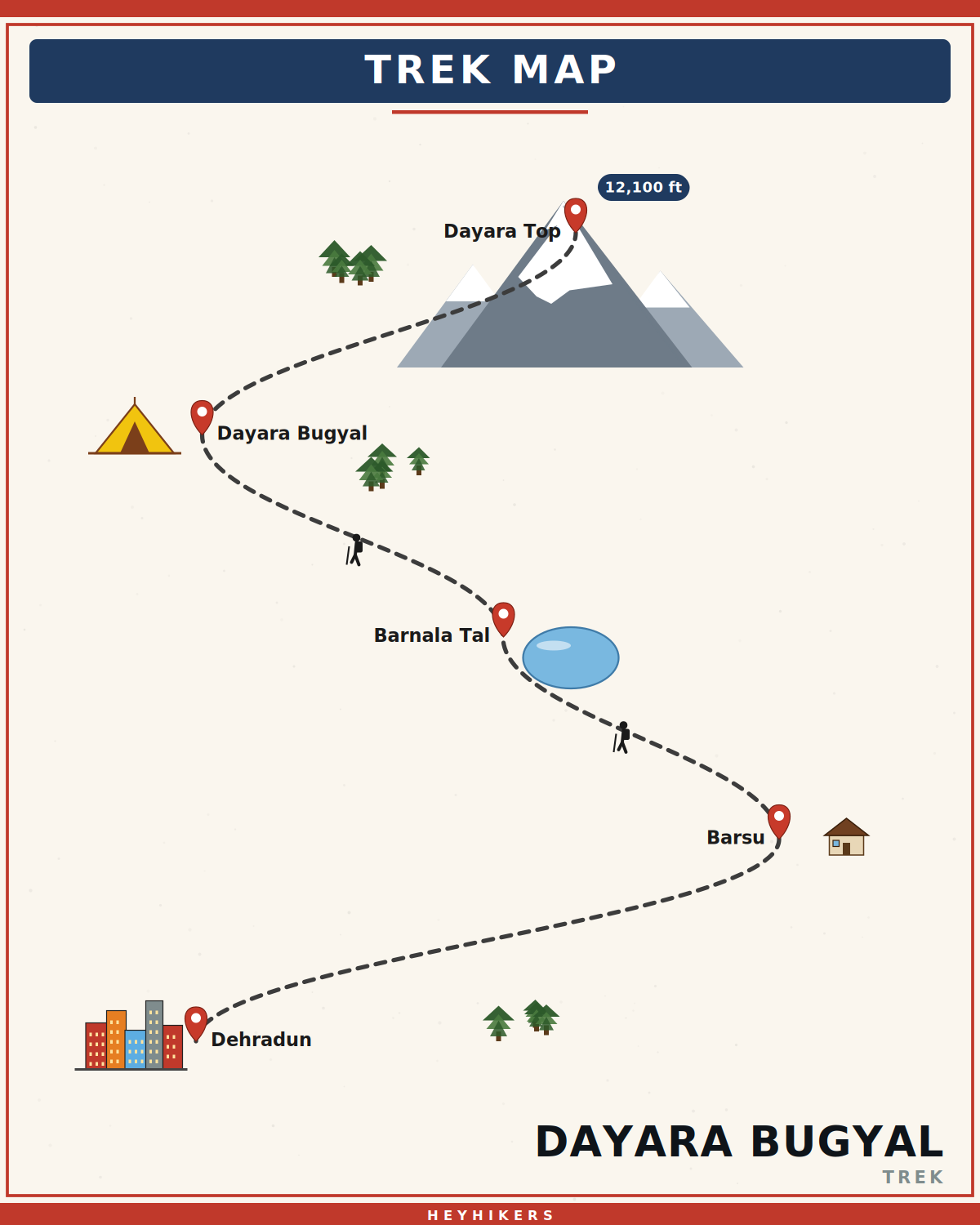
The trek begins at Barsu (7,200 ft), a Garhwali village reached by a 9-hour drive from Dehradun via Mussoorie, Chamba, Tehri, and Uttarkashi. The first day's trail climbs through old-growth oak (banj and moru), Himalayan rhododendron, and stands of horse chestnut to Barnala Tal (9,000 ft), a small alpine pond used as a seasonal forest department rest-house and a popular early campsite. The lake freezes from late December through February. Day 3 climbs above the treeline through silver birch (bhojpatra) and breaks abruptly onto the meadow's lower edge at 11,000 ft — the transition is dramatic, one moment under tree canopy, the next on open grass with the entire Bandarpoonch wall above you. We camp inside the bugyal itself with 360° views, then on Day 4 walk to Bakaria Top before descending to Barsu. Day 5 is the drive back to Dehradun.
What the meadow is famous for
Two things have made Dayara famous beyond the standard trekking circuit. First, the annual Butter Festival (Anduri Utsav) held in the bugyal each August — a one-day Garhwali shepherd celebration where villagers smear themselves with butter and yogurt, distribute milk products, and dance to traditional drumming. The festival has become an attraction for trekkers in recent years. Second, Dayara is being developed as a winter ski destination by the Uttarakhand tourism department — its long, gentle, snow-covered slopes are technically ideal for beginner skiing and a small ski lift is operated in some seasons. In peak winter (January-February) the meadow gets 3-5 feet of snow and becomes a vast white playground for snow play, sledding, and short-ski sessions.
Best season and conditions
Dayara has three distinct windows. April-June brings rhododendron bloom in the lower forest, snow-melt streams across the meadow, and the first wildflowers (yellow potentillas, blue gentians, white anemones) by late May. September-October is the post-monsoon golden window — the meadow turns gold, the air is clearest, and the Bandarpoonch panorama is reliably visible at sunrise. November-March is the snow season — the trek transforms into an easy winter snow walk with gentle slopes for snow play, microspikes provided. Monsoon (July-August) is closed due to leeches in the lower forest and clouded views.
Camping and infrastructure
HeyHikers operates a designated forest-department-permitted campsite inside the bugyal with two-person tents, sleeping bags rated to -5°C (or -10°C in winter), kitchen tents, and pit toilets. Mules carry group gear from Barsu onwards; trekkers carry only a 5 kg daypack. Barsu itself has a clean stay with hot bucket water and Jio mobile network; above Barnala Tal there is no signal until you return. The Forest Department permit is included.
Who this trek is for
Dayara is the textbook beginner's high-altitude trek. The total distance is 28 km across five days; the maximum sleeping altitude is 11,000 ft (well below the AMS threshold for sleeping); the gradient is gentle throughout; and the camping is on a flat meadow rather than a tilted shoulder. Children 10+ with prior hiking experience complete it comfortably. Senior trekkers (we have seen 65+) with reasonable fitness do well. Six weeks of cardiovascular base training (4 km jogs three times a week) is sufficient. Dayara is also one of the very few high-altitude treks suitable for school groups.
Cultural and ecological context
The Dayara meadow is a working pastoral landscape — the Garhwali shepherds who use it in summer come from villages in the lower Bhagirathi valley (Barsu, Raithal, Bhatwari) and walk their flocks (sheep, goats, water buffalo) up to the bugyal each May, returning in late September. The dogris dotted across the meadow have stone walls, juniper-wood roofs, and a single hearth; many have been continuously used for ten generations. The Garhwali language spoken here belongs to the Central Pahari group; many of our trek leaders speak it natively. The meadow is also a known habitat for Himalayan tahr (a wild goat occasionally spotted at dusk), monal pheasant (the Uttarakhand state bird), and the occasional black bear (mostly in the lower forest, very rarely on the open meadow).
Itinerary
Map
What trekkers say
"I'd never camped in snow before. The HeyHikers team made me feel safe every single step. The summit sunrise — standing at 12,500 ft watching peaks turn gold — I cried. Not from the cold. From the beauty."
PS
Priya Sharma
Kedarkantha, Dec 2025
"Seven lakes, each more unreal than the last. The logistics were flawless — the food at 13,000 ft was better than most restaurants I know. Our guide Farooq knew every stone on the trail. Doing Goechala with them next."
AM
Arjun Mehta
Kashmir Great Lakes, Aug 2025
Inclusion
- All meals
- Camping gear
- Trek guide
- Permits
- First aid
- Barsu stay
Exclusion
- Travel to/from Dehradun
- Personal gear
- Insurance
- Tips
Things to Carry
- Trekking shoes (high-ankle, broken-in)
- 40-50L backpack with rain cover
- Two pairs of trek pants
- Three full-sleeve t-shirts (synthetic, not cotton)
- Fleece jacket and a heavier down/insulated jacket
- Thermal innerwear (top + bottom)
- Waterproof outer shell (jacket + pants)
- Woollen cap, sun cap, balaclava
- Two pairs of warm gloves (inner liner + outer)
- UV-rated sunglasses
- Headlamp with spare batteries
- Reusable water bottles (2L total) or hydration bladder
- Personal medical kit and prescription medicines
- Sunscreen (SPF 50+) and lip balm
- Toiletries and quick-dry towel
- Original photo ID (mandatory at forest checkposts)
How to Reach
Reach Dehradun. Our shared transport departs at 6:30 AM on Day 1 and reaches Barsu village near Uttarkashi in 9-10 hours via Mussoorie and Tehri.
Safety & Security
- Acclimatize properly — never skip rest days at altitude.
- Drink at least 4 litres of water per day above 9,000 ft.
- Tell your trek leader immediately if you feel headache, nausea, or breathlessness — early AMS signs are treatable, ignored ones are not.
- Stay close to the group; do not take shortcuts off the marked trail.
- Avoid alcohol and smoking for the entire duration of the trek.
- Keep a buffer day for travel — Himalayan roads can close without notice.
- Carry travel insurance that explicitly covers high-altitude trekking and helicopter evacuation.
Cancellation Policy
Cancellations must be requested in writing.
- More than 30 days before the trek start date: 90% refund. - 21–30 days before: 50% refund. - 11–20 days before: 25% refund. - 10 days or fewer: no refund, but you may transfer your slot to another trekker or to any future batch within 12 months at no extra charge.
Refunds are processed to the original payment method within 7-10 working days. Trip cancellations triggered by us (weather, force majeure, government restrictions) are refunded in full or moved to an alternate batch at your option.
Meet your trek leader
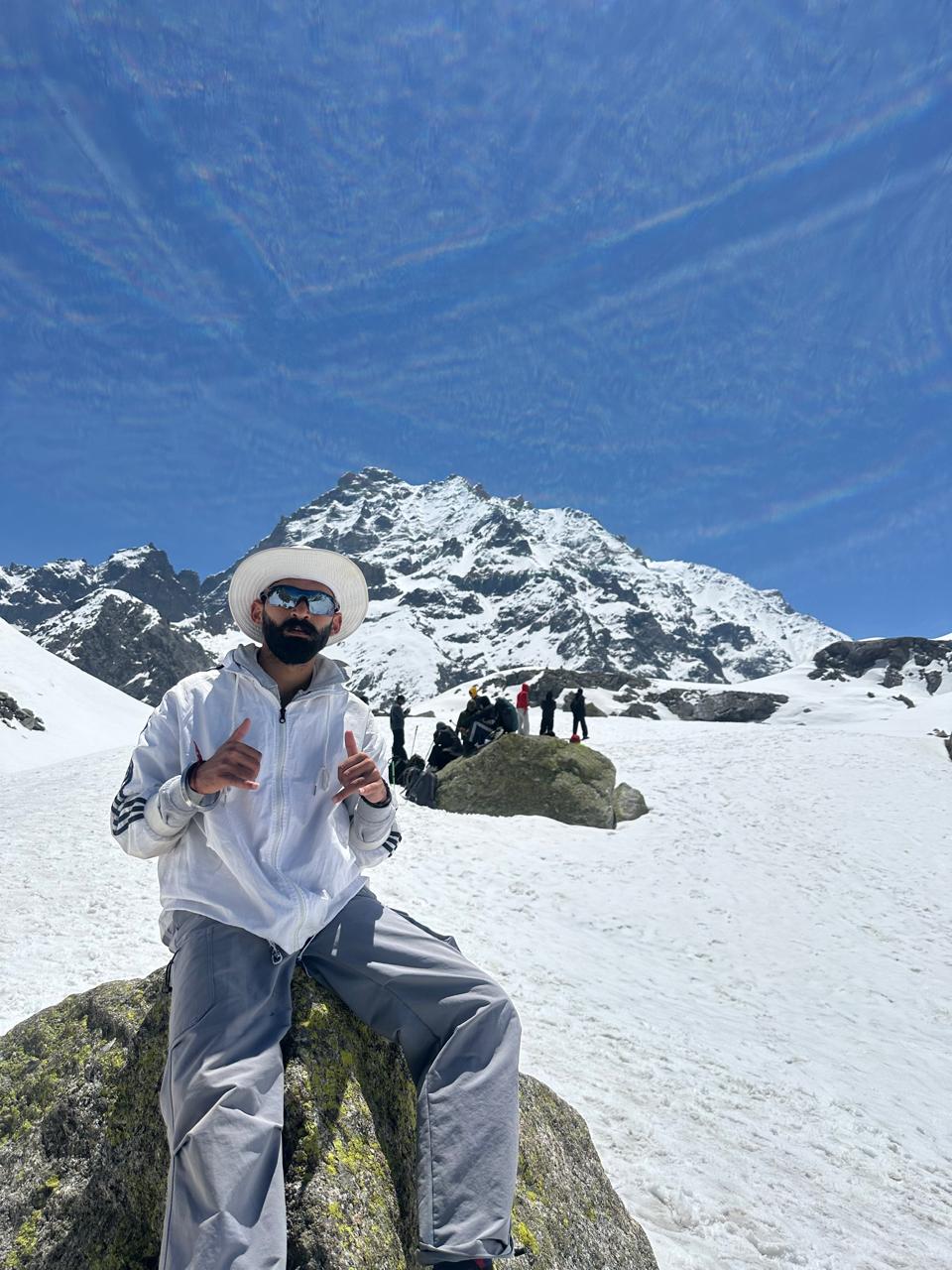
Akhil Deruwan
NIM Uttarkashi certified · 9 yrs experience
Akhil grew up in the foothills of the Garhwal Himalayas and has spent nearly a decade navigating its most demanding trails. He has led over 150 batches across Uttarakhand and Himachal Pradesh, with a strong focus on technical high-altitude routes and safety management. His calm under pressure and deep knowledge of local terrain make him a trusted leader for both beginner and advanced trekkers.
- Wilderness First Responder
- High Altitude Medicine
- Technical Route Navigation
- Search & Rescue
FAQ
Why Trek With Us
Travel Safe
Certified Team
Easy Cancellation
Well Equipped Campsite
Experienced Guide
No Hidden Charges