Overview
Har Ki Dun — The Valley of Gods, the Mahabharata's Last Trail
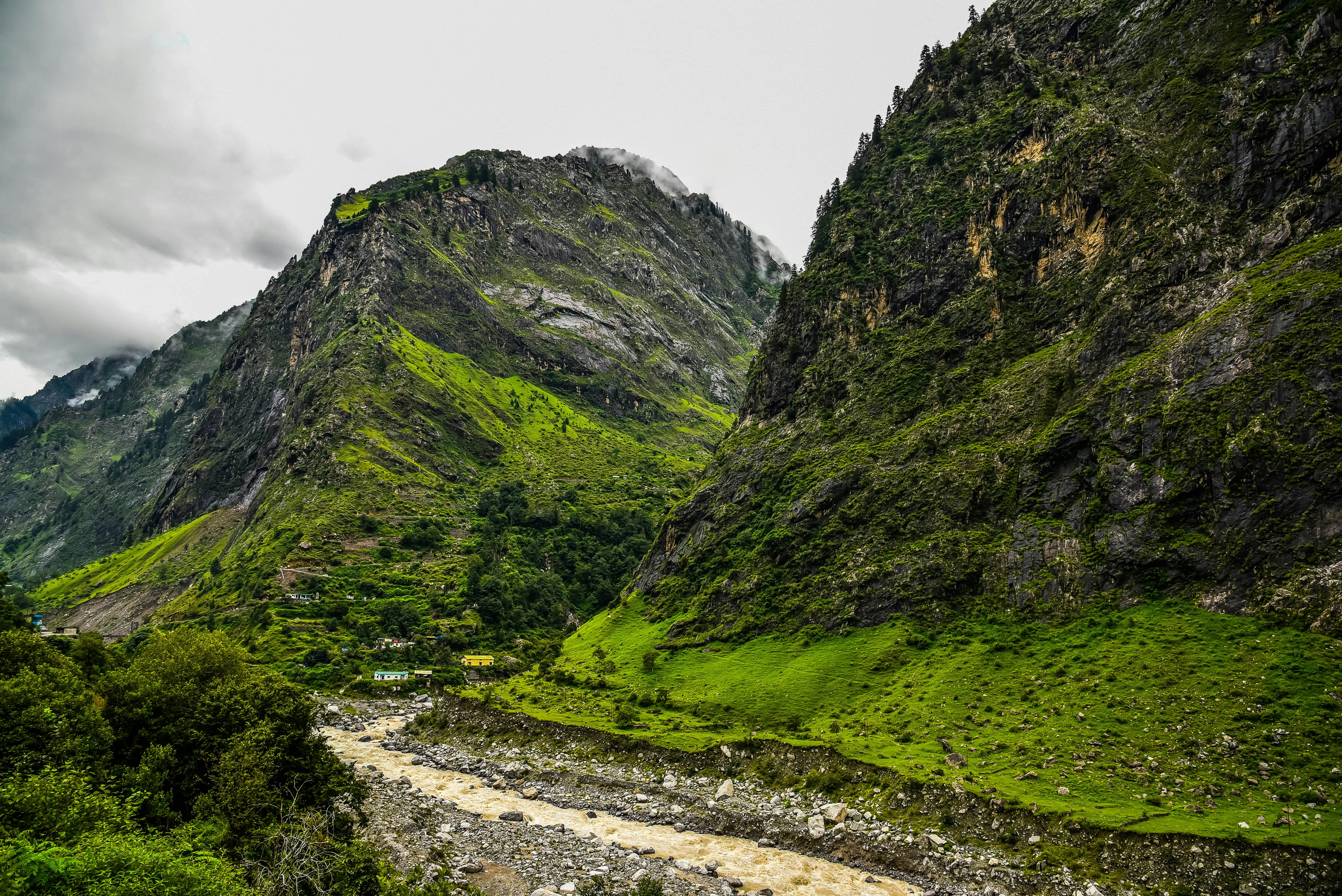
Har Ki Dun (literally "Valley of Gods" in Garhwali) at 11,700 ft (3,566 m) is one of the very few Himalayan treks where the culture you walk through is as compelling as the landscape you walk into. The seven-day route from Sankri in the Tons valley climbs through 3,000-year-old villages where the antagonist of the Mahabharata is worshipped as a benevolent god, traces a glacier-carved cradle flanked on three sides by the 21,000 ft Swargarohini massif — the literal "stairway to heaven" up which the Pandava brothers are said to have walked at the close of the epic — and ends in a wide alpine bowl where Hindu mythology, ethnobotany, and pure mountain spectacle meet at every campsite.
The geography that makes this valley unique
Har Ki Dun sits at the head of the Supin river drainage inside the Govind Pashu Vihar Wildlife Sanctuary — a 953 sq km protected area in western Uttarakhand created in 1955 to protect the snow leopard, Himalayan brown bear, and Himalayan tahr. The valley itself is a textbook U-shaped glacial trough, carved by the Jaundhar glacier roughly ten thousand years ago, and is flanked on its northern and eastern walls by the Swargarohini I-IV peaks (20,000-21,000 ft) and on its southern wall by the Kalanag (Black Peak, 20,955 ft) ridge. The valley floor is a wide, tilted alpine meadow scattered with summer wildflowers (Himalayan primula, marsh marigold, anemone, edelweiss) and held in place by the small Maninda Tal lake near its head. From the campsite at 11,700 ft the entire amphitheatre is visible in a single 180° sweep.
The route from Sankri
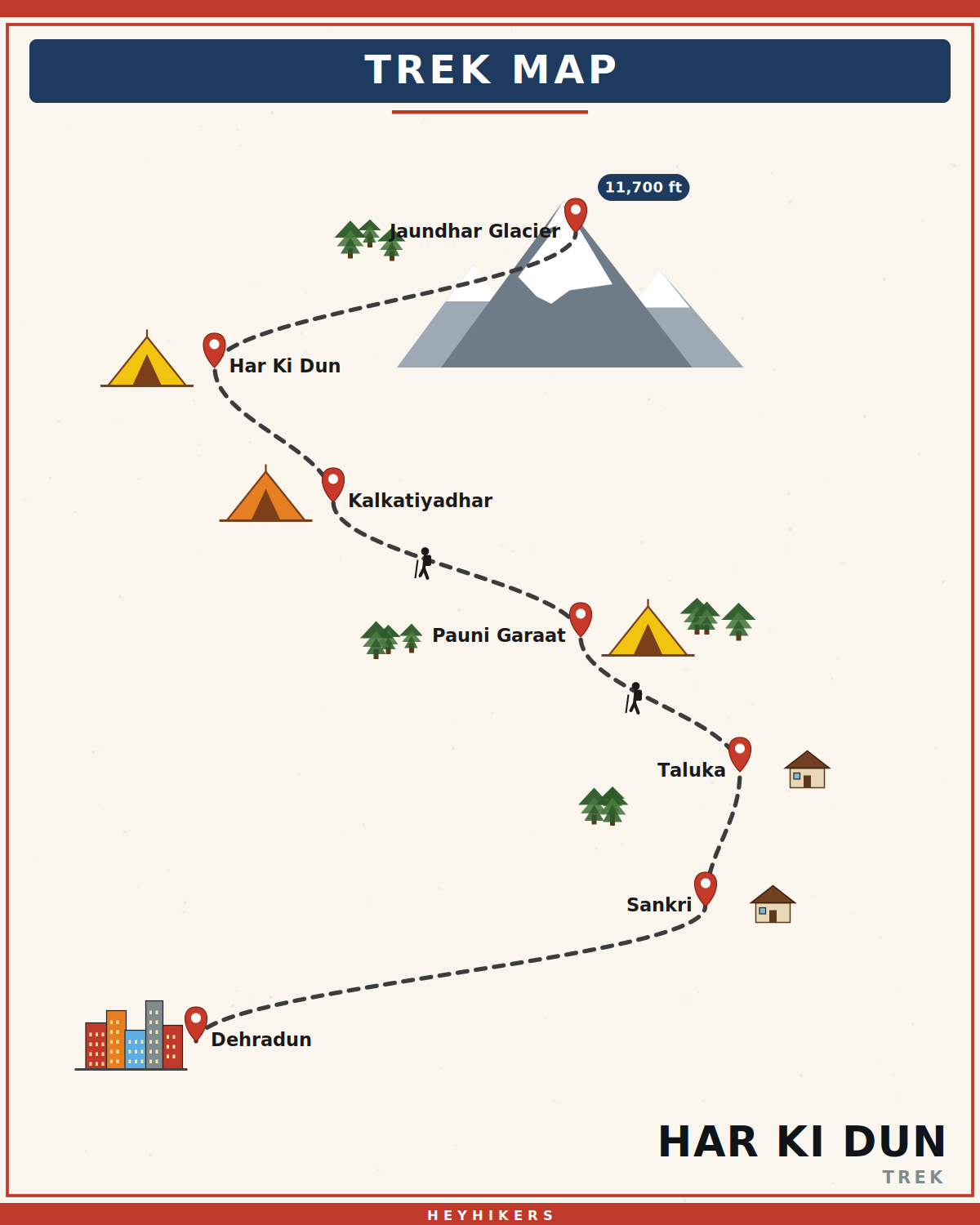
The trek begins at Sankri (6,400 ft), the small Garhwali village inside Govind sanctuary that is also the trailhead for Kedarkantha, Phulara Ridge, and Bali Pass. Day 2 drives 12 km to Taluka (7,200 ft) on a teeth-rattling rough road and trails 12 km up the Supin through pine and deodar to the Cheludgad campsite at 8,200 ft. Day 3 climbs through oak and rhododendron past the famous viewpoint of Osla village across the river and continues to Kalkatiyadhar at 9,800 ft. Day 4 is the moment of arrival — the trail breaks above the treeline and the entire valley unfolds, leading to the head campsite at 11,700 ft. Day 5 is a layover for the day-hike to the Jaundhar Glacier viewpoint at 12,500 ft directly under the Swargarohini wall. Days 6-7 retrace the descent to Sankri and the long drive back to Dehradun.
Osla and the Duryodhana temple
The cultural centrepiece of the trek is Osla village — a cluster of stone-and-deodar-wood houses perched on a cliff above the Supin, considered by some Garhwali elders to be 3,000 years old and continuously inhabited. Osla is famous across north India for its temple, which is dedicated not to one of the standard Hindu deities but to Duryodhana — the Kaurava antagonist of the Mahabharata — worshipped here as a benevolent local deity in a striking inversion of the standard north Indian narrative. Local lore explains the inversion two ways: that Duryodhana was a fair ruler to the people of this valley regardless of his role in the epic, and that the village predates the Mahabharata story arc and the deity's identity was retrofitted later. The temple itself is a wooden pagoda structure with intricate carved beams, a brass bell, and a small inner sanctum visited only by the resident pujari. Photography of the temple exterior is permitted; the interior requires permission and a small offering. The neighbouring villages of Gangad, Datmir, and Seema also retain Mahabharata-era ritual customs and architectural styles.
Swargarohini and the Mahabharata's last walk
The Swargarohini massif (20,000-21,000 ft) at the head of the valley is, in Hindu tradition, the literal swarg-rohini — the "ascent to heaven" up which Yudhishthira and his four brothers and the dog (in some tellings, the god Dharma in disguise) walked at the close of the Mahabharata. The peak itself is considered too sacred for serious mountaineering by local belief and most expeditions have respected this; it has been climbed only a handful of times, and our trail leaders never refer to it as a climbable mountain in front of village porters. From the Jaundhar viewpoint on Day 5 you stand at the foot of this ascent, with the granite pyramid of Swargarohini I directly above and the smaller satellite peaks fanning out on either side.
Best season and conditions
Har Ki Dun runs in three windows. April-May brings rhododendron bloom (the lower forest turns crimson in mid-April), snow-melt streams, and patches of unmelted snow at the head of the valley. September-October is the post-monsoon golden window — the meadow turns gold, the air is at its clearest, and the Swargarohini panorama is reliably visible. December-March sees deep snow and most operators close the trail; we run a small winter batch only if conditions permit. Monsoon (July-August) brings landslides on the Taluka road and is closed.
Camping and infrastructure
HeyHikers operates designated forest-department-permitted campsites at Cheludgad, Kalkatiyadhar, and Har Ki Dun, with two-person tents, sleeping bags rated to -5°C (or -10°C for shoulder-season batches), kitchen tents, and pit toilets. Mules ferry group gear from Taluka onwards; trekkers carry only a 5-7 kg daypack. Sankri has clean guesthouses with hot bucket water and mobile network (Jio, BSNL); above Taluka there is no signal until you return. The Forest Department permit is included in the trek price.
Who this trek is for
Har Ki Dun is graded easy-to-moderate — suitable for fit first-time Himalayan trekkers, families with children 12+, and senior trekkers with cardiac clearance. The daily mileage is 9-12 km on graded forest paths and the maximum sleeping altitude is 11,700 ft, well below the AMS sweet spot. The longest single day is the Day 6 descent (19 km), where trekking poles are mandatory. Six weeks of cardiovascular base training (4 km jogs three times a week) is the recommended preparation. There are no technical sections, no rope work, and no glacier travel.
Itinerary
Map
What trekkers say
"I'd never camped in snow before. The HeyHikers team made me feel safe every single step. The summit sunrise — standing at 12,500 ft watching peaks turn gold — I cried. Not from the cold. From the beauty."
PS
Priya Sharma
Kedarkantha, Dec 2025
"Seven lakes, each more unreal than the last. The logistics were flawless — the food at 13,000 ft was better than most restaurants I know. Our guide Farooq knew every stone on the trail. Doing Goechala with them next."
AM
Arjun Mehta
Kashmir Great Lakes, Aug 2025
Inclusion
- All meals
- Camping gear
- Trek guide
- Forest permits
- First aid
- Guesthouse stay at Sankri
Exclusion
- Travel to/from Dehradun
- Personal gear
- Insurance
- Tips
Things to Carry
- Trekking shoes (high-ankle, broken-in)
- 40-50L backpack with rain cover
- Two pairs of trek pants
- Three full-sleeve t-shirts (synthetic, not cotton)
- Fleece jacket and a heavier down/insulated jacket
- Thermal innerwear (top + bottom)
- Waterproof outer shell (jacket + pants)
- Woollen cap, sun cap, balaclava
- Two pairs of warm gloves (inner liner + outer)
- UV-rated sunglasses
- Headlamp with spare batteries
- Reusable water bottles (2L total) or hydration bladder
- Personal medical kit and prescription medicines
- Sunscreen (SPF 50+) and lip balm
- Toiletries and quick-dry towel
- Original photo ID (mandatory at forest checkposts)
How to Reach
Same trailhead as Kedarkantha — Sankri village in Uttarakhand. Reach Dehradun by air, rail, or road. Our shared transport leaves Prince Chowk at 6:30 AM on Day 1 and reaches Sankri in 9-10 hours.
Safety & Security
- Acclimatize properly — never skip rest days at altitude.
- Drink at least 4 litres of water per day above 9,000 ft.
- Tell your trek leader immediately if you feel headache, nausea, or breathlessness — early AMS signs are treatable, ignored ones are not.
- Stay close to the group; do not take shortcuts off the marked trail.
- Avoid alcohol and smoking for the entire duration of the trek.
- Keep a buffer day for travel — Himalayan roads can close without notice.
- Carry travel insurance that explicitly covers high-altitude trekking and helicopter evacuation.
Cancellation Policy
Cancellations must be requested in writing.
- More than 30 days before the trek start date: 90% refund. - 21–30 days before: 50% refund. - 11–20 days before: 25% refund. - 10 days or fewer: no refund, but you may transfer your slot to another trekker or to any future batch within 12 months at no extra charge.
Refunds are processed to the original payment method within 7-10 working days. Trip cancellations triggered by us (weather, force majeure, government restrictions) are refunded in full or moved to an alternate batch at your option.
Meet your trek leader
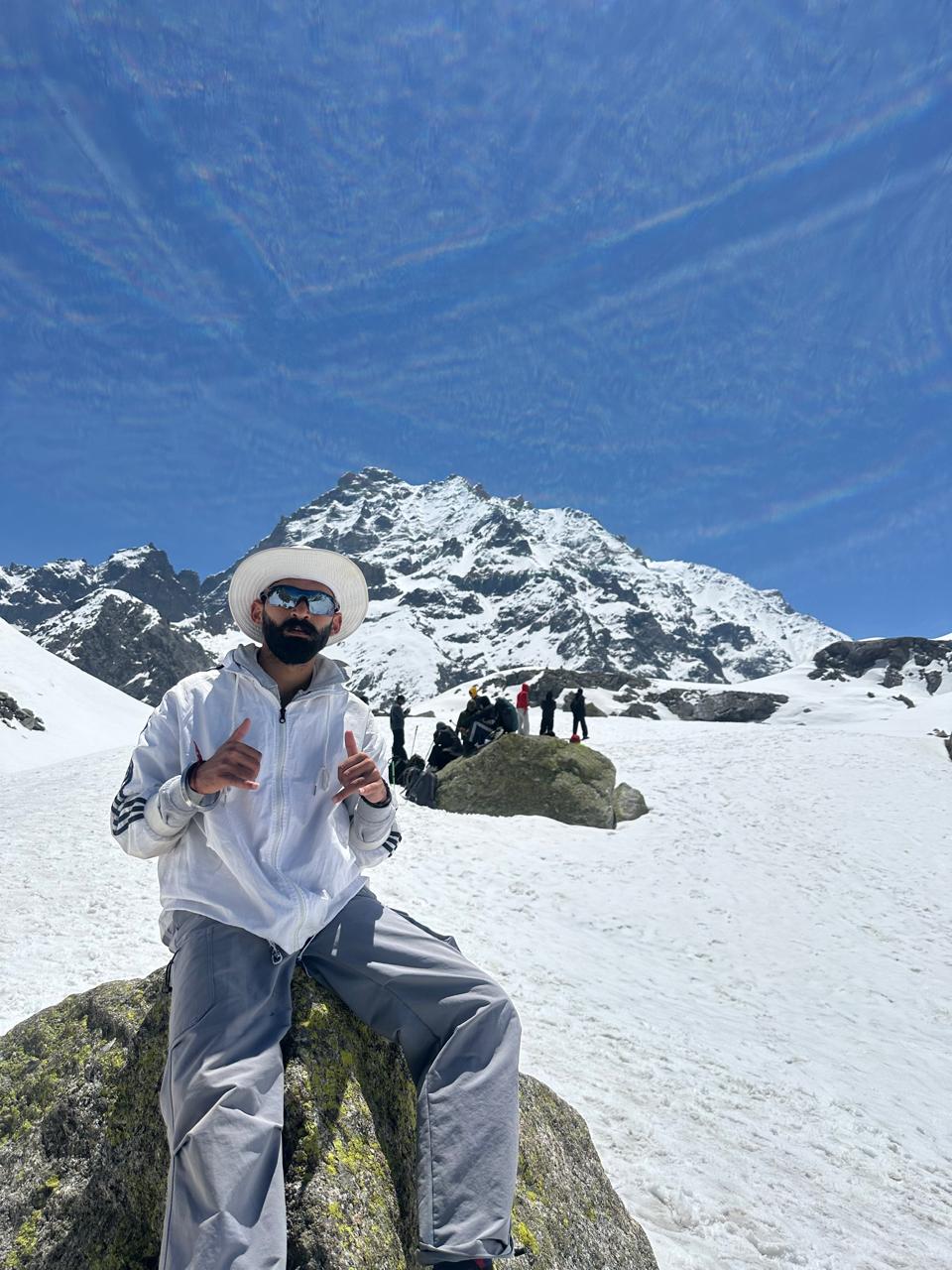
Akhil Deruwan
NIM Uttarkashi certified · 9 yrs experience
Akhil grew up in the foothills of the Garhwal Himalayas and has spent nearly a decade navigating its most demanding trails. He has led over 150 batches across Uttarakhand and Himachal Pradesh, with a strong focus on technical high-altitude routes and safety management. His calm under pressure and deep knowledge of local terrain make him a trusted leader for both beginner and advanced trekkers.
- Wilderness First Responder
- High Altitude Medicine
- Technical Route Navigation
- Search & Rescue
FAQ
Why Trek With Us
Travel Safe
Certified Team
Easy Cancellation
Well Equipped Campsite
Experienced Guide
No Hidden Charges