Overview
Kheerganga — Hot Springs in the Pines, Sacred to Shiva
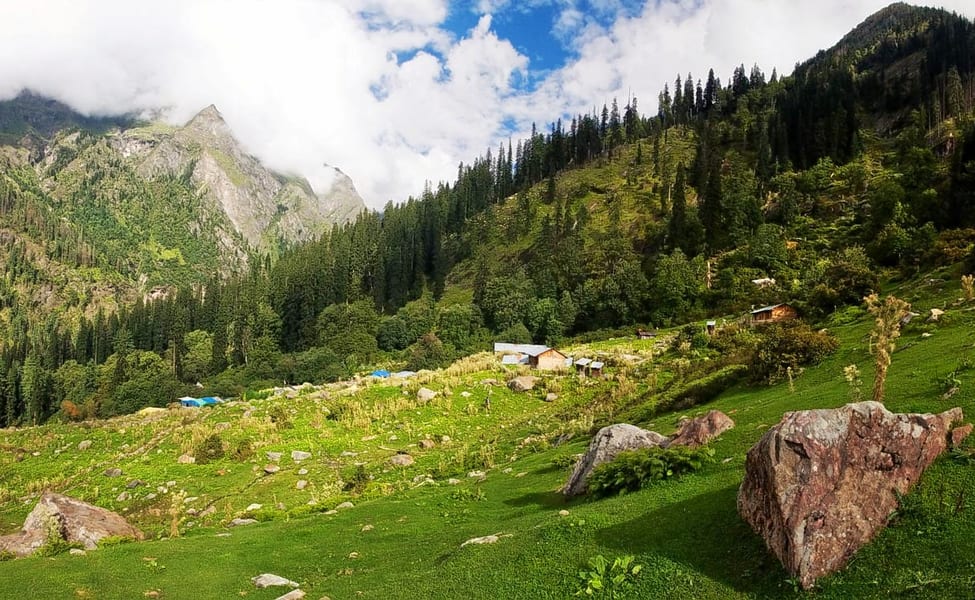
Kheerganga is the Parvati valley's most beloved overnight destination — a sulphur-spring meadow at 9,700 ft (2,960 m) sacred to Lord Shiva, set under the green wall of the Parvati massif. The trek to it is short (12 km of well-graded forest trail), the climb is forgiving, and the reward at the top is a pair of stone bathing pools fed by mineralised water at around 50°C, surrounded by silver birch and snow peaks. It is the rare Himalayan trek where the destination is a sacred bath house.
The geography and the springs
The Parvati valley runs east from Bhuntar in the Kullu district, draining a fan of glaciers that includes the Parvati, Tosh, and Dibibokri glaciers. Kheerganga sits on a high meadow on the south bank of the Parvati river, at the foot of a steep ridge that drains the mineral-rich rocks above. The hot springs here are believed to be the discharge of geothermally heated water that has percolated through layers of granite and basalt, picking up sulphur, calcium, and magnesium along the way. The water emerges at the meadow at around 50°C and is channelled into two stone bathing pools — one for men, one for women — both walled with low slate masonry. The smell of sulphur is mild but unmistakable; the water is clear and slightly milky, and the locals call this milky appearance kheer (rice pudding), which is where the name Kheerganga (literally "milky Ganges") comes from.
Mythological context
Hindu legend places Kheerganga as the spot where Lord Shiva's son Kartikeya meditated for 3,000 years. A small Shiva temple sits at the top of the meadow, run by a resident sadhu who has been there for over fifteen years. Pilgrims walk up year-round; in summer the meadow has a steady flow of devotees, naga sadhus, and Israeli backpackers in roughly equal numbers. The temple priest serves langar (free community kitchen) when supplies permit, and the conversation around the sadhu's fire ranges from Vedanta to backpacker logistics in the same evening.
The route from Barshaini
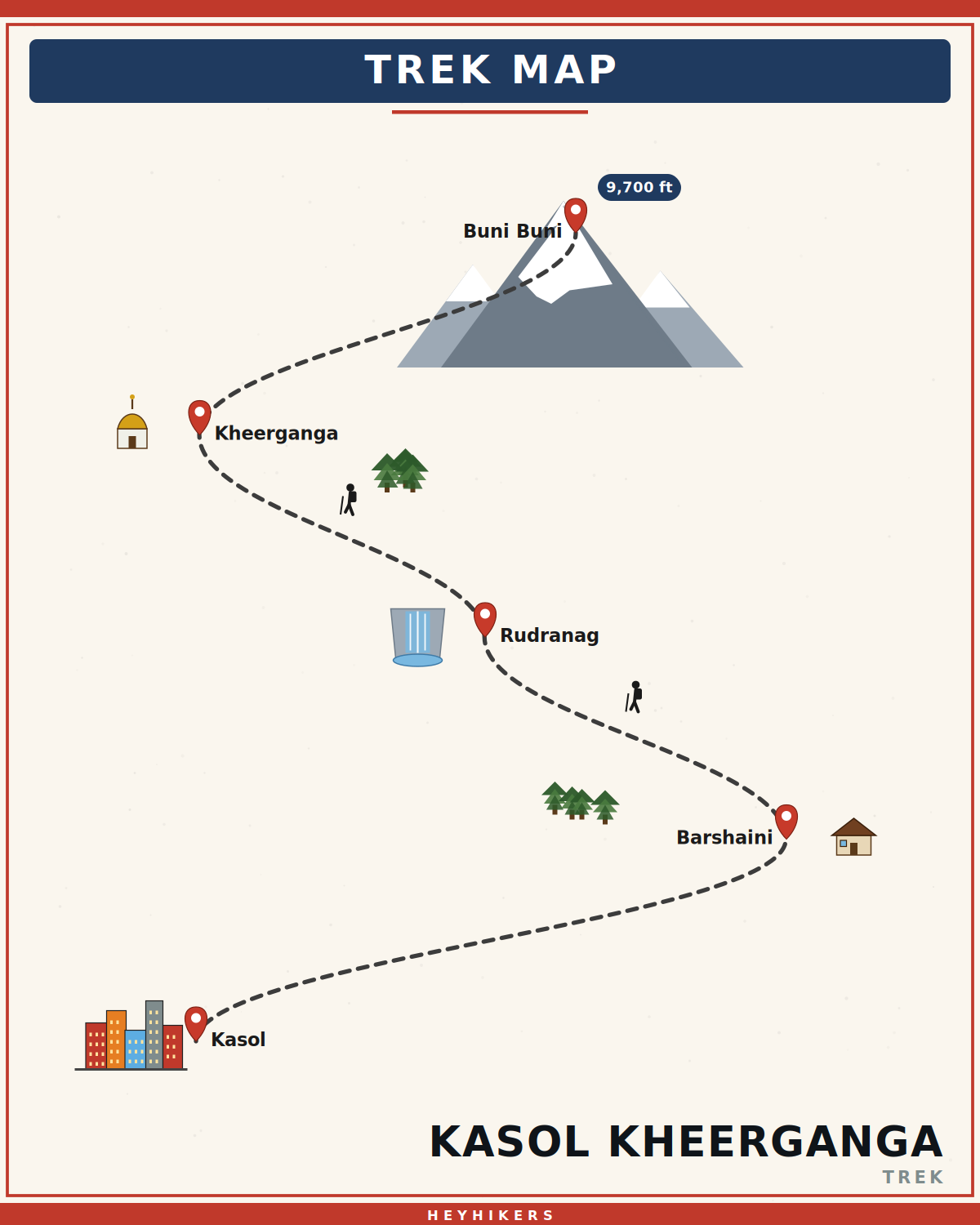
The trek begins at Barshaini (7,500 ft), the road head 18 km east of Kasol. Cross the iron bridge over the Tosh nala and turn east up the right bank of the Parvati. The first kilometre passes the small village of Nakthan, then crosses to the south bank where the trail proper begins. Through pine and oak forest the path climbs steadily, with the Parvati river thundering below. The first major landmark is Rudra Nag, a 30-metre waterfall shaped like a cobra (rudra naag) onto a small Hindu shrine. Above Rudra Nag the trail enters the famous "12 turns" — a series of steep switchbacks that climb 400 metres of vertical in just over a kilometre. Above the switchbacks the gradient eases and the trail reaches Kheerganga meadow.
What to do at Kheerganga
Most trekkers spend the first afternoon at the springs — the bath is the centrepiece of the experience and is best done before sunset when the air cools rapidly. The next day is for exploration: a 4 km uphill walk to Buni Buni meadow at 11,200 ft gives the first proper view of the upper Parvati glacier and the unnamed peaks topping out around 18,000 ft. Trekkers who don't want to climb spend the day reading at the springs, exploring the small Shiva temple, or chatting with the resident sadhus. The night sky at Kheerganga is exceptional — the meadow is far enough from any town that the Milky Way is clearly visible.
Best season
Kheerganga runs almost year-round but the best windows are April to June (snow patches near the meadow, pleasant days, cold nights) and September to early November (post-monsoon clarity, golden meadows, frosty nights). July-August is monsoon and the trail becomes slippery; views are usually clouded. December-March sees deep snow on the upper switchbacks; the trek is still possible with microspikes and gaiters but most regulars avoid the deep-winter window. The hot springs are at their most therapeutic in the cold months — emerging from the bath into freezing air is part of the ritual.
Camping and infrastructure
HeyHikers operates a designated camping site on the Kheerganga meadow with two-person tents, sleeping bags rated to -5°C, communal kitchen, and pit toilets. There are a handful of small dhabas at the meadow run by Nakthan villagers serving Maggi, eggs, paratha, and dal-chawal. The bathing pools are open from sunrise to sunset and managed informally by the sadhus. A 1.5-hour walk down to Nakthan brings you to the nearest mobile network; Kheerganga itself is offline.
Who this trek is for
Kheerganga is the textbook easy-Himalayan weekend trek. If you can walk 12 km in a day with a 5 kg daypack, you can do this. We see schoolchildren, retirees, solo travellers, and large family groups on this trail every weekend in season. The 12 turns are the only steep section — pace yourself on the climb and the rest of the trek is gentle. Common pitfall: people underestimate the cold at 9,700 ft after a hot bath; bring a fleece and a beanie even in May.
Itinerary
Map
What trekkers say
"I'd never camped in snow before. The HeyHikers team made me feel safe every single step. The summit sunrise — standing at 12,500 ft watching peaks turn gold — I cried. Not from the cold. From the beauty."
PS
Priya Sharma
Kedarkantha, Dec 2025
"Seven lakes, each more unreal than the last. The logistics were flawless — the food at 13,000 ft was better than most restaurants I know. Our guide Farooq knew every stone on the trail. Doing Goechala with them next."
AM
Arjun Mehta
Kashmir Great Lakes, Aug 2025
Inclusion
- All meals during the trek (vegetarian, freshly cooked)
- Camping gear — tents, sleeping bags, mats
- Certified trek leader and support guides
- Forest department permits and entry fees
- First-aid kit and supplemental oxygen
- Basecamp accommodation on twin/triple sharing
Exclusion
- Travel to and from the basecamp pickup point
- Personal trekking gear and clothing
- Travel insurance covering high-altitude trekking
- Tips, personal expenses, and meals during travel days
- Anything not explicitly listed under inclusions
Things to Carry
- Trekking shoes (high-ankle, broken-in)
- 40-50L backpack with rain cover
- Two pairs of trek pants
- Three full-sleeve t-shirts (synthetic, not cotton)
- Fleece jacket and a heavier down/insulated jacket
- Thermal innerwear (top + bottom)
- Waterproof outer shell (jacket + pants)
- Woollen cap, sun cap, balaclava
- Two pairs of warm gloves (inner liner + outer)
- UV-rated sunglasses
- Headlamp with spare batteries
- Reusable water bottles (2L total) or hydration bladder
- Personal medical kit and prescription medicines
- Sunscreen (SPF 50+) and lip balm
- Toiletries and quick-dry towel
- Original photo ID (mandatory at forest checkposts)
How to Reach
Reach Bhuntar by air or Kasol by overnight Volvo from Delhi. The trek begins at Barshaini (45 min from Kasol).
Safety & Security
- Acclimatize properly — never skip rest days at altitude.
- Drink at least 4 litres of water per day above 9,000 ft.
- Tell your trek leader immediately if you feel headache, nausea, or breathlessness — early AMS signs are treatable, ignored ones are not.
- Stay close to the group; do not take shortcuts off the marked trail.
- Avoid alcohol and smoking for the entire duration of the trek.
- Keep a buffer day for travel — Himalayan roads can close without notice.
- Carry travel insurance that explicitly covers high-altitude trekking and helicopter evacuation.
Cancellation Policy
Cancellations must be requested in writing.
- More than 30 days before the trek start date: 90% refund. - 21–30 days before: 50% refund. - 11–20 days before: 25% refund. - 10 days or fewer: no refund, but you may transfer your slot to another trekker or to any future batch within 12 months at no extra charge.
Refunds are processed to the original payment method within 7-10 working days. Trip cancellations triggered by us (weather, force majeure, government restrictions) are refunded in full or moved to an alternate batch at your option.
Meet your trek leader
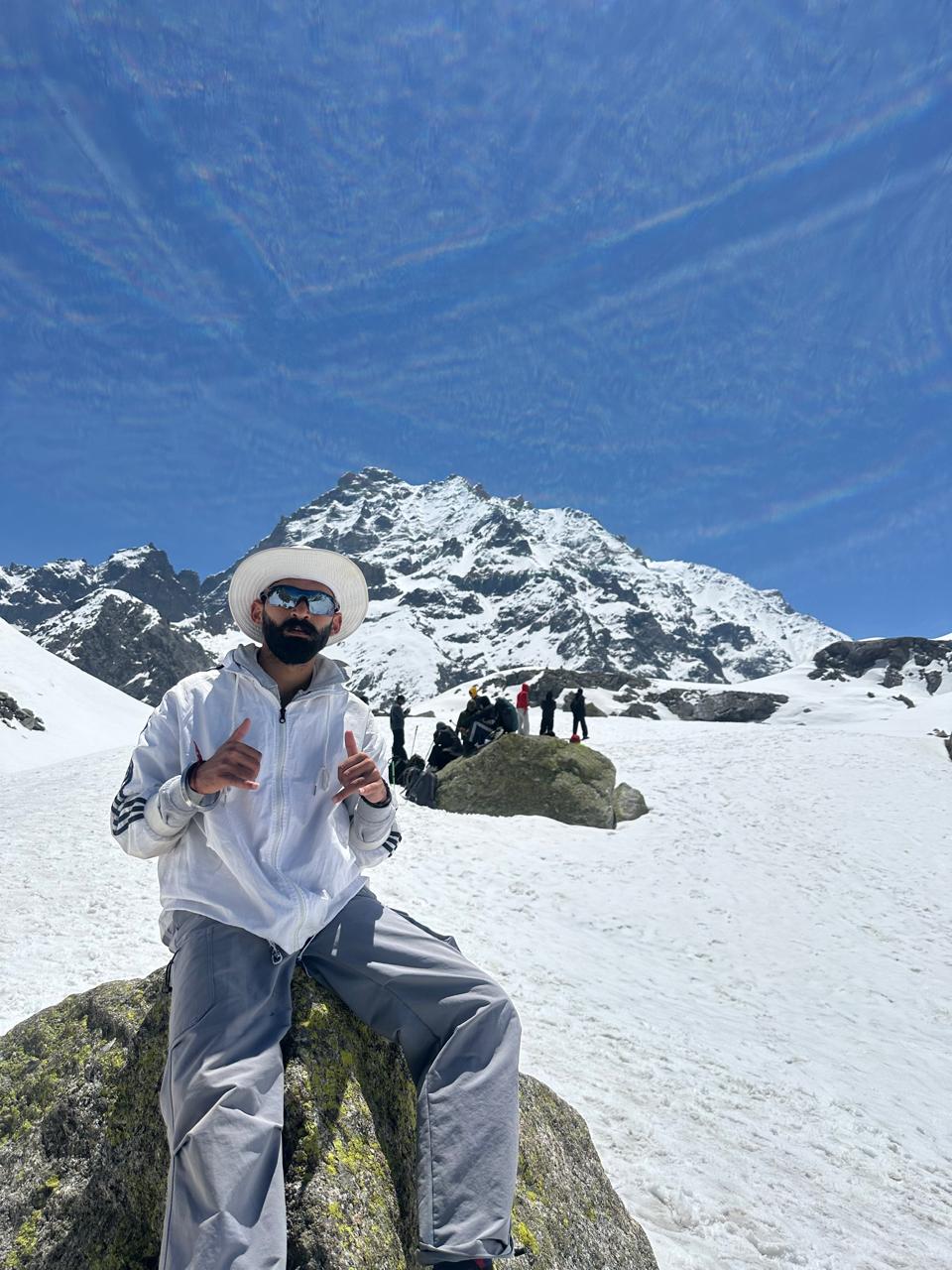
Akhil Deruwan
NIM Uttarkashi certified · 9 yrs experience
Akhil grew up in the foothills of the Garhwal Himalayas and has spent nearly a decade navigating its most demanding trails. He has led over 150 batches across Uttarakhand and Himachal Pradesh, with a strong focus on technical high-altitude routes and safety management. His calm under pressure and deep knowledge of local terrain make him a trusted leader for both beginner and advanced trekkers.
- Wilderness First Responder
- High Altitude Medicine
- Technical Route Navigation
- Search & Rescue
FAQ
Why Trek With Us
Travel Safe
Certified Team
Easy Cancellation
Well Equipped Campsite
Experienced Guide
No Hidden Charges