Overview
Lamkhaga Pass — From Harsil's Apple Orchards to Chitkul's Mountain Heart
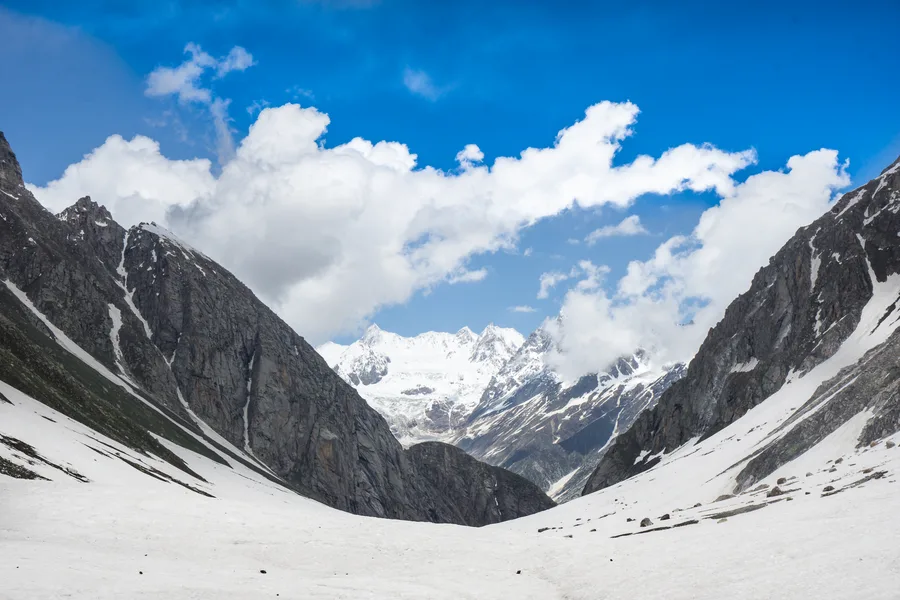
Lamkhaga Pass at 17,336 ft (5,284 m) is one of the highest, hardest, and most remote crossover treks in the Indian Himalayas. The ten-day route connects the Bhagirathi valley in Uttarakhand (near Harsil) to the Baspa valley in Himachal (Chitkul), crossing the main Himalayan watershed at an unbridged glacier pass. The route was a working trade corridor for centuries — Bhotia traders moved salt, wool, and dried meat between Tibet and the upper Bhagirathi via this very pass — until the 1962 Indo-China war sealed the Tibetan side and the trade collapsed. Today Lamkhaga is a serious mountaineering trek that demands prior 16,000+ ft experience, glacier travel skills, and a tolerance for ten consecutive days above 11,500 ft.
Why this trek matters
Most Himalayan crossover treks are shorter, lower, and on better-marked trails. Lamkhaga is a step above: the camps stay above 13,000 ft for five consecutive nights, the pass itself sits at 17,336 ft with a 50° snow-and-ice headwall, and the route is genuinely remote — once you commit to the upper Jalandhari glacier on Day 5, there is no escape route except to continue forward over the pass into Himachal. The reward is a pass crossing that rivals Auden's Col and Kalindi Khal in seriousness while being slightly more accessible logistically.
Geography and route
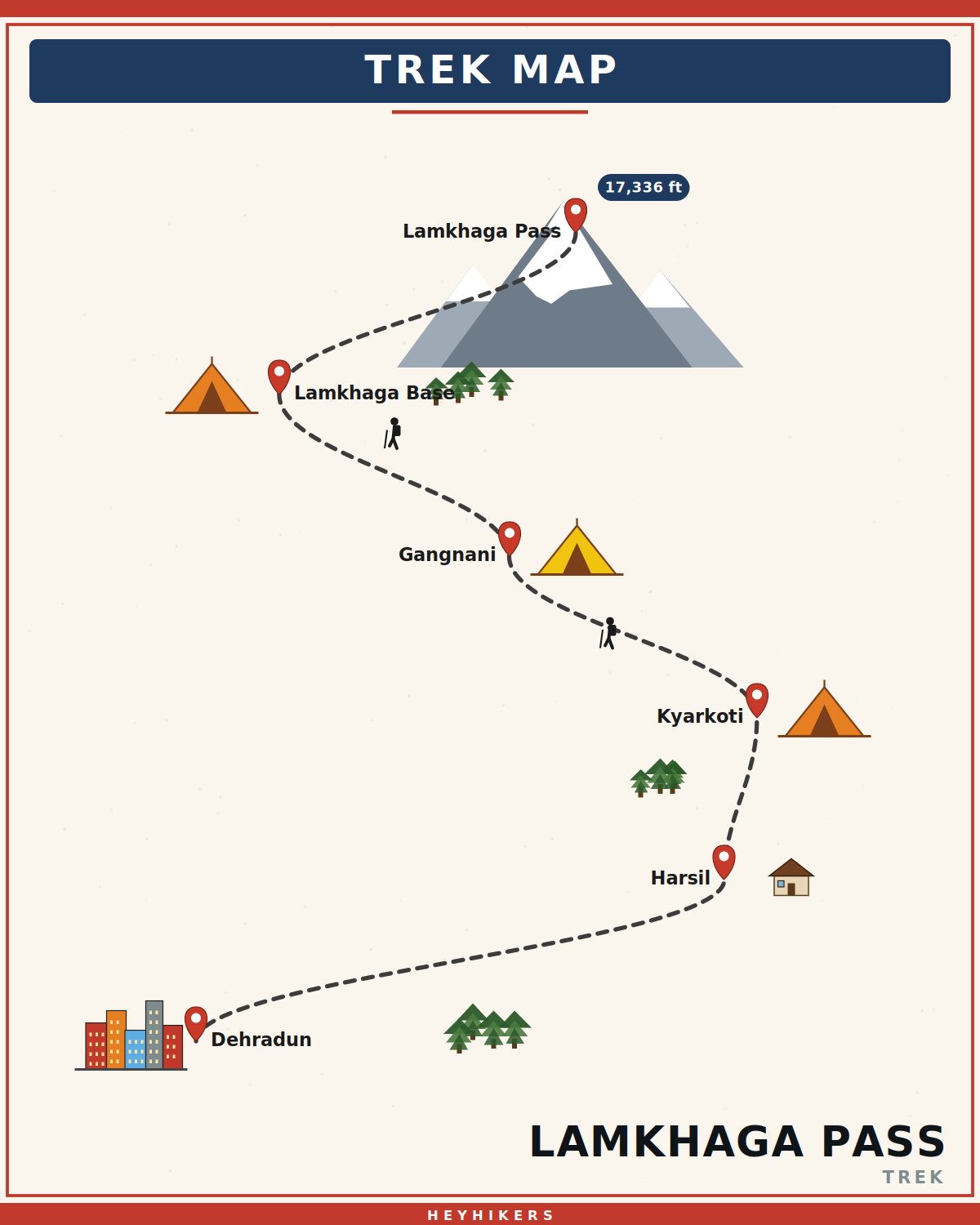
The trek begins at Harsil (7,860 ft), an apple-orchard hamlet on the Bhagirathi made famous in the 1860s by British botanist Frederick Wilson, who pioneered the deodar timber trade here. The trail follows the Jalandhari Gad upstream — a tributary of the Bhagirathi that drains the southern flank of the Lamkhaga peaks. Three camps (Kyarkoti, Gangnani, Lamkhaga Base) ladder up the valley to the glacier base. Pass day crosses the watershed and descends into the upper Baspa valley on the Himachal side. Three more camps (Gunderi, Dumti, Chitkul homestay) bring you down to the famous border village of Chitkul (11,300 ft) — the last village before the Tibetan border, with its 500-year-old Mathi temple and traditional Kinnauri wood-and-stone architecture.
The pass crossing in detail
Pass day is the longest of the trek — 12-15 hours on the move with a 1 AM start. The first three hours is a steady glacier ascent over snow with crevasse-aware foot placement, roped in two-person teams. By 5:30 AM you reach the base of the pass headwall — a 300 m snow-and-ice slope at 50° where we deploy two fixed ropes and ascend with jumars. The middle section has exposed sections of bare ice that require careful crampon work. You reach the pass at 17,336 ft typically by 8-9 AM. The descent on the Himachal side is a 600 m snow slope to the Baspa glacier moraine; we glissade where safe and rope-down the steeper sections with belay. Below the snow, a long moraine descent leads to Gunderi camp at 14,800 ft.
Difficulty and prerequisites
Lamkhaga is a graded difficult trek bordering on alpine expedition. We require: at least one prior trek above 16,000 ft (Pin Parvati Pass, Auden's Col, Stok Kangri, Kang Yatze, Roopkund-plus); demonstrated proficiency with crampons, ice axe, and fixed-line ascent (we run a refresher drill on Day 2); cardiovascular fitness equivalent to running 8 km in 45 minutes; a recent medical fitness certificate including ECG; and a fitness video submitted as part of enrolment. Anyone with untreated hypertension, pulmonary issues, or knee instability should not attempt this trek.
Permits and access
Both ends of the trek lie in inner-line border zones. The Uttarakhand side requires a Forest Department permit issued at Uttarkashi. The Himachal side requires an Inner Line Permit (ILP) for the upper Baspa, issued by the Sub-Divisional Magistrate at Reckong Peo, valid for 7 days. Foreign nationals require additional permissions and are typically not allowed beyond Nagasthi check-post; we advise foreign trekkers to plan 60 days in advance. We handle all paperwork; trekkers must submit passport copies (or Aadhaar for Indians) 30 days before departure.
Best season
The pass is only crossable in mid-June to mid-July (pre-monsoon) and mid-September to mid-October (post-monsoon). June still has consolidated snow on the headwall, which is preferred for fixed-rope work. September has drier rock, less snow, and clearer air but colder summit-camp nights. Outside these windows the route is either monsoon-soaked (late July-August) or buried in deep winter snow (November-May). We track weather windows obsessively and may delay the pass crossing by 24-48 hours if conditions warrant.
The Bhotia trade corridor — historical context
The Bagori village just upstream of Harsil is a Bhotia (ethnic Tibetan) settlement; the Bagori Bhotias controlled the salt-and-wool trade through Lamkhaga and the parallel Nelang and Mana passes for centuries. The trade was finally killed by the 1962 Sino-Indian war, when the upper border was sealed and the Bhotias forced to switch to apple cultivation, weaving, and tourism. The route you walk on Days 1-5 was a working pack-pony trail until the 1950s; you can still see remnants of stone shelters and trade-era cairns near Kyarkoti and Gangnani. The Chitkul end of the trek has its own analogous history — Kinnauri traders moved Tibetan goods south via this pass before 1962.
Camping and infrastructure
The trek uses one guesthouse night (Harsil), six camps (Kyarkoti, Gangnani, Lamkhaga Base, Gunderi, Dumti, Chitkul homestay), and the Shimla hotel on the way out. HeyHikers provides 4-season tents, -20°C sleeping bags, kitchen tents below the glacier, fixed ropes for the pass, harnesses, helmets, and high-altitude porters who carry group gear. You carry a 7-9 kg daypack (water, snacks, layers, camera). Personal trekking poles, microspikes, and gaiters are mandatory; crampons and ice axes are issued for the pass day only and returned at Gunderi.
Who this trek is for
Lamkhaga is for experienced high-altitude trekkers who have completed at least one previous 16,000+ ft pass crossing and want a step up in technical content, remoteness, and duration. It is not for first-timers or even moderately experienced trekkers — the consequences of altitude failure on the upper glacier are serious because the evacuation route adds 4 days back over the Uttarakhand side. We deliberately keep batches small (6 trekkers maximum) with 1:3 guide ratios and turn down enrolments that do not meet the prerequisites.
Itinerary
Map
What trekkers say
"I'd never camped in snow before. The HeyHikers team made me feel safe every single step. The summit sunrise — standing at 12,500 ft watching peaks turn gold — I cried. Not from the cold. From the beauty."
PS
Priya Sharma
Kedarkantha, Dec 2025
"Seven lakes, each more unreal than the last. The logistics were flawless — the food at 13,000 ft was better than most restaurants I know. Our guide Farooq knew every stone on the trail. Doing Goechala with them next."
AM
Arjun Mehta
Kashmir Great Lakes, Aug 2025
Inclusion
- All meals during the trek (vegetarian, freshly cooked)
- Camping gear — tents, sleeping bags, mats
- Certified trek leader and support guides
- Forest department permits and entry fees
- First-aid kit and supplemental oxygen
- Basecamp accommodation on twin/triple sharing
Exclusion
- Travel to and from the basecamp pickup point
- Personal trekking gear and clothing
- Travel insurance covering high-altitude trekking
- Tips, personal expenses, and meals during travel days
- Anything not explicitly listed under inclusions
Things to Carry
- Trekking shoes (high-ankle, broken-in)
- 40-50L backpack with rain cover
- Two pairs of trek pants
- Three full-sleeve t-shirts (synthetic, not cotton)
- Fleece jacket and a heavier down/insulated jacket
- Thermal innerwear (top + bottom)
- Waterproof outer shell (jacket + pants)
- Woollen cap, sun cap, balaclava
- Two pairs of warm gloves (inner liner + outer)
- UV-rated sunglasses
- Headlamp with spare batteries
- Reusable water bottles (2L total) or hydration bladder
- Personal medical kit and prescription medicines
- Sunscreen (SPF 50+) and lip balm
- Toiletries and quick-dry towel
- Original photo ID (mandatory at forest checkposts)
How to Reach
Reach Dehradun. Drive 10 hours up the Bhagirathi to Harsil on Day 1. The trek ends at Chitkul in Himachal; we drive back via the Sangla–Kinnaur route to Shimla on Day 9 and onward to Delhi.
Safety & Security
- Acclimatize properly — never skip rest days at altitude.
- Drink at least 4 litres of water per day above 9,000 ft.
- Tell your trek leader immediately if you feel headache, nausea, or breathlessness — early AMS signs are treatable, ignored ones are not.
- Stay close to the group; do not take shortcuts off the marked trail.
- Avoid alcohol and smoking for the entire duration of the trek.
- Keep a buffer day for travel — Himalayan roads can close without notice.
- Carry travel insurance that explicitly covers high-altitude trekking and helicopter evacuation.
Cancellation Policy
Cancellations must be requested in writing.
- More than 30 days before the trek start date: 90% refund. - 21–30 days before: 50% refund. - 11–20 days before: 25% refund. - 10 days or fewer: no refund, but you may transfer your slot to another trekker or to any future batch within 12 months at no extra charge.
Refunds are processed to the original payment method within 7-10 working days. Trip cancellations triggered by us (weather, force majeure, government restrictions) are refunded in full or moved to an alternate batch at your option.
Meet your trek leader
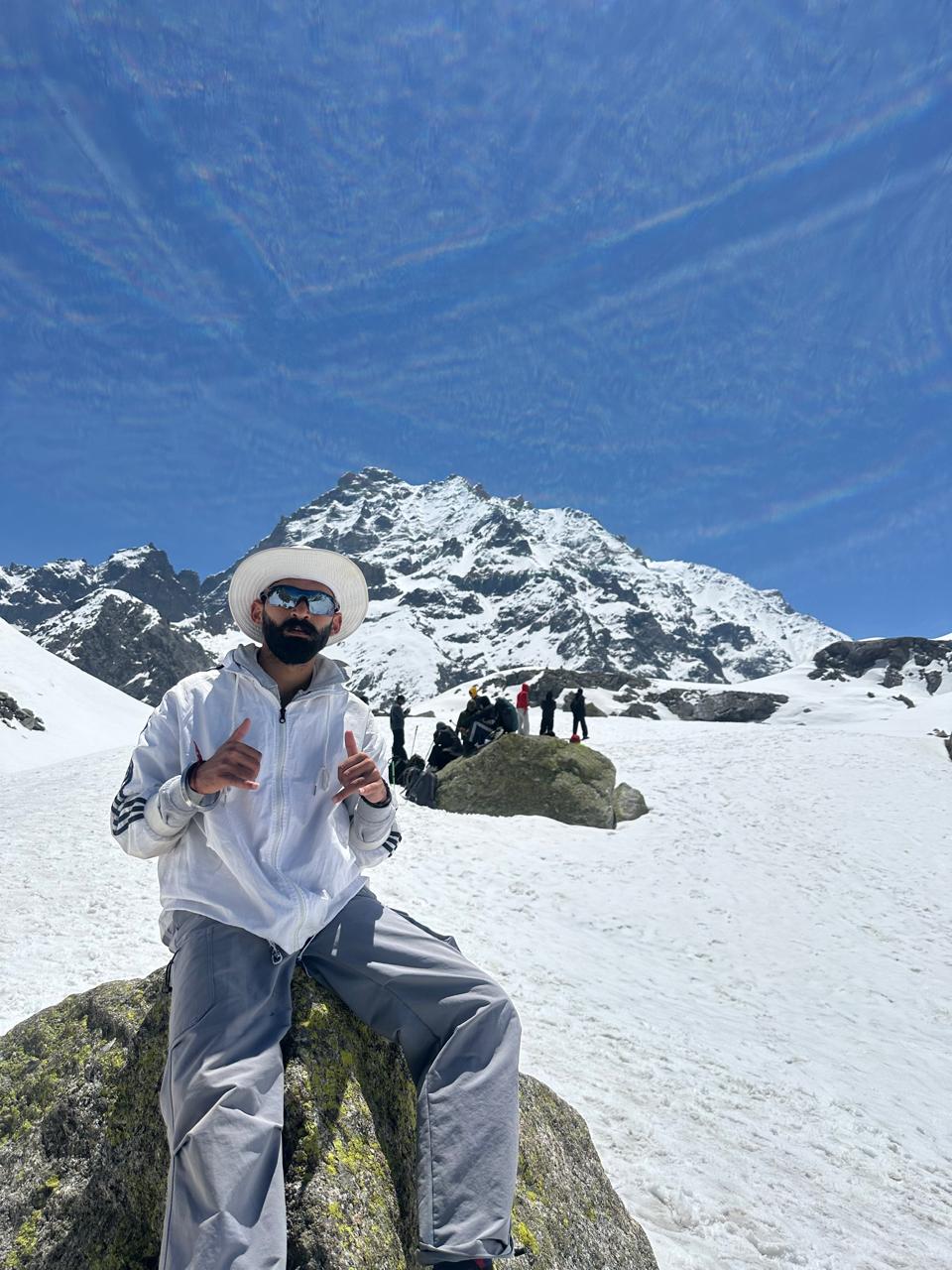
Akhil Deruwan
NIM Uttarkashi certified · 9 yrs experience
Akhil grew up in the foothills of the Garhwal Himalayas and has spent nearly a decade navigating its most demanding trails. He has led over 150 batches across Uttarakhand and Himachal Pradesh, with a strong focus on technical high-altitude routes and safety management. His calm under pressure and deep knowledge of local terrain make him a trusted leader for both beginner and advanced trekkers.
- Wilderness First Responder
- High Altitude Medicine
- Technical Route Navigation
- Search & Rescue
FAQ
Why Trek With Us
Travel Safe
Certified Team
Easy Cancellation
Well Equipped Campsite
Experienced Guide
No Hidden Charges