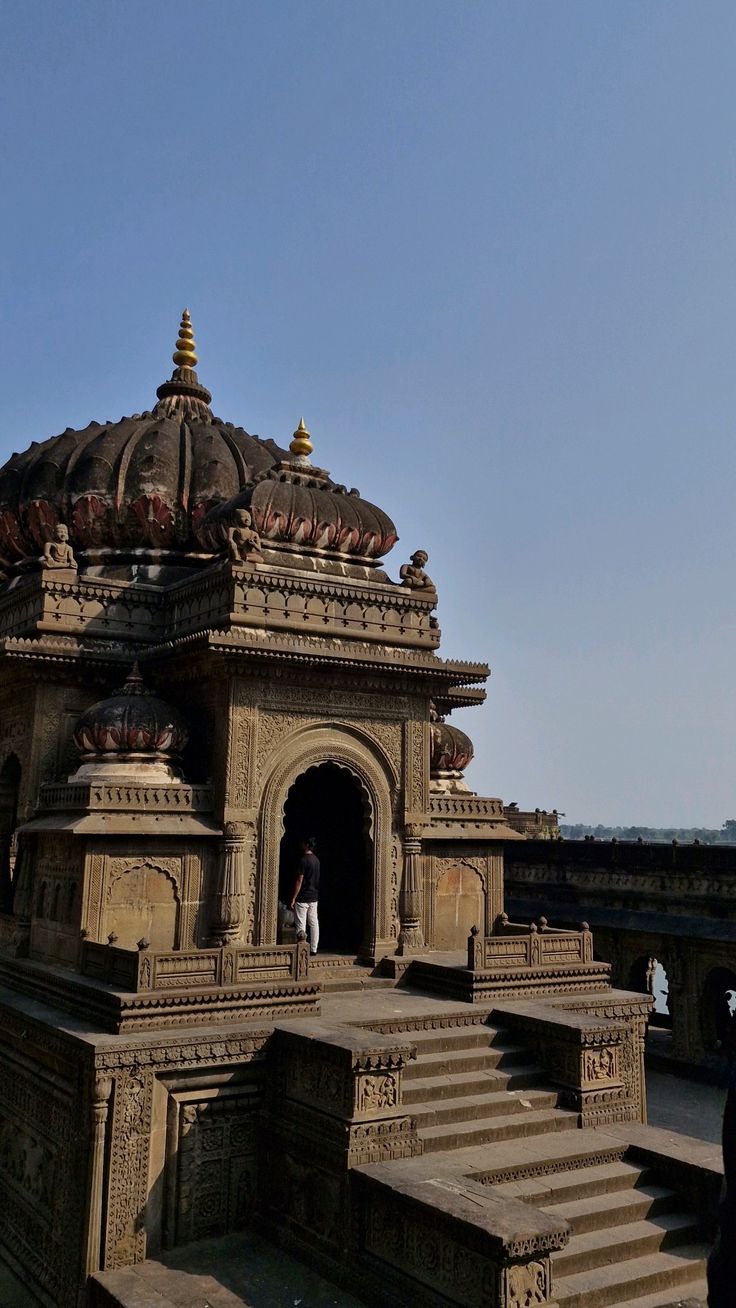
Overview
Madmaheshwar — The Second of the Panch Kedar
Madmaheshwar (also spelled Madhyamaheshwar) at 11,473 ft (3,497 m) is the second of the Panch Kedar — the five sacred temples of Lord Shiva scattered across the Garhwal Himalayas. In the legend that frames all five sites, Lord Shiva took the form of a bull (Nandi) to escape the Pandavas, who sought him out for absolution after the Kurukshetra war. The bull dove into the ground and re-emerged at five separate locations: Kedarnath (the hump), Madmaheshwar (the navel), Tungnath (the arms), Rudranath (the face), and Kalpeshwar (the hair). The Madmaheshwar temple, said to have been built in the 8th century by Adi Shankaracharya, holds the navel-shaped lingam in a small grey-stone shrine inside a wide alpine meadow with the Chaukhamba massif (23,419 ft) directly overhead.
Why this trek is unique
Madmaheshwar is what Kedarnath was forty years ago — quiet, rural, and essentially unchanged. The pilgrim trail runs through working Garhwali villages (Ransi, Goundhar, Bantoli) with subsistence farms of rajma, madua, and ogal (buckwheat); the temple precinct itself sees a fraction of the foot traffic of the busier shrines, and the immediate surroundings remain a wide grass-and-flower meadow with views of one of the largest non-summited massifs in the Indian Himalayas. The trek combines a stiff forest climb (Day 3 gains 4,300 ft over 8 km), a working pilgrim route, and the optional pre-dawn ascent to Buddha Madmaheshwar (13,123 ft) — a viewpoint from which Chaukhamba I-IV, Kedar Dome, and Mandani Parvat appear in a single 180° sweep.
The route from Ransi
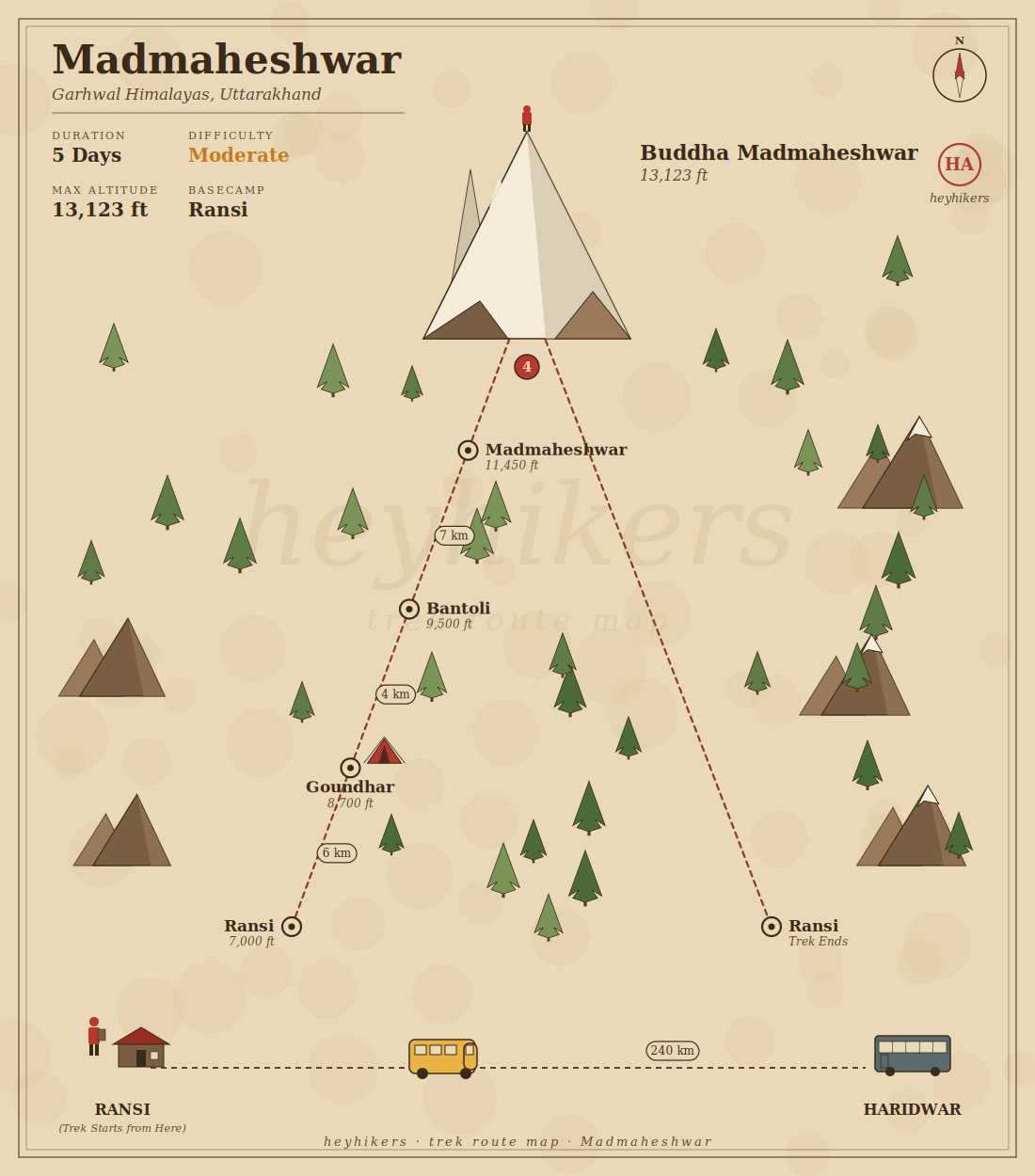
The trek begins at Ransi (6,400 ft), a small Garhwali village 12 km east of Ukhimath in the Mandakini-Madmaheshwar Ganga divide. Day 2 walks 6 km to Goundhar (7,200 ft), a riverside hamlet of a dozen houses with a small forest rest house. Day 3 is the hardest day on trail — 8 km of switchbacks via Bantoli (8,200 ft) climbing through banj oak and Himalayan birch forest to the temple meadow at 11,473 ft. Day 4 is the optional pre-dawn climb to Buddha Madmaheshwar at 13,123 ft for sunrise on Chaukhamba, then a full descent to Goundhar on the same trail. Day 5 closes the loop with a 6 km descent to Ransi roadhead and the long drive back to Haridwar.
What you'll see at the temple
The temple sits in a tilted alpine meadow with a small cluster of pilgrim guesthouses (dharamshalas), a kitchen mess, and a stone-paved courtyard. The shrine itself is a Nagara-style grey-stone structure with a 30 ft shikhara (spire), oriented north-south, with the navel-shaped lingam inside. The afternoon and evening aartis are the principal rituals — the priests perform abhishek with milk, ghee, and bilva leaves, and offer arati at 5:30 PM in season. The signature image of the trek is the temple shikhara silhouetted against Chaukhamba in golden hour, taken from the meadow above the courtyard.
Best time to trek
Madmaheshwar is open to pilgrims from early May to mid-November. The temple closes in mid-November when winter snow seals the upper trail; the deity is then carried in procession to its winter seat at Ukhimath, where worship continues until the temple reopens in May. The single best months are September and October — clear skies, autumn meadows, and fewer pilgrims after the monsoon rush. May-June are also excellent (rhododendron bloom, wildflowers, snow patches above 11,000 ft); July-August are monsoon and we generally avoid these batches due to landslides and slippery stone steps.
Camping and infrastructure
The trail is a working pilgrim route with stone-step paths, suspension bridges, and chai shops every 2-3 km in season. We use the village rest house at Goundhar (or pitch tents on a flat field above the village) and stay in a clean dharamshala at the Madmaheshwar temple precinct. Hot vegetarian meals are available at the temple mess. Mobile network ends at Ransi and resumes at the temple meadow on the BSNL band.
Difficulty and prerequisites
Madmaheshwar is a graded moderate trek. The Day 3 climb is the demanding section — 4,300 ft of gain over 8 km, mostly stone steps. We require a six-week fitness base (5 km jogs three times a week, or equivalent stair-climbing). First-time trekkers manage well with this base. Children above 12 with prior hiking exposure regularly complete the trek. Anyone with significant knee instability should bring trekking poles for the descent.
Cultural and religious context
The Panch Kedar pilgrimage is one of the oldest continuous Hindu pilgrim circuits — local lore traces it to the 8th-century reformer Adi Shankaracharya, who is said to have rediscovered all five shrines after the Kurukshetra-era myth. Most pilgrims walk in saffron, take only a small water bottle and a thali, and complete each shrine in a single visit; the modern trekking idiom of camping and base camp dinners is a recent overlay. Out of respect, we observe a "no leather" rule inside the temple precinct (leather belts and shoes off the marked outer path), no photography inside the sanctum, and modest dress.
Itinerary
Map
What trekkers say
"I'd never camped in snow before. The HeyHikers team made me feel safe every single step. The summit sunrise — standing at 12,500 ft watching peaks turn gold — I cried. Not from the cold. From the beauty."
PS
Priya Sharma
Kedarkantha, Dec 2025
"Seven lakes, each more unreal than the last. The logistics were flawless — the food at 13,000 ft was better than most restaurants I know. Our guide Farooq knew every stone on the trail. Doing Goechala with them next."
AM
Arjun Mehta
Kashmir Great Lakes, Aug 2025
Inclusion
- All meals during the trek (vegetarian, freshly cooked)
- Camping gear — tents, sleeping bags, mats
- Certified trek leader and support guides
- Forest department permits and entry fees
- First-aid kit and supplemental oxygen
- Basecamp accommodation on twin/triple sharing
Exclusion
- Travel to and from the basecamp pickup point
- Personal trekking gear and clothing
- Travel insurance covering high-altitude trekking
- Tips, personal expenses, and meals during travel days
- Anything not explicitly listed under inclusions
Things to Carry
- Trekking shoes (high-ankle, broken-in)
- 40-50L backpack with rain cover
- Two pairs of trek pants
- Three full-sleeve t-shirts (synthetic, not cotton)
- Fleece jacket and a heavier down/insulated jacket
- Thermal innerwear (top + bottom)
- Waterproof outer shell (jacket + pants)
- Woollen cap, sun cap, balaclava
- Two pairs of warm gloves (inner liner + outer)
- UV-rated sunglasses
- Headlamp with spare batteries
- Reusable water bottles (2L total) or hydration bladder
- Personal medical kit and prescription medicines
- Sunscreen (SPF 50+) and lip balm
- Toiletries and quick-dry towel
- Original photo ID (mandatory at forest checkposts)
How to Reach
Reach Haridwar by air (Jolly Grant via Dehradun, 1.5 hours by cab), train (Haridwar Junction — multiple daily Shatabdi, Mussoorie Express, Nanda Devi from Delhi), or overnight Volvo bus from Delhi.
Our shared transport leaves Haridwar Railway Station at 7:00 AM on Day 1 and reaches Ransi in 9-10 hours via Devprayag, Rudraprayag, and Ukhimath.
If you're driving privately, follow Google Maps to "Ransi village, Madmaheshwar". The road is paved up to Ransi and the village has a small parking strip near the temple gate.
Safety & Security
- Acclimatize properly — never skip rest days at altitude.
- Drink at least 4 litres of water per day above 9,000 ft.
- Tell your trek leader immediately if you feel headache, nausea, or breathlessness — early AMS signs are treatable, ignored ones are not.
- Stay close to the group; do not take shortcuts off the marked trail.
- Avoid alcohol and smoking for the entire duration of the trek.
- Keep a buffer day for travel — Himalayan roads can close without notice.
- Carry travel insurance that explicitly covers high-altitude trekking and helicopter evacuation.
Cancellation Policy
Cancellations must be requested in writing.
- More than 30 days before the trek start date: 90% refund. - 21–30 days before: 50% refund. - 11–20 days before: 25% refund. - 10 days or fewer: no refund, but you may transfer your slot to another trekker or to any future batch within 12 months at no extra charge.
Refunds are processed to the original payment method within 7-10 working days. Trip cancellations triggered by us (weather, force majeure, government restrictions) are refunded in full or moved to an alternate batch at your option.
Meet your trek leader
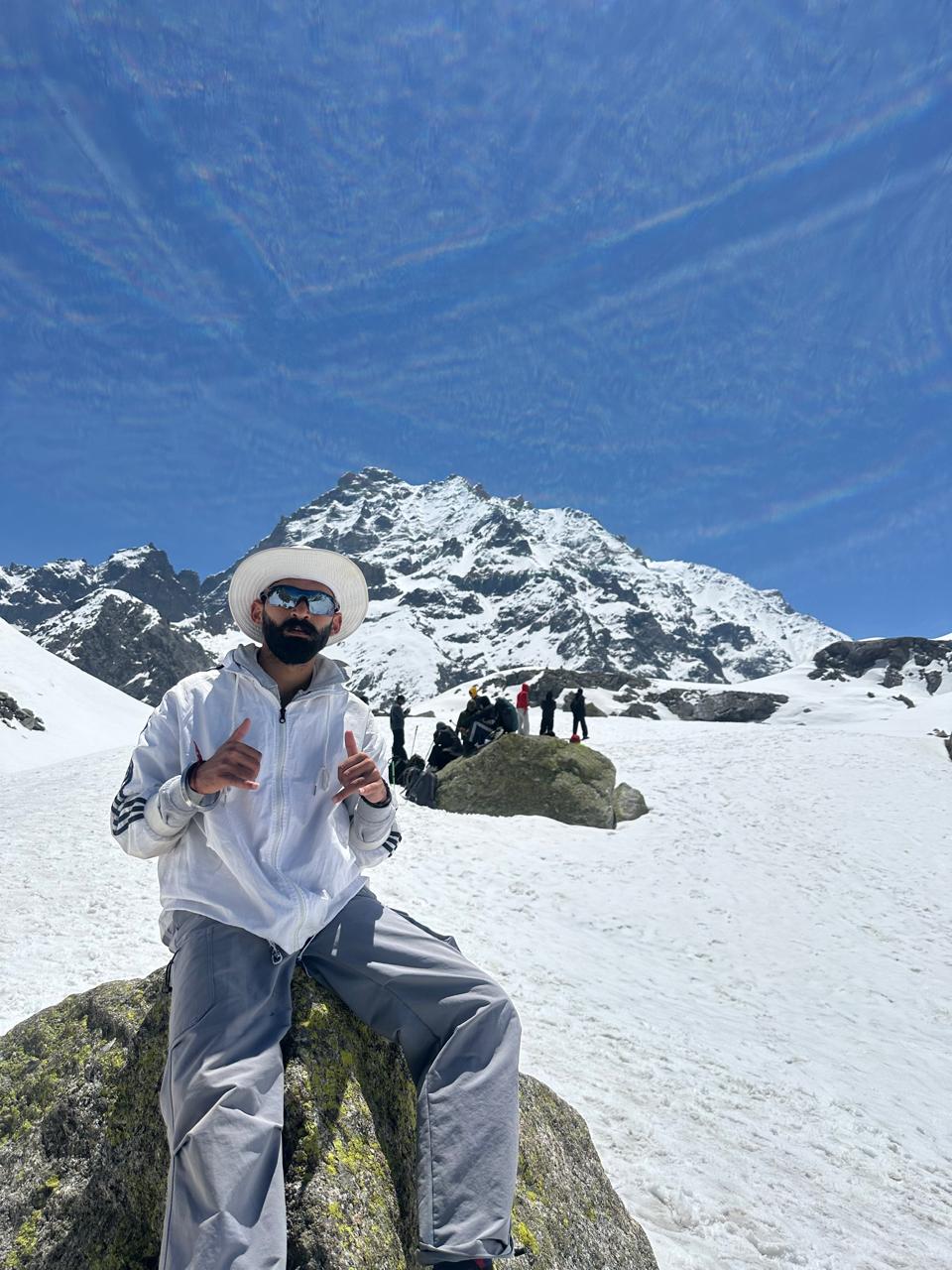
Akhil Deruwan
NIM Uttarkashi certified · 9 yrs experience
Akhil grew up in the foothills of the Garhwal Himalayas and has spent nearly a decade navigating its most demanding trails. He has led over 150 batches across Uttarakhand and Himachal Pradesh, with a strong focus on technical high-altitude routes and safety management. His calm under pressure and deep knowledge of local terrain make him a trusted leader for both beginner and advanced trekkers.
- Wilderness First Responder
- High Altitude Medicine
- Technical Route Navigation
- Search & Rescue
FAQ
Why Trek With Us
Travel Safe
Certified Team
Easy Cancellation
Well Equipped Campsite
Experienced Guide
No Hidden Charges