Overview
Malana — One of the World's Oldest Democracies
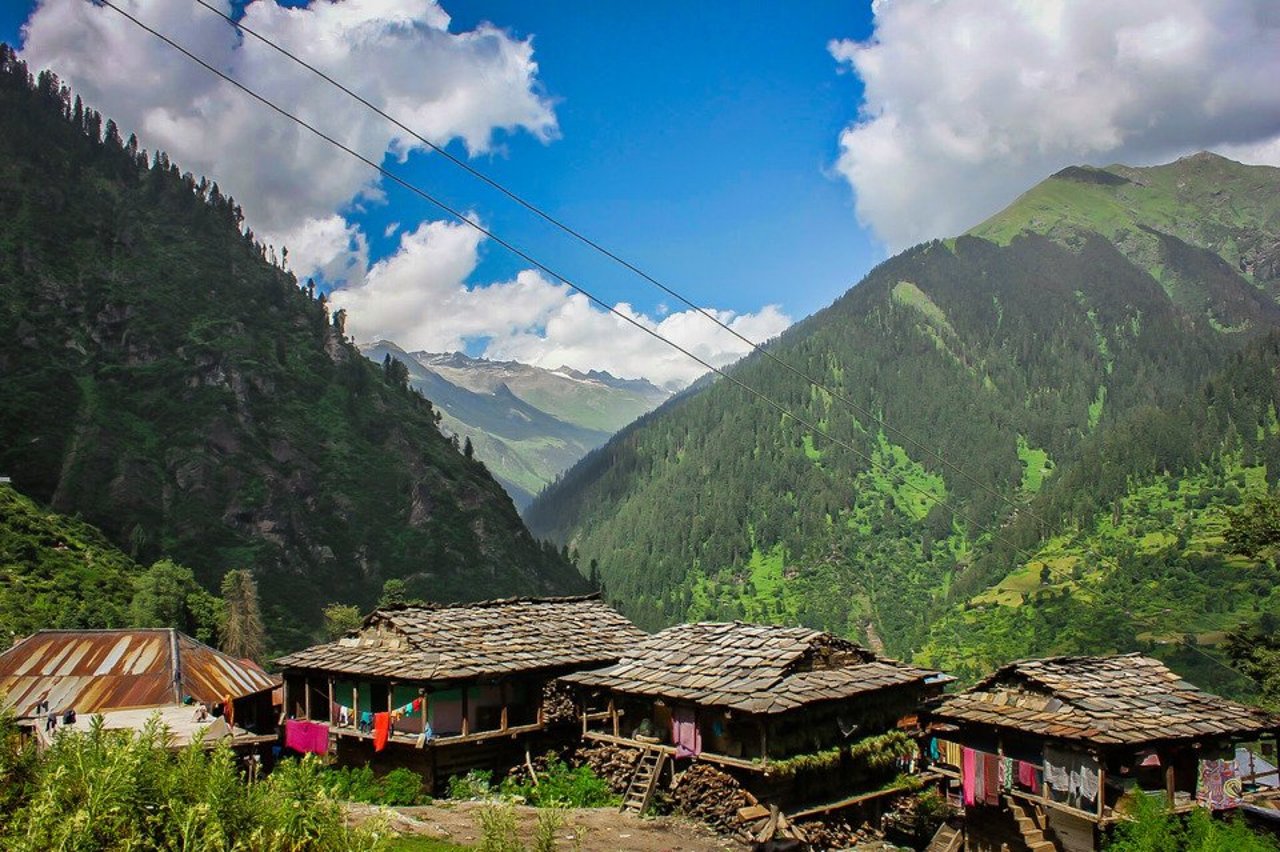
Malana is one of the most culturally remarkable villages in India — a self-governing Himachali settlement at 8,700 ft (2,650 m) whose residents claim descent from Alexander the Great's soldiers, speak a language (Kanashi) unrelated to any neighbouring tongue, and operate one of the oldest continuous democratic systems in human history. The trek to Malana is short — a 6 km climb of around 3,500 ft from Jari village — but the cultural distance covered is enormous. You leave a Hindi-speaking, Indian-modern world at the road head and arrive a few hours later in a place that has chosen to remain ritually and politically separate from the country around it for at least a thousand years.
The geography and the village
Malana sits on a high terrace above the Malana nala, a tributary of the Parvati river. The village is a tight cluster of two-storey wooden houses arranged in two distinct neighbourhoods, Dhara Beda and Sara Beda, separated by a small public square. Above the village rises the steep wall of the Chanderkhani ridge (12,150 ft); below, the Malana nala drops 3,500 ft to the Parvati. The village's isolation was almost complete until the 1980s — the first jeep road to nearby Jari was built then, and the Malana hydroelectric project in the 2000s brought a service road close to the village edge. Even today, the foot trail from Jari is the only way an outsider can enter Malana without express village permission.
The democratic tradition
Malana's political system is unique. The village is governed by Jamlu Devta (also called Jamadagni Rishi), a deity believed to have ruled the village for thousands of years. The deity speaks through an oracle (the gur) on major matters; routine governance is handled by a two-tier parliament — the upper house (Jyeshtang, 11 members) and the lower house (Kanishtang, all village heads-of-household). Decisions are made by consensus after debate; there is no written constitution but extensive oral law. Many anthropologists describe Malana as one of the earliest functioning democracies in the world, with continuous practice predating Athenian democracy.
The cultural rules visitors must follow
Outsiders are not permitted to touch any villager, building, or temple object in Malana without explicit permission. The village considers all outsiders ritually impure, and the touch is considered to require purification of the touched object. There is a fine (around Rs. 2,500) traditionally levied for accidental touch, paid to the village for the ritual cleansing. Photography of villagers requires explicit consent. The Jamlu Devta temple and the village square are off-limits to outsiders for entry; you can view them from a distance only. A local guide accompanies every HeyHikers group and briefs trekkers on rules at the trailhead.
The route from Jari
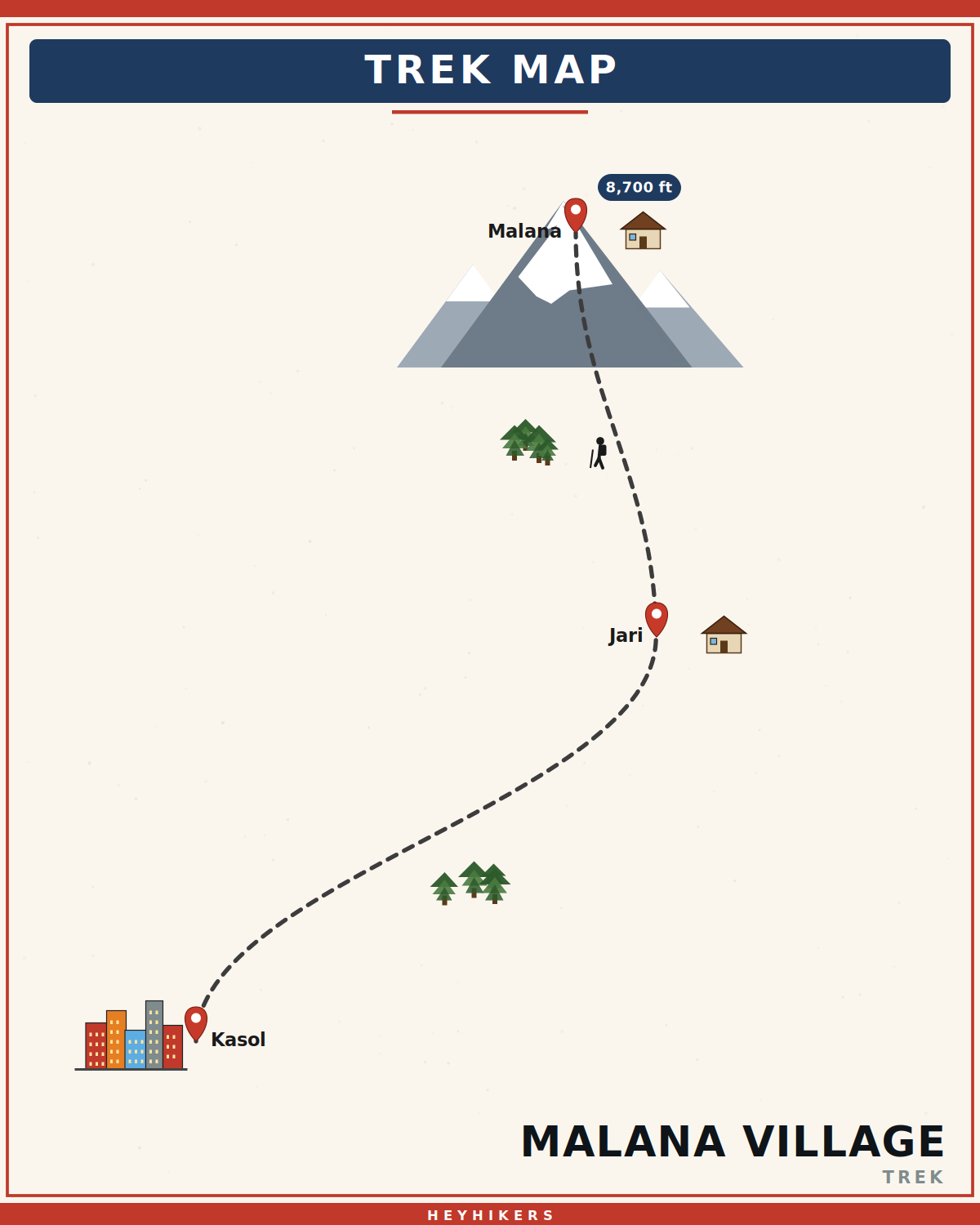
The trek begins at Jari (5,200 ft), a small village 25 km north of Kasol. Cross the bridge over the Malana nala and turn up its true left bank. The first kilometre is gentle through walnut orchards, then the trail steepens into switchbacks through deodar and silver oak. About halfway up the trail passes the entrance to the Malana Hydroelectric Power Station — the underground project that ironically brought modern roads close to the village. Above the power station the trail climbs through the gorge with the nala roaring 200 metres below, crosses a wooden bridge to the right bank, and ascends the final hour to the village terrace at 8,700 ft. Total elevation gain: 3,500 ft over 6 km — sharp but short.
The "Malana cream" controversy
Malana has become internationally known for its high-quality cannabis resin, which travels in backpacker circles as "Malana cream". Cannabis cultivation is technically illegal in Himachal but is the village's main cash crop, and the issue is contested between the state government (which periodically conducts eradication drives) and the village (which considers cannabis a traditional crop predating Indian independence). HeyHikers does not engage with this trade in any form; trekkers should be aware that buying or carrying cannabis is illegal under Indian law and can result in substantial penalties.
Best season
Malana is accessible April to early November. The best windows are May-June (warm days, occasional snow on the upper ridge) and September-October (post-monsoon clarity, cool weather, autumn colours). The village closes to outsiders during certain festival days (typically Dussehra and the Phagli festival in February); we plan our batches to avoid these. December-March sees heavy snow on the upper trail and the village goes into semi-hibernation.
Who this trek is for
Malana is short and the climb is doable for any reasonably fit trekker. The cultural intensity is the real challenge — outsiders must be willing to follow strict village rules, accept that they will be treated with polite distance, and understand that the experience is one of observation rather than immersion. This is not a trek for travellers who want photographs with locals or hands-on village experiences. It is the right pick for trekkers interested in anthropology, political philosophy, and the genuine strangeness of human cultural variation.
Itinerary
Map
What trekkers say
"I'd never camped in snow before. The HeyHikers team made me feel safe every single step. The summit sunrise — standing at 12,500 ft watching peaks turn gold — I cried. Not from the cold. From the beauty."
PS
Priya Sharma
Kedarkantha, Dec 2025
"Seven lakes, each more unreal than the last. The logistics were flawless — the food at 13,000 ft was better than most restaurants I know. Our guide Farooq knew every stone on the trail. Doing Goechala with them next."
AM
Arjun Mehta
Kashmir Great Lakes, Aug 2025
Inclusion
- All meals during the trek (vegetarian, freshly cooked)
- Camping gear — tents, sleeping bags, mats
- Certified trek leader and support guides
- Forest department permits and entry fees
- First-aid kit and supplemental oxygen
- Basecamp accommodation on twin/triple sharing
Exclusion
- Travel to and from the basecamp pickup point
- Personal trekking gear and clothing
- Travel insurance covering high-altitude trekking
- Tips, personal expenses, and meals during travel days
- Anything not explicitly listed under inclusions
Things to Carry
- Trekking shoes (high-ankle, broken-in)
- 40-50L backpack with rain cover
- Two pairs of trek pants
- Three full-sleeve t-shirts (synthetic, not cotton)
- Fleece jacket and a heavier down/insulated jacket
- Thermal innerwear (top + bottom)
- Waterproof outer shell (jacket + pants)
- Woollen cap, sun cap, balaclava
- Two pairs of warm gloves (inner liner + outer)
- UV-rated sunglasses
- Headlamp with spare batteries
- Reusable water bottles (2L total) or hydration bladder
- Personal medical kit and prescription medicines
- Sunscreen (SPF 50+) and lip balm
- Toiletries and quick-dry towel
- Original photo ID (mandatory at forest checkposts)
How to Reach
Reach Kasol via overnight Volvo from Delhi or fly to Bhuntar. From Kasol, our shared transport reaches Jari village in 30 minutes.
Safety & Security
- Acclimatize properly — never skip rest days at altitude.
- Drink at least 4 litres of water per day above 9,000 ft.
- Tell your trek leader immediately if you feel headache, nausea, or breathlessness — early AMS signs are treatable, ignored ones are not.
- Stay close to the group; do not take shortcuts off the marked trail.
- Avoid alcohol and smoking for the entire duration of the trek.
- Keep a buffer day for travel — Himalayan roads can close without notice.
- Carry travel insurance that explicitly covers high-altitude trekking and helicopter evacuation.
Cancellation Policy
Cancellations must be requested in writing.
- More than 30 days before the trek start date: 90% refund. - 21–30 days before: 50% refund. - 11–20 days before: 25% refund. - 10 days or fewer: no refund, but you may transfer your slot to another trekker or to any future batch within 12 months at no extra charge.
Refunds are processed to the original payment method within 7-10 working days. Trip cancellations triggered by us (weather, force majeure, government restrictions) are refunded in full or moved to an alternate batch at your option.
Meet your trek leader
Akhil Deruwan
NIM Uttarkashi certified · 9 yrs experience
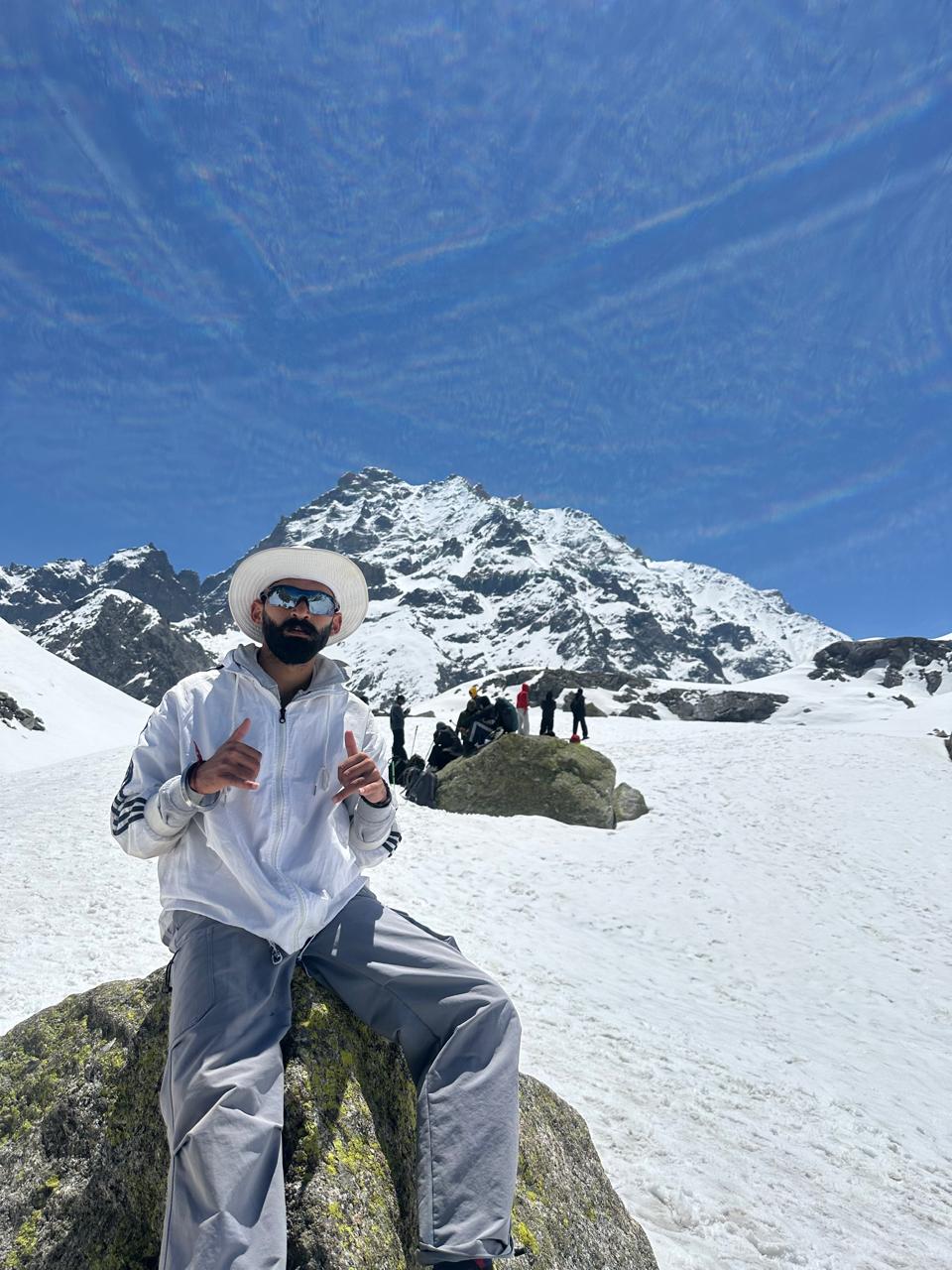
Akhil grew up in the foothills of the Garhwal Himalayas and has spent nearly a decade navigating its most demanding trails. He has led over 150 batches across Uttarakhand and Himachal Pradesh, with a strong focus on technical high-altitude routes and safety management. His calm under pressure and deep knowledge of local terrain make him a trusted leader for both beginner and advanced trekkers.
- Wilderness First Responder
- High Altitude Medicine
- Technical Route Navigation
- Search & Rescue
FAQ
Why Trek With Us
Travel Safe
Certified Team
Easy Cancellation
Well Equipped Campsite
Experienced Guide
No Hidden Charges