Overview
Pin Bhaba Pass — Kinnaur's Forests to Spiti's Cold Desert
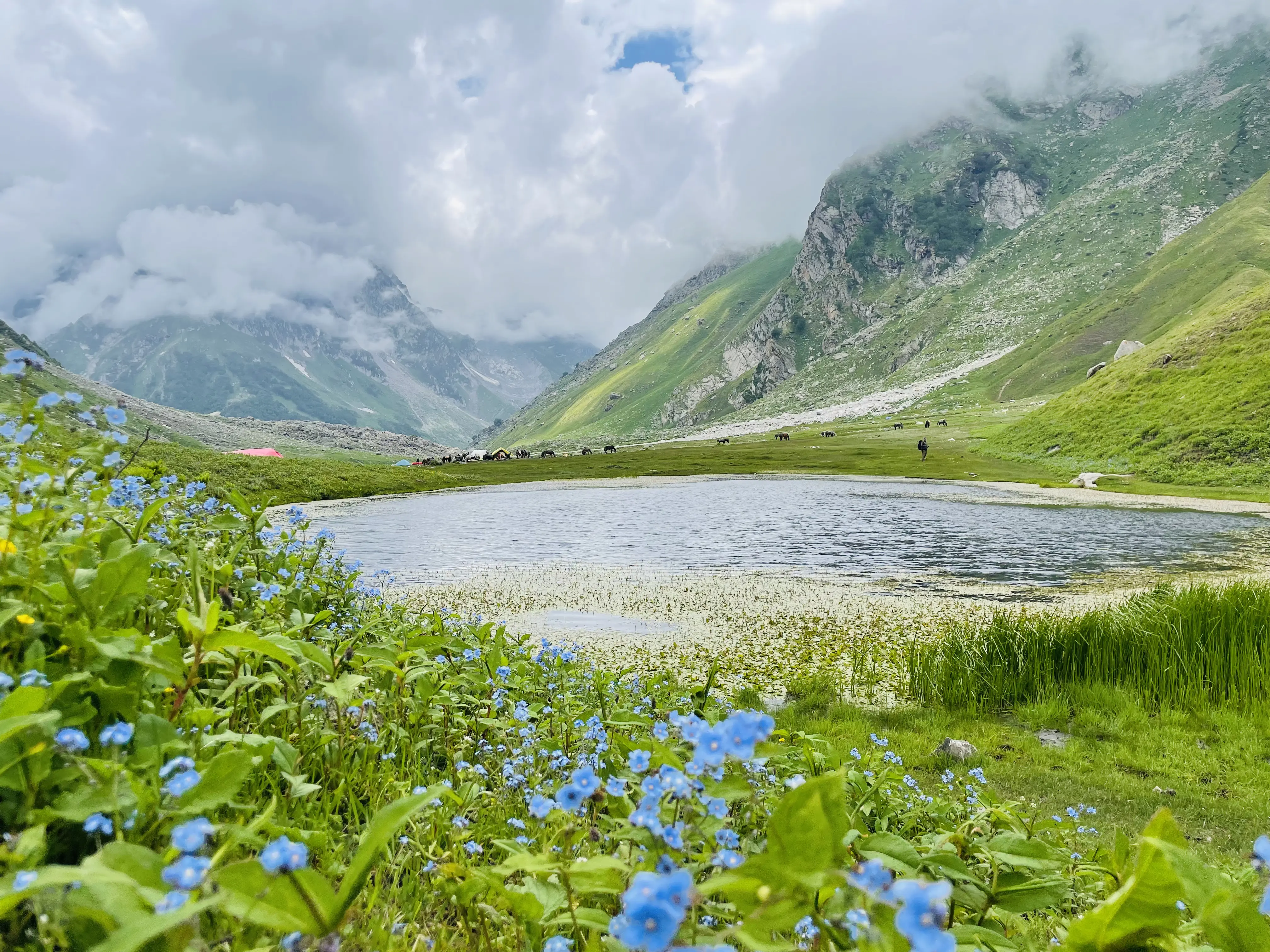
Pin Bhaba Pass at 16,105 ft (4,910 m) is the most beautiful, and arguably the most complete, crossover trek in the Indian Himalayas. Across eight days the trail walks you out of Kafnu village in Kinnaur, climbs through dense pine and silver birch forests beside the Bhaba river, traverses the wide alpine meadows of the Bhaba Valley, summits a 16,105 ft pass on the main Himalayan ridge, and descends into the bone-dry, treeless moonscape of Spiti, ending at the village of Mud (12,300 ft). The transition between the two sides — from monsoon-watered Kinnaur to rain-shadow Spiti — is the visual centrepiece of the trek and one of the great surprises in Indian mountain travel.
The geography of the crossing
Pin Bhaba is the gentler sibling of Pin Parvati Pass, both crossing the main Himalayan watershed but Pin Bhaba via a lower (16,105 vs 17,451 ft) and non-glaciated saddle. The Bhaba valley on the Kinnaur side is a classic U-shaped glacial trough, draining south into the Sutlej. The Pin valley on the Spiti side is a longer, drier, broader trough draining north into the Spiti river and ultimately into the Sutlej near Khab. The pass itself sits at the head of the Bhaba glacier, on the Indo-Tibetan watershed proper. The descent on the Spiti side passes through high yak pastures and the Pin Valley National Park — the only protected habitat of the elusive Himalayan ibex and snow leopard in the trans-Himalayan region.
The route from Kafnu
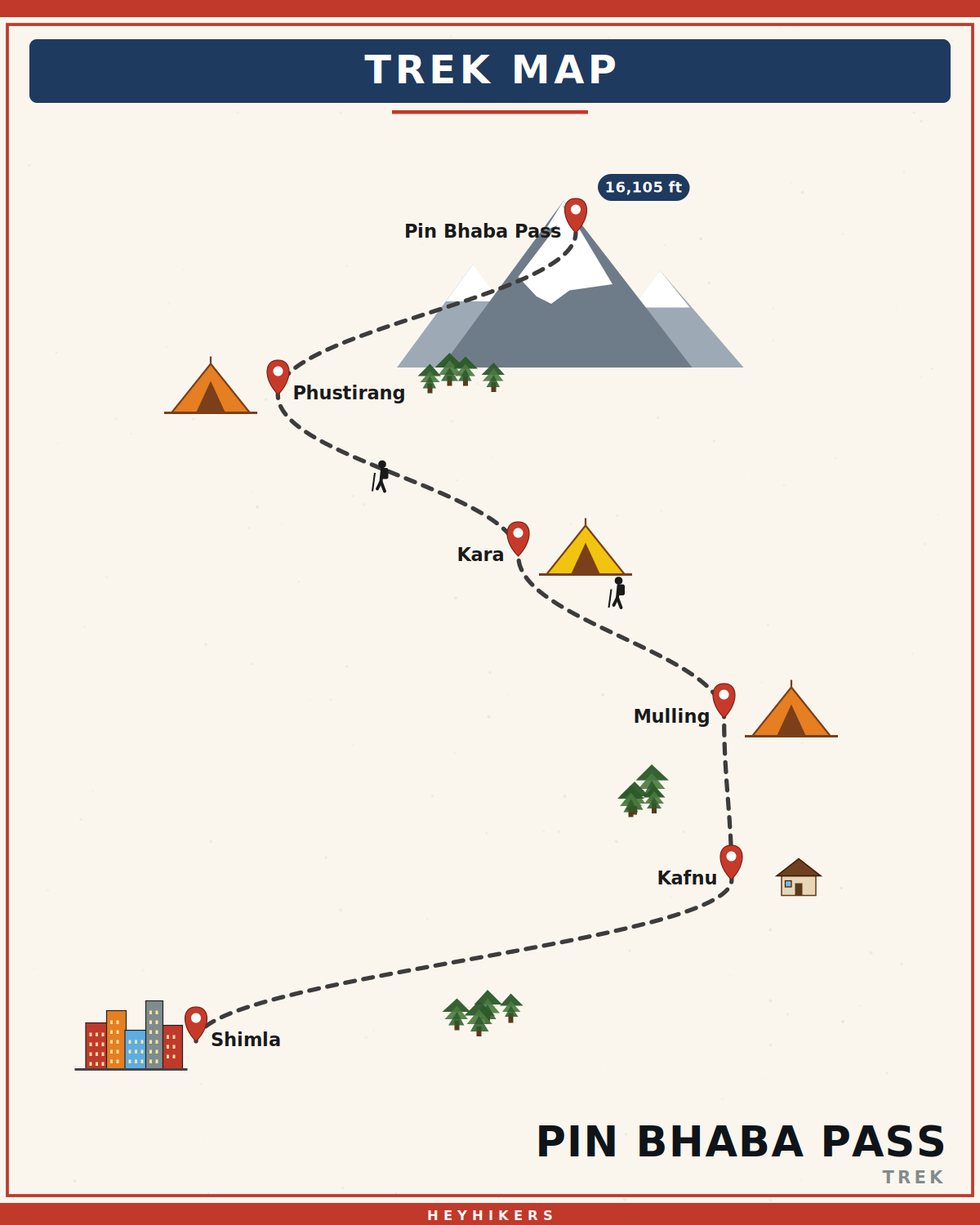
The trek begins at Kafnu (7,800 ft), a small Kinnauri village beside a hydroelectric reservoir, reached by a 10-hour drive from Shimla via Rampur and the Sutlej road. Day 2 climbs through dense pine and walnut forest along the Bhaba river to Mulling (10,800 ft), a riverside meadow camp with willow trees and a small shepherd hut. Day 3 traces the river upstream to Kara (12,400 ft), a wide meadow famous for its summer wildflowers — primula, geranium, and the elusive blue Himalayan poppy (Meconopsis aculeata). Day 4 is acclimatization at Kara. Day 5 climbs to Pushtirang (14,200 ft), the high alpine camp where the meadow gives way to moraine.
Pass day and the descent
Day 6 is summit day. A 3 AM start under headlamps, microspikes on, and a sustained four-hour climb up moraine-and-snow to the pass. The route is non-technical but the altitude and the sustained gradient make it the longest single day of the trek. The pass itself is a narrow saddle on a sub-ridge of the main Himalayan range, marked by cairns and a Tibetan prayer-flag array. From the top the view spans the Kinner Kailash range to the south, the Spiti basin opening to the north, and the white pyramids of the Bhabha and Pin glaciers on either side. The descent on the Spiti side is steep — a 1,500 ft snow-and-scree descent to Baldar (14,400 ft). Day 7 walks down the Pin valley to Mud village (12,300 ft), the first roadhead in Spiti. Day 8 drives back to Manali via Kaza, Kunzum Pass, and the Atal Tunnel.
Best season and weather
Pin Bhaba runs in a tight window: mid-July to mid-September. June still has too much snow on the Spiti side; mid-September onwards the weather window closes as winter storms arrive. The Kinnaur side gets monsoon rain (we hike in raincoats for Days 1-3); the Spiti side is in rain shadow and stays dry. Daytime temperatures range from 15°C in the lower Bhaba forests to -5°C at Pushtirang. The pass-day weather is closely tracked on satellite communicators; we may delay the crossing by a day if conditions warrant.
Camping and infrastructure
HeyHikers operates two-person tents, sleeping bags rated to -15°C, communal kitchen, and pit toilets at all five high camps. The Day 1 night is in a Kafnu homestay; the Day 7 night is in a Mud guesthouse. Mules carry load to Pushtirang; above that the gear is portered. Microspikes are issued at Kafnu; we provide ropes for safety on the pass-day descent. Mobile network ends at Kafnu and resumes only at Mud village.
Difficulty and prerequisites
Pin Bhaba is graded moderate-to-difficult. Required: prior experience of one Himalayan trek above 14,000 ft (Hampta, Roopkund, Goecha La, Bhrigu Lake qualify) and the ability to run 5 km in 30 minutes. Pass day is 10-12 hours and the cumulative ascent from Kara to the pass is 4,000 ft over two days. Trekkers with cardiac history or untreated hypertension should not attempt this trek. We require a fitness video and prior-trek certificates as part of enrolment.
Cultural and historical context
The Pin Bhaba route was a working trade corridor between the Kinnauri Hindu-Buddhist villages and the Spiti Tibetan-Buddhist monasteries until the 1962 Sino-Indian war disrupted regional trade. Mud village's Mud Gompa is one of the oldest in Spiti, dating to the 14th century and belonging to the Nyingma school of Tibetan Buddhism. The Pin Valley National Park, through which the descent runs, is one of only two designated snow-leopard habitats in the world that allows public foot access; sightings are rare but tracks and scat are commonly visible. The pass also marks the boundary of the Indian monsoon — a few hundred metres north of the saddle, you cross into the rain shadow and the vegetation changes within a single hour of walking.
Itinerary
Map
What trekkers say
"I'd never camped in snow before. The HeyHikers team made me feel safe every single step. The summit sunrise — standing at 12,500 ft watching peaks turn gold — I cried. Not from the cold. From the beauty."
PS
Priya Sharma
Kedarkantha, Dec 2025
"Seven lakes, each more unreal than the last. The logistics were flawless — the food at 13,000 ft was better than most restaurants I know. Our guide Farooq knew every stone on the trail. Doing Goechala with them next."
AM
Arjun Mehta
Kashmir Great Lakes, Aug 2025
Inclusion
- All meals during the trek (vegetarian, freshly cooked)
- Camping gear — tents, sleeping bags, mats
- Certified trek leader and support guides
- Forest department permits and entry fees
- First-aid kit and supplemental oxygen
- Basecamp accommodation on twin/triple sharing
Exclusion
- Travel to and from the basecamp pickup point
- Personal trekking gear and clothing
- Travel insurance covering high-altitude trekking
- Tips, personal expenses, and meals during travel days
- Anything not explicitly listed under inclusions
Things to Carry
- Trekking shoes (high-ankle, broken-in)
- 40-50L backpack with rain cover
- Two pairs of trek pants
- Three full-sleeve t-shirts (synthetic, not cotton)
- Fleece jacket and a heavier down/insulated jacket
- Thermal innerwear (top + bottom)
- Waterproof outer shell (jacket + pants)
- Woollen cap, sun cap, balaclava
- Two pairs of warm gloves (inner liner + outer)
- UV-rated sunglasses
- Headlamp with spare batteries
- Reusable water bottles (2L total) or hydration bladder
- Personal medical kit and prescription medicines
- Sunscreen (SPF 50+) and lip balm
- Toiletries and quick-dry towel
- Original photo ID (mandatory at forest checkposts)
How to Reach
Reach Shimla via overnight Volvo from Delhi. Our shared transport leaves at 6:00 AM on Day 1 and reaches Kafnu village in 10 hours via Rampur and the Sutlej road.
Safety & Security
- Acclimatize properly — never skip rest days at altitude.
- Drink at least 4 litres of water per day above 9,000 ft.
- Tell your trek leader immediately if you feel headache, nausea, or breathlessness — early AMS signs are treatable, ignored ones are not.
- Stay close to the group; do not take shortcuts off the marked trail.
- Avoid alcohol and smoking for the entire duration of the trek.
- Keep a buffer day for travel — Himalayan roads can close without notice.
- Carry travel insurance that explicitly covers high-altitude trekking and helicopter evacuation.
Cancellation Policy
Cancellations must be requested in writing.
- More than 30 days before the trek start date: 90% refund. - 21–30 days before: 50% refund. - 11–20 days before: 25% refund. - 10 days or fewer: no refund, but you may transfer your slot to another trekker or to any future batch within 12 months at no extra charge.
Refunds are processed to the original payment method within 7-10 working days. Trip cancellations triggered by us (weather, force majeure, government restrictions) are refunded in full or moved to an alternate batch at your option.
Meet your trek leader
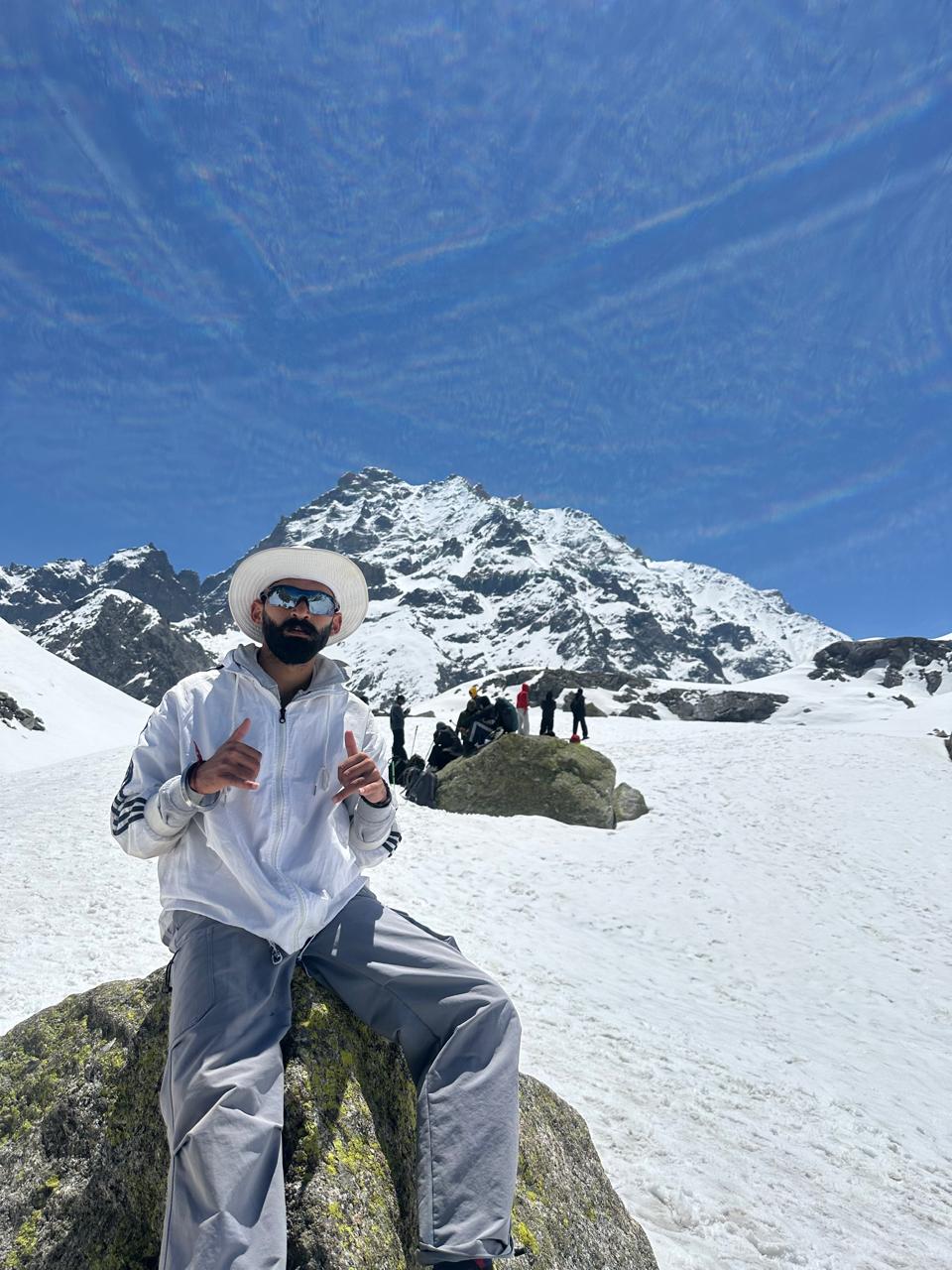
Akhil Deruwan
NIM Uttarkashi certified · 9 yrs experience
Akhil grew up in the foothills of the Garhwal Himalayas and has spent nearly a decade navigating its most demanding trails. He has led over 150 batches across Uttarakhand and Himachal Pradesh, with a strong focus on technical high-altitude routes and safety management. His calm under pressure and deep knowledge of local terrain make him a trusted leader for both beginner and advanced trekkers.
- Wilderness First Responder
- High Altitude Medicine
- Technical Route Navigation
- Search & Rescue
FAQ
Why Trek With Us
Travel Safe
Certified Team
Easy Cancellation
Well Equipped Campsite
Experienced Guide
No Hidden Charges