Overview
Pin Parvati Pass — From Kullu's Forests to Spiti's Cold Desert
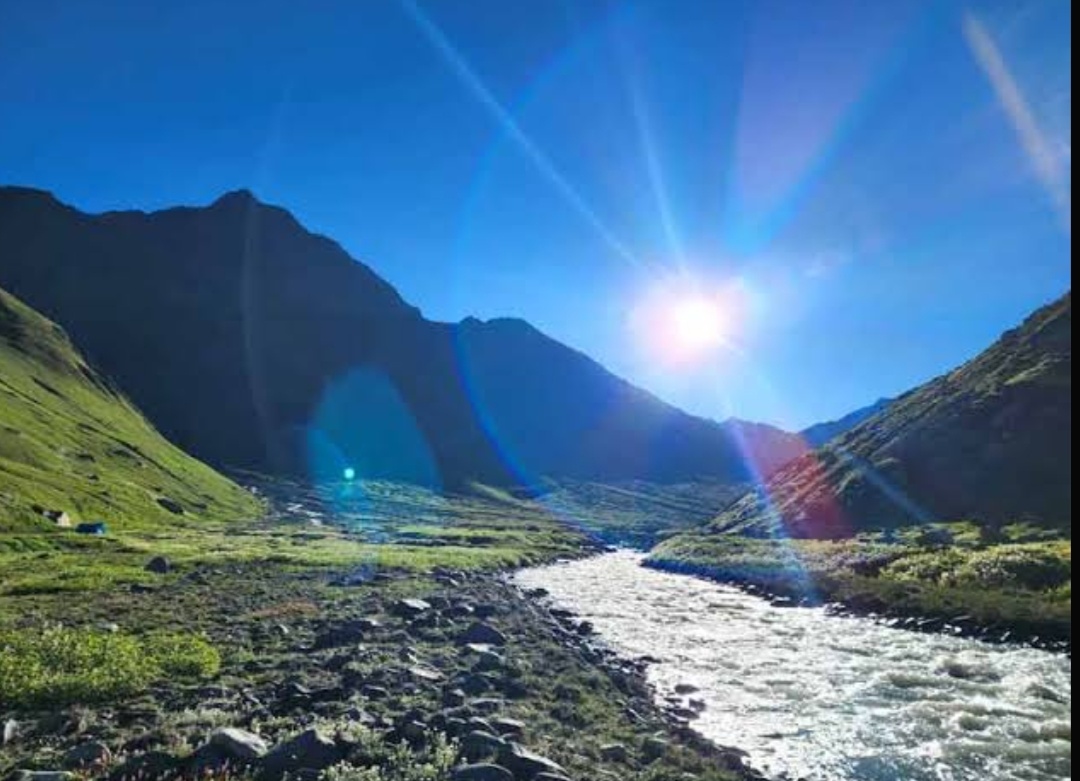
Pin Parvati Pass is the most demanding crossover trek in the Indian Himalayas. Across eleven days and roughly 110 kilometres, you walk from the dripping pine forests of Kullu's Parvati valley over a 17,451 ft pass and down into the bone-dry, treeless moonscape of Spiti — a transition between two completely different climates, cultures, and ecosystems. It was first crossed in modern recorded form by Sir Louis Dane in 1884, and earlier still by traders carrying salt from Tibet to the plains. Today it remains a serious mountaineering trek, technical at points, with no escape route once you commit to the upper Parvati glacier.
Why this trek is unique
Most Himalayan treks happen on one side of the main range or the other — Pin Parvati is one of the very few that takes you across. On the south side you have the lush, monsoon-watered Parvati valley with its hot springs, dense forests, and Hindu pilgrimage tradition; on the north side you have Spiti, a Tibetan-Buddhist district that gets less rainfall than the Sahara. The pass itself sits on the main Himalayan ridge, dividing two worlds. To watch the desert open up below you on the descent — terraced barley fields, mud-brick monasteries, prayer flags — is one of the most striking transitions in trekking.
The Parvati valley approach
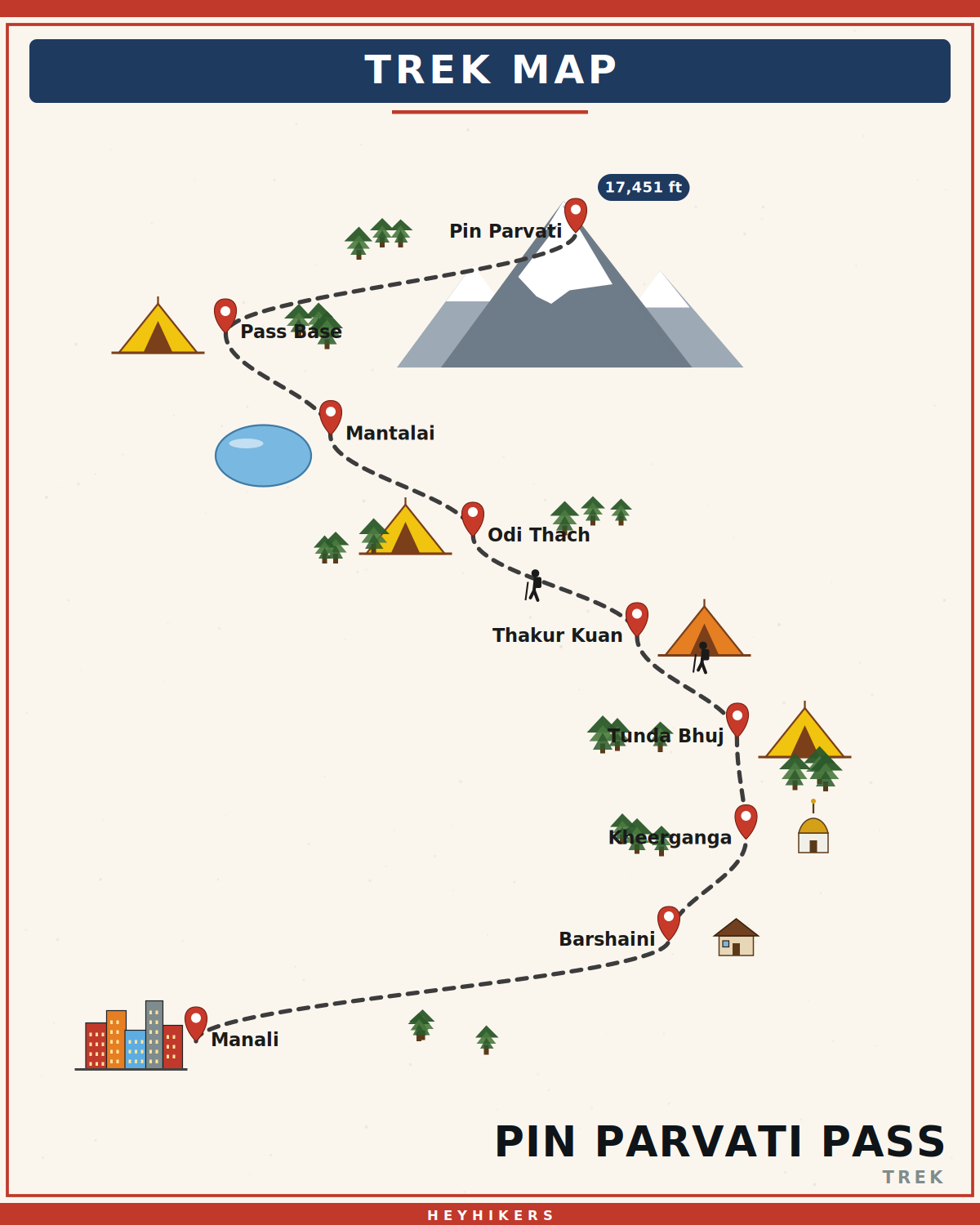
The trek begins at Barshaini (7,500 ft), where the road ends and the foot trail begins. Day 2 takes you to Kheerganga (9,700 ft), a famous hot spring complex sacred to Lord Shiva — Hindu legend places this as the spot where Shiva meditated for 3,000 years. Three more days follow the Parvati river upstream through Tunda Bhuj, Thakur Kuan, and Odi Thach. Several sections require wire-and-pulley river crossings over the violent Parvati — this is the only trek in India where this is part of the standard route. By Day 6 you reach Mantalai Lake (13,500 ft), the source of the Parvati river. According to Hindu mythology, this is where Lord Shiva and Parvati were married; pilgrims still come here in summer. The lake is a vast, glassy basin surrounded by 18,000 ft peaks.
The pass crossing
From Mantalai you have one acclimatization day before the move onto the upper Parvati glacier. Day 8 takes you to Pass Base Camp at 16,000 ft — a moraine pocket on the glacier where weather forecasts are checked obsessively. Day 9 is summit day: a 3 AM start, four hours of glacier travel roped up against crevasses, and the final 200-metre snow climb to the pass. The descent on the Spiti side is steeper than the ascent — a 600-metre drop on snow before reaching the Vasuki glacier moraine. Total walking time on pass day is typically 12-14 hours.
Down to Mud village
From Vasuki the trek continues two more days through the upper Pin valley — past Tibetan Buddhist gompas, mani walls (prayer-stone walls), and yak pastures — before reaching Mud village (12,300 ft), the first roadhead in Spiti. The drive back to Manali is a separate adventure: a long day over Kunzum Pass (15,059 ft) and Rohtang Pass (13,058 ft), through the Lahaul valley, often via the Atal Tunnel.
Difficulty and prerequisites
Pin Parvati is a graded difficult trek — we only enrol trekkers who have completed at least one trek above 16,000 ft (Stok Kangri, Friendship Peak, Auden's Col, etc.) and can demonstrate cardiovascular fitness equivalent to running 8 km in 40 minutes. The trek requires basic mountaineering skills (rope work, ice axe arrest, crampon use) which we cover in a Day-1 briefing. Prior glacier experience is strongly preferred. Anyone with a history of pulmonary issues, untreated hypertension, or knee instability should not attempt this trek.
Best season and weather
The pass is only crossable in July, August, and the first ten days of September. June still has too much snow on the Spiti side; mid-September onwards the weather window closes as the first winter storms arrive. The Parvati side gets monsoon rain (we hike in raincoats for several days); the Spiti side is in rain shadow and stays dry. Daytime temperatures range from 10°C in the lower forests to -10°C at pass base camp. We track weather windows carefully and may delay the pass crossing by a day if conditions warrant.
What you carry, what we carry
HeyHikers provides tents, sleeping bags rated to -15°C, kitchen, fixed ropes for the pass, harnesses, helmets, and high-altitude porters who carry the group gear. You carry your daypack with personal items (water, snacks, layers, camera) — typically 5-7 kg. Personal trekking poles, microspikes, and gaiters are mandatory; we can rent these at Manali if you don't own them. Crampons are issued for the pass day only and returned at Mud.
Cultural and historical context
The Pin Parvati route was a working trade corridor for centuries. Tibetan salt, wool, and dried meat moved south; Indian grains, tea, and tobacco moved north. The route was also a pilgrim trail — Mantalai Lake remains an active Hindu pilgrimage site, and Mud village's monastery is one of the oldest in Spiti. You'll pass abandoned shepherd camps, the ruins of trade-era shelters, and prayer flag arrays at every pass and ridge. This is not a wilderness trek in the Western sense — it's a corridor walked by humans for at least a thousand years.
Itinerary
Map
What trekkers say
"I'd never camped in snow before. The HeyHikers team made me feel safe every single step. The summit sunrise — standing at 12,500 ft watching peaks turn gold — I cried. Not from the cold. From the beauty."
PS
Priya Sharma
Kedarkantha, Dec 2025
"Seven lakes, each more unreal than the last. The logistics were flawless — the food at 13,000 ft was better than most restaurants I know. Our guide Farooq knew every stone on the trail. Doing Goechala with them next."
AM
Arjun Mehta
Kashmir Great Lakes, Aug 2025
Inclusion
- All meals during the trek (vegetarian, freshly cooked)
- Camping gear — tents, sleeping bags, mats
- Certified trek leader and support guides
- Forest department permits and entry fees
- First-aid kit and supplemental oxygen
- Basecamp accommodation on twin/triple sharing
Exclusion
- Travel to and from the basecamp pickup point
- Personal trekking gear and clothing
- Travel insurance covering high-altitude trekking
- Tips, personal expenses, and meals during travel days
- Anything not explicitly listed under inclusions
Things to Carry
- Trekking shoes (high-ankle, broken-in)
- 40-50L backpack with rain cover
- Two pairs of trek pants
- Three full-sleeve t-shirts (synthetic, not cotton)
- Fleece jacket and a heavier down/insulated jacket
- Thermal innerwear (top + bottom)
- Waterproof outer shell (jacket + pants)
- Woollen cap, sun cap, balaclava
- Two pairs of warm gloves (inner liner + outer)
- UV-rated sunglasses
- Headlamp with spare batteries
- Reusable water bottles (2L total) or hydration bladder
- Personal medical kit and prescription medicines
- Sunscreen (SPF 50+) and lip balm
- Toiletries and quick-dry towel
- Original photo ID (mandatory at forest checkposts)
How to Reach
Reach Manali via overnight Volvo from Delhi (12 hours, multiple departures). The trek begins from Barshaini (5 hours from Manali) and ends in Mud village in Spiti, from where we drive back to Manali via Kunzum and Rohtang.
Safety & Security
- Acclimatize properly — never skip rest days at altitude.
- Drink at least 4 litres of water per day above 9,000 ft.
- Tell your trek leader immediately if you feel headache, nausea, or breathlessness — early AMS signs are treatable, ignored ones are not.
- Stay close to the group; do not take shortcuts off the marked trail.
- Avoid alcohol and smoking for the entire duration of the trek.
- Keep a buffer day for travel — Himalayan roads can close without notice.
- Carry travel insurance that explicitly covers high-altitude trekking and helicopter evacuation.
Cancellation Policy
Cancellations must be requested in writing.
- More than 30 days before the trek start date: 90% refund. - 21–30 days before: 50% refund. - 11–20 days before: 25% refund. - 10 days or fewer: no refund, but you may transfer your slot to another trekker or to any future batch within 12 months at no extra charge.
Refunds are processed to the original payment method within 7-10 working days. Trip cancellations triggered by us (weather, force majeure, government restrictions) are refunded in full or moved to an alternate batch at your option.
Meet your trek leader
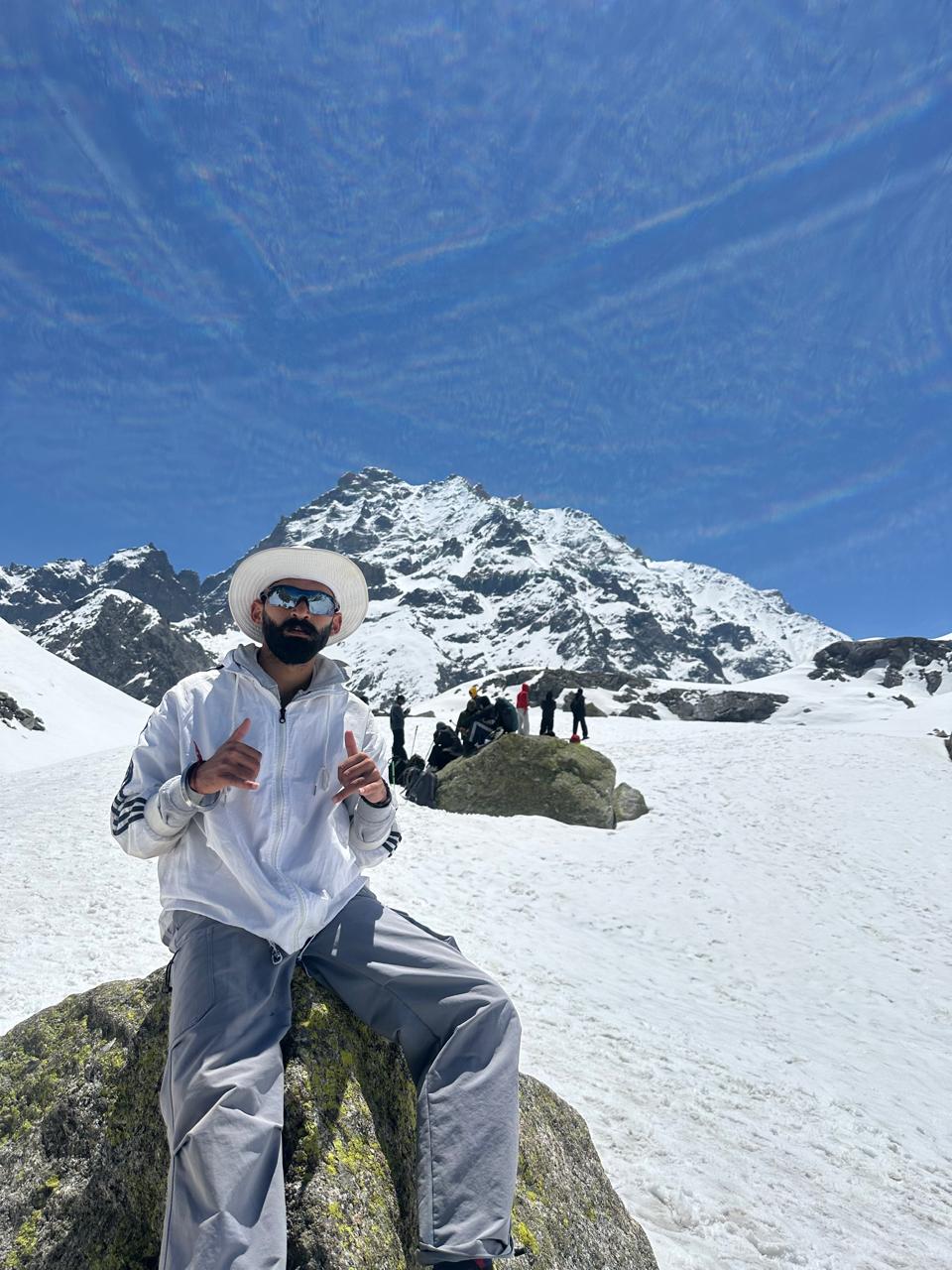
Akhil Deruwan
NIM Uttarkashi certified · 9 yrs experience
Akhil grew up in the foothills of the Garhwal Himalayas and has spent nearly a decade navigating its most demanding trails. He has led over 150 batches across Uttarakhand and Himachal Pradesh, with a strong focus on technical high-altitude routes and safety management. His calm under pressure and deep knowledge of local terrain make him a trusted leader for both beginner and advanced trekkers.
- Wilderness First Responder
- High Altitude Medicine
- Technical Route Navigation
- Search & Rescue
FAQ
Why Trek With Us
Travel Safe
Certified Team
Easy Cancellation
Well Equipped Campsite
Experienced Guide
No Hidden Charges