Overview
Tosh Valley — Apple Orchards, Israeli Cafes, and the Tosh Glacier
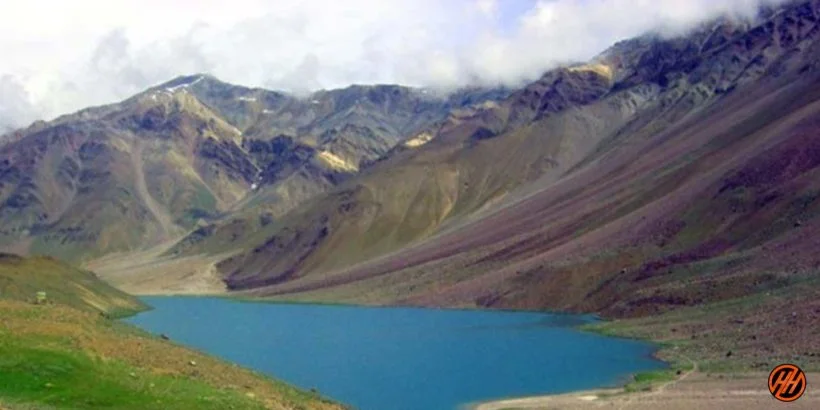
The Tosh Valley trek is the quietest of the three classic Parvati-valley short treks — gentler than Sar Pass, less crowded than Kheerganga, and arguably more beautiful than either. Across three relaxed days you walk from Kasol (5,250 ft) to the village of Tosh and on up to the Buddhaban meadow at 12,000 ft (3,660 m), beneath the south face of the Tosh glacier. The trek is a study in scale: from apple orchards and German bakeries at the start, through silver birch and shepherd huts in the middle, to the white wall of unnamed 18,000 ft peaks at the top.
The geography of the Tosh nala
The Tosh nala is the largest tributary of the Parvati and drains a fan of glaciers on the south side of the main Parvati range — the Tosh glacier, which gives the valley its name, descends from a rim of unnamed peaks to around 13,000 ft. The valley is U-shaped (a classic glacial trough), with the Tosh village sitting on a high terrace on the eastern bank near the confluence with the Parvati. Above the village the valley narrows briefly through a forested gorge, then opens into a series of high meadows — Bakhrethach, then Buddhaban — that are the summer pastures for Gaddi shepherds from the lower Bara Bhangal valley.
The route from Kasol
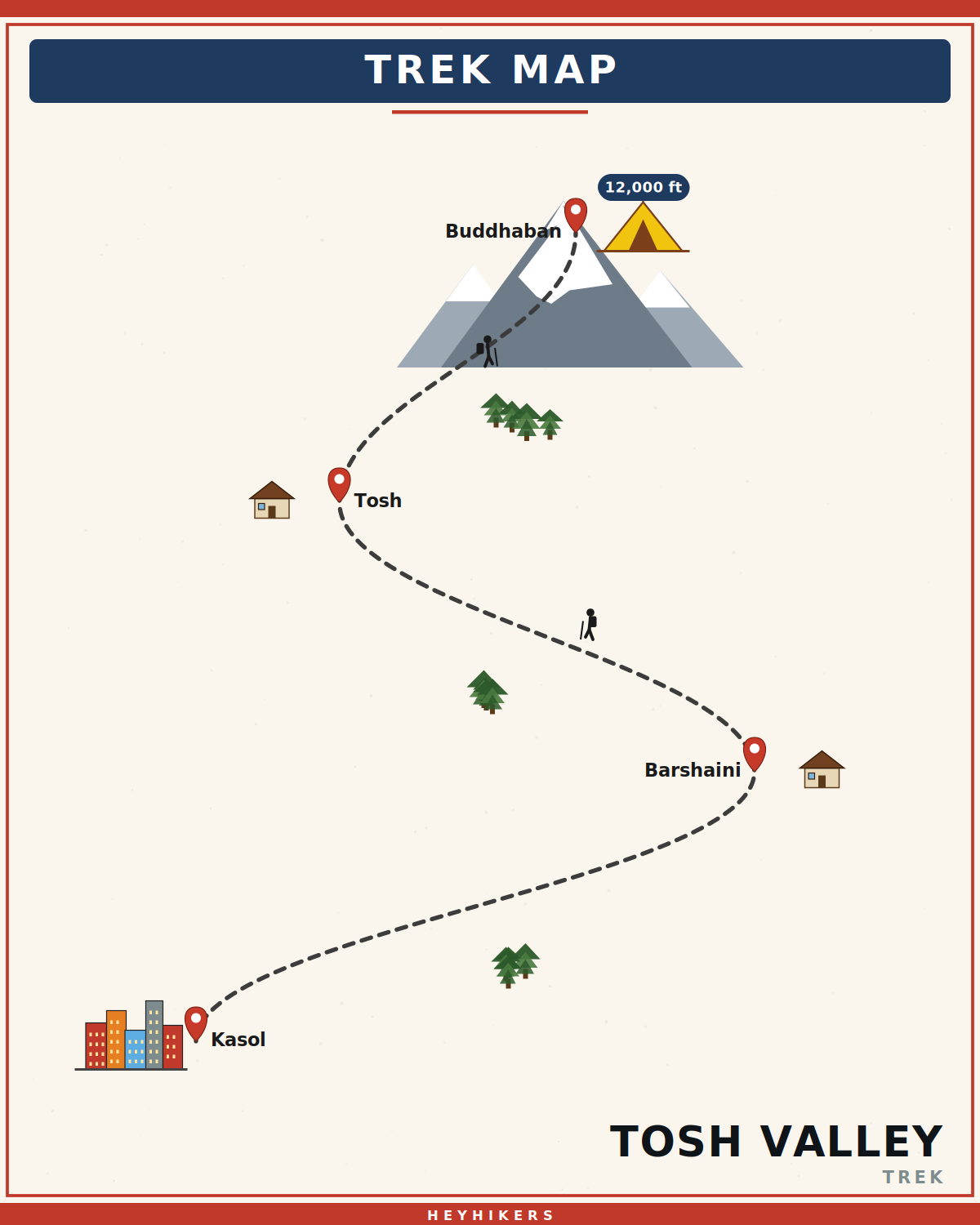
The trek begins with a 30-minute drive from Kasol to Barshaini (7,500 ft), the road head where the trails to Sar Pass, Kheerganga, and Tosh all diverge. From Barshaini we walk the final 3 km up the village road to Tosh village (7,800 ft), gaining altitude through apple orchards and walnut trees. We overnight in a homestay or guesthouse in the upper village. Day 2 is the proper trekking day — a 12 km round-trip up the eastern bank of the Tosh nala through pine, walnut, and silver birch to Bakhrethach (9,500 ft, "goat meadow"), and on through old-growth birch to the Buddhaban meadow at 12,000 ft. The view from Buddhaban is the defining moment of the trek: the Tosh glacier directly above, the white wall of Papsura (21,165 ft) and Dharamsura (21,148 ft, sometimes called White Sail) visible to the east on clear days, and the Parvati valley stretching south behind you.
The village of Tosh
Tosh is unique among Parvati villages — it has shifted from a sleepy shepherd settlement to one of the valley's most popular long-stay backpacker destinations in the last fifteen years, but the upper village (where we stay) retains its slate-roofed wooden architecture and old social order. Tosh has its own village deity (Jamlu, shared with Malana) and its own annual fair in late summer. The lower village now has a string of cafes — Pink Floyd, Buddha Place, Stone Garden — that have made Tosh famous in backpacker circles, but the trek deliberately stays above this strip.
Best season
Tosh Valley runs from late April to mid-November, with the prime windows being May-June (apple blossoms, mild weather) and September-October (post-monsoon clarity, autumn colours, golden grass on the meadows). July-August is monsoon — the upper trail becomes slippery and views are usually clouded, though the meadow is at its lushest. November-March sees deep snow above 9,000 ft and the trek is generally not run in winter. The Buddhaban view is best in late September when the air is cleanest and the unnamed peaks are visible without haze.
Camping and infrastructure
This is one of the few HeyHikers treks where Day 1 and Day 3 are spent in homestays rather than tents — Tosh has a number of family-run guesthouses with hot showers, basic but clean beds, and traditional Himachali kitchens. The Day 2 day-hike to Buddhaban is a packed-lunch affair; we don't camp at the meadow. This makes the Tosh Valley trek the most comfortable of the three Parvati shorts: warm beds at night, hot showers, and home-cooked siddu (steamed wheat dumplings) and dal-chawal at dinner.
Who this trek is for
Tosh Valley is genuinely beginner-friendly — it has the lowest cumulative climbing of the Parvati shorts and the homestay-based logistics make it accessible to trekkers who don't want a tented camp. Families with children eight and above, older trekkers, and people coming off injury all do this trek successfully. The Day 2 climb to Buddhaban is the hardest section (4,200 ft round-trip) but is on a well-graded trail. We recommend this trek as a soft introduction to the Himalayas — a single demanding day, a beautiful destination, and warm hospitality at both ends.
Cultural context
The Gaddi shepherds who use the Tosh meadows in summer come from the Bara Bhangal and Chamba valleys, walking their flocks (sheep, goats, and a few cows) over high passes each June and back in late September. They live in stone enclosures called dogris on the meadows for three months, churning butter, weaving wool, and making cheese. The shepherd economy is centuries old and largely unchanged; meeting a Gaddi family on the meadow is one of the unexpected highlights of this trek.
Itinerary
Map
What trekkers say
"I'd never camped in snow before. The HeyHikers team made me feel safe every single step. The summit sunrise — standing at 12,500 ft watching peaks turn gold — I cried. Not from the cold. From the beauty."
PS
Priya Sharma
Kedarkantha, Dec 2025
"Seven lakes, each more unreal than the last. The logistics were flawless — the food at 13,000 ft was better than most restaurants I know. Our guide Farooq knew every stone on the trail. Doing Goechala with them next."
AM
Arjun Mehta
Kashmir Great Lakes, Aug 2025
Inclusion
- All meals during the trek (vegetarian, freshly cooked)
- Camping gear — tents, sleeping bags, mats
- Certified trek leader and support guides
- Forest department permits and entry fees
- First-aid kit and supplemental oxygen
- Basecamp accommodation on twin/triple sharing
Exclusion
- Travel to and from the basecamp pickup point
- Personal trekking gear and clothing
- Travel insurance covering high-altitude trekking
- Tips, personal expenses, and meals during travel days
- Anything not explicitly listed under inclusions
Things to Carry
- Trekking shoes (high-ankle, broken-in)
- 40-50L backpack with rain cover
- Two pairs of trek pants
- Three full-sleeve t-shirts (synthetic, not cotton)
- Fleece jacket and a heavier down/insulated jacket
- Thermal innerwear (top + bottom)
- Waterproof outer shell (jacket + pants)
- Woollen cap, sun cap, balaclava
- Two pairs of warm gloves (inner liner + outer)
- UV-rated sunglasses
- Headlamp with spare batteries
- Reusable water bottles (2L total) or hydration bladder
- Personal medical kit and prescription medicines
- Sunscreen (SPF 50+) and lip balm
- Toiletries and quick-dry towel
- Original photo ID (mandatory at forest checkposts)
How to Reach
Reach Kasol via overnight Volvo from Delhi (14 hours) or fly to Bhuntar. From Kasol, our transport reaches Tosh village in 1 hour via Barshaini.
Safety & Security
- Acclimatize properly — never skip rest days at altitude.
- Drink at least 4 litres of water per day above 9,000 ft.
- Tell your trek leader immediately if you feel headache, nausea, or breathlessness — early AMS signs are treatable, ignored ones are not.
- Stay close to the group; do not take shortcuts off the marked trail.
- Avoid alcohol and smoking for the entire duration of the trek.
- Keep a buffer day for travel — Himalayan roads can close without notice.
- Carry travel insurance that explicitly covers high-altitude trekking and helicopter evacuation.
Cancellation Policy
Cancellations must be requested in writing.
- More than 30 days before the trek start date: 90% refund. - 21–30 days before: 50% refund. - 11–20 days before: 25% refund. - 10 days or fewer: no refund, but you may transfer your slot to another trekker or to any future batch within 12 months at no extra charge.
Refunds are processed to the original payment method within 7-10 working days. Trip cancellations triggered by us (weather, force majeure, government restrictions) are refunded in full or moved to an alternate batch at your option.
Meet your trek leader
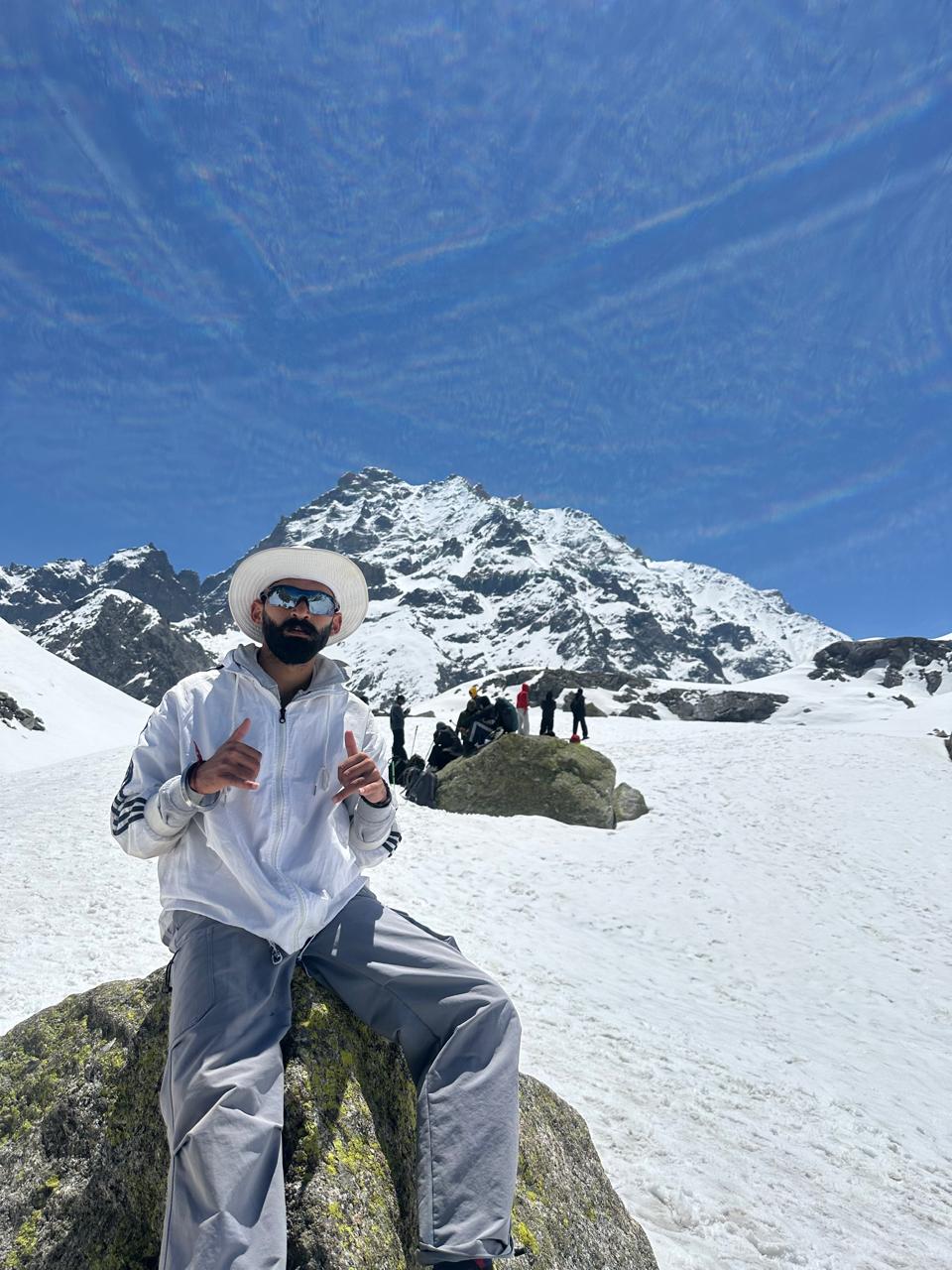
Akhil Deruwan
NIM Uttarkashi certified · 9 yrs experience
Akhil grew up in the foothills of the Garhwal Himalayas and has spent nearly a decade navigating its most demanding trails. He has led over 150 batches across Uttarakhand and Himachal Pradesh, with a strong focus on technical high-altitude routes and safety management. His calm under pressure and deep knowledge of local terrain make him a trusted leader for both beginner and advanced trekkers.
- Wilderness First Responder
- High Altitude Medicine
- Technical Route Navigation
- Search & Rescue
FAQ
Why Trek With Us
Travel Safe
Certified Team
Easy Cancellation
Well Equipped Campsite
Experienced Guide
No Hidden Charges