Overview
Yulla Kanda — Kinnaur's Hidden Sacred Lake
Yulla Kanda at 14,107 ft (4,300 m) is one of the lesser-known sacred lakes of the Indian Himalayas — a small green-blue alpine pool tucked into the meadow bowl below the Yulla Kanda peak in Kinnaur, Himachal Pradesh. The lake is venerated by the Kinnauri community as the home of their guardian deity, and the small Pangi village at the trailhead worships it with an annual fair (called Phulaich, "the festival of flowers") every September, when villagers carry offerings of butter, wheat, and seasonal flowers up to the shore. Unlike better-known sacred lakes like Manimahesh or Hemkund, Yulla Kanda sees fewer than two hundred non-local visitors a year, and the trail remains essentially a working pilgrim route used by Kinnauri shepherds and seasonal devotees.
Why this trek is unique
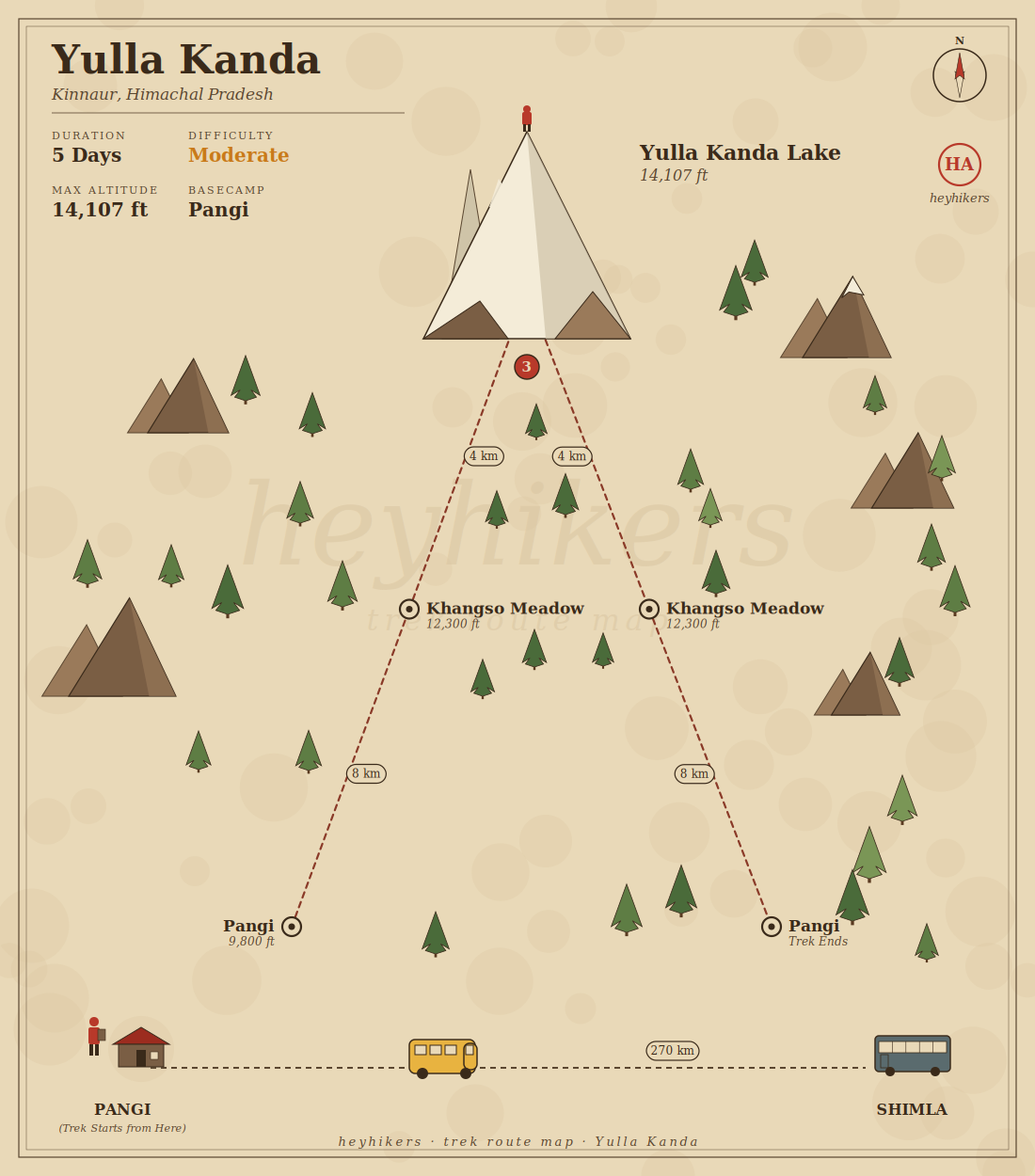
Yulla Kanda is a short, steep, rural Kinnaur trek with a lake-and-meadow finale and a strong sense of place. The trail starts in Pangi village at 8,200 ft — a Kinnauri settlement of slate-roofed houses, apple-and-pear orchards, and a 16th-century wooden temple to the local deity — and climbs through deodar and Bhojpatra (Himalayan birch) forest in a single sustained day to a meadow camp at Khangso (12,300 ft). From Khangso the lake is a 4 km grass-and-scree walk gaining 1,800 ft. The trek is short by Indian Himalayan standards (4 days on trail, 5 with the drive day) but the elevation gain rate is steep — the Pangi-to-Khangso climb is 4,100 ft in 6 km, which is among the steepest single-day climbs in our Himachal portfolio.
The route from Pangi
The drive into Pangi is the longest part of the trek — 295 km from Shimla via Narkanda, Rampur, Reckong Peo, and Karchham, taking 11-12 hours one way. Pangi (8,200 ft) sits on a steep shelf above the Sutlej-Baspa confluence at Karchham; the Kinnauri name refers to the small Pangi nala that drains the Yulla Kanda lake. Day 2 climbs through the village's upper apple orchards and into deodar forest, crosses a wooden bridge over the Pangi nala, and emerges into Bhojpatra forest before reaching the meadow camp at Khangso. Day 3 is the lake day: a 4 km morning push to the lake at 14,107 ft, an hour at the shore for darshan and photographs, and a return to Khangso. Day 4 descends to Pangi; Day 5 is the long drive back to Shimla.
What you'll see at the lake
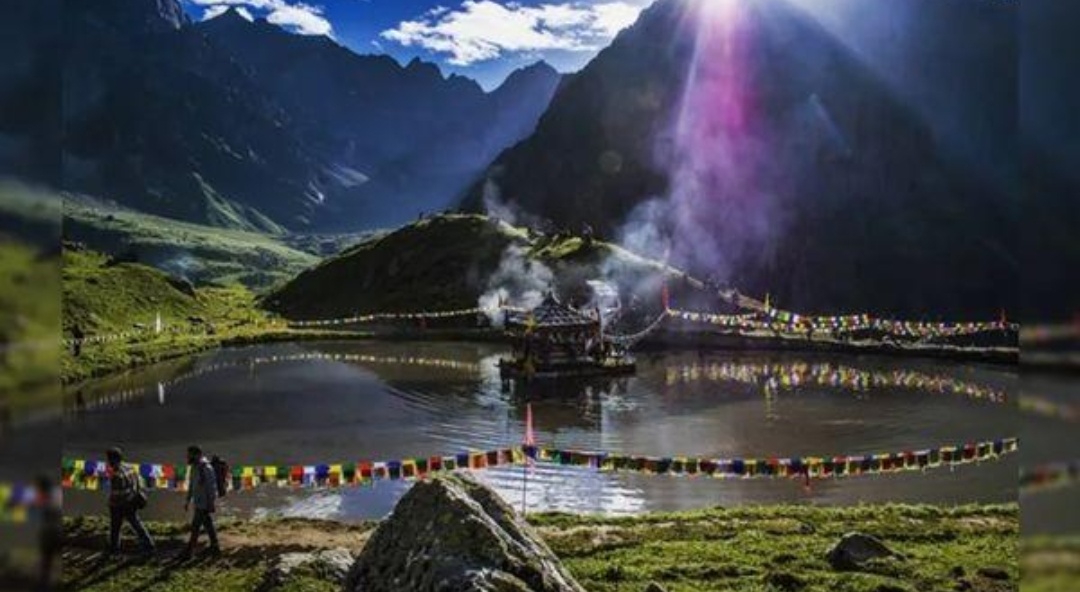
The lake itself is a small green-blue pool roughly 80 metres across, ringed by grass and broken scree. The shore holds a small stone shrine to Yulla Kanda Devta with a brass trishul, prayer flags, and a stone-built fire pit used during the September Phulaich fair. The peak of Yulla Kanda (16,400 ft) rises directly above the lake to the south as a clean rock-and-snow pyramid. To the north, the Pin valley range is visible across the Sutlej gorge with the snow-capped Kinner Kailash (19,850 ft) dominating the southern horizon — locally considered the seat of Lord Shiva, with a 79 ft natural rock lingam visible from the Sangla valley.
Best time to trek
The standard windows are mid-May to early July (post-snow, wildflower bloom, longest daylight) and early September to mid-October (post-monsoon clarity, the Phulaich festival window in September, autumn forest colour). We avoid July-August (monsoon — Kinnaur is not as rain-shadowed as Spiti and the foot trail above Pangi becomes a wet mud slip) and the October-end onwards winter window (snow seals the upper meadow). The single best month is September — clear skies, the village festival, and the chance to attend the local Phulaich procession if dates align.
Camping and infrastructure
Pangi has two homestays we work with — both run by Kinnauri families with deep ties to the deity temple and the village fair. Rooms are simple but clean, with hot bucket water, twin-sharing beds, and a wood-fired kitchen serving Kinnauri specialties (siddu, chha gosht, chilgoza chutney). At Khangso we operate a self-contained campsite with two-person tents, sleeping bags rated to -10°C, foam mattresses, and a kitchen tent producing hot vegetarian meals. Toilets are pit-style with a portable enclosure. Mobile network is BSNL-only above Pangi (Jio works in the village).
Difficulty and prerequisites
Yulla Kanda is a graded moderate trek with one specific demand: the Day 2 climb is a sustained 4,100 ft gain in 6 km, which is steeper than most moderate treks. We require a six-week fitness base of 5 km jogs three times a week, or equivalent stair-climbing. First-time trekkers manage well with this base. Children above 12 with prior hiking experience regularly complete the trek. Anyone with significant knee issues should bring trekking poles for the steep descent. Altitude exposure (12,300 ft sleep, 14,107 ft daytime) is mild and AMS is rare; we run pulse oximetry at Khangso evening and again before the lake walk.
Cultural and religious context
Yulla Kanda Devta is the principal village deity of Pangi and is one of the senior deities of the Kinnauri pantheon — the deity travels in palanquin form (rath) to nearby villages during festivals and is consulted for community decisions through an oracular medium (gur). The annual Phulaich festival in September is the most important local event: villagers gather seasonal flowers from the meadows around Khangso, carry them in procession up to the lake, and offer them at the shrine. Outside trekkers are welcome to observe respectfully but should avoid photography of the procession itself. The temple in Pangi village (built in the 16th century, with carved deodar pillars and a slate roof) is closed to non-Kinnauris during certain ritual periods; check with the village pradhan before entering.
Itinerary
Map
What trekkers say
"I'd never camped in snow before. The HeyHikers team made me feel safe every single step. The summit sunrise — standing at 12,500 ft watching peaks turn gold — I cried. Not from the cold. From the beauty."
PS
Priya Sharma
Kedarkantha, Dec 2025
"Seven lakes, each more unreal than the last. The logistics were flawless — the food at 13,000 ft was better than most restaurants I know. Our guide Farooq knew every stone on the trail. Doing Goechala with them next."
AM
Arjun Mehta
Kashmir Great Lakes, Aug 2025
Inclusion
- All meals during the trek (vegetarian, freshly cooked)
- Camping gear — tents, sleeping bags, mats
- Certified trek leader and support guides
- Forest department permits and entry fees
- First-aid kit and supplemental oxygen
- Basecamp accommodation on twin/triple sharing
Exclusion
- Travel to and from the basecamp pickup point
- Personal trekking gear and clothing
- Travel insurance covering high-altitude trekking
- Tips, personal expenses, and meals during travel days
- Anything not explicitly listed under inclusions
Things to Carry
- Trekking shoes (high-ankle, broken-in)
- 40-50L backpack with rain cover
- Two pairs of trek pants
- Three full-sleeve t-shirts (synthetic, not cotton)
- Fleece jacket and a heavier down/insulated jacket
- Thermal innerwear (top + bottom)
- Waterproof outer shell (jacket + pants)
- Woollen cap, sun cap, balaclava
- Two pairs of warm gloves (inner liner + outer)
- UV-rated sunglasses
- Headlamp with spare batteries
- Reusable water bottles (2L total) or hydration bladder
- Personal medical kit and prescription medicines
- Sunscreen (SPF 50+) and lip balm
- Toiletries and quick-dry towel
- Original photo ID (mandatory at forest checkposts)
How to Reach
Shimla is the staging town. Reach Shimla by overnight Volvo from Delhi (8-9 hours, multiple HRTC and HPTDC departures from ISBT Kashmere Gate from 8 PM onwards), train (Kalka–Shimla narrow-gauge "toy train" — 5 hours, scenic but slow) to Shimla, or by air to the small Jubbarhatti airport (1 hour cab to the city).
Our shared transport leaves Shimla bus stand at 6:00 AM on Day 1 and reaches Pangi village in 11-12 hours via Narkanda, Rampur, Reckong Peo, and Karchham. The reverse drive on Day 5 returns to Shimla by 7-8 PM, in time for the overnight Volvo back to Delhi.
Safety & Security
- Acclimatize properly — never skip rest days at altitude.
- Drink at least 4 litres of water per day above 9,000 ft.
- Tell your trek leader immediately if you feel headache, nausea, or breathlessness — early AMS signs are treatable, ignored ones are not.
- Stay close to the group; do not take shortcuts off the marked trail.
- Avoid alcohol and smoking for the entire duration of the trek.
- Keep a buffer day for travel — Himalayan roads can close without notice.
- Carry travel insurance that explicitly covers high-altitude trekking and helicopter evacuation.
Cancellation Policy
Cancellations must be requested in writing.
- More than 30 days before the trek start date: 90% refund. - 21–30 days before: 50% refund. - 11–20 days before: 25% refund. - 10 days or fewer: no refund, but you may transfer your slot to another trekker or to any future batch within 12 months at no extra charge.
Refunds are processed to the original payment method within 7-10 working days. Trip cancellations triggered by us (weather, force majeure, government restrictions) are refunded in full or moved to an alternate batch at your option.
Meet your trek leader
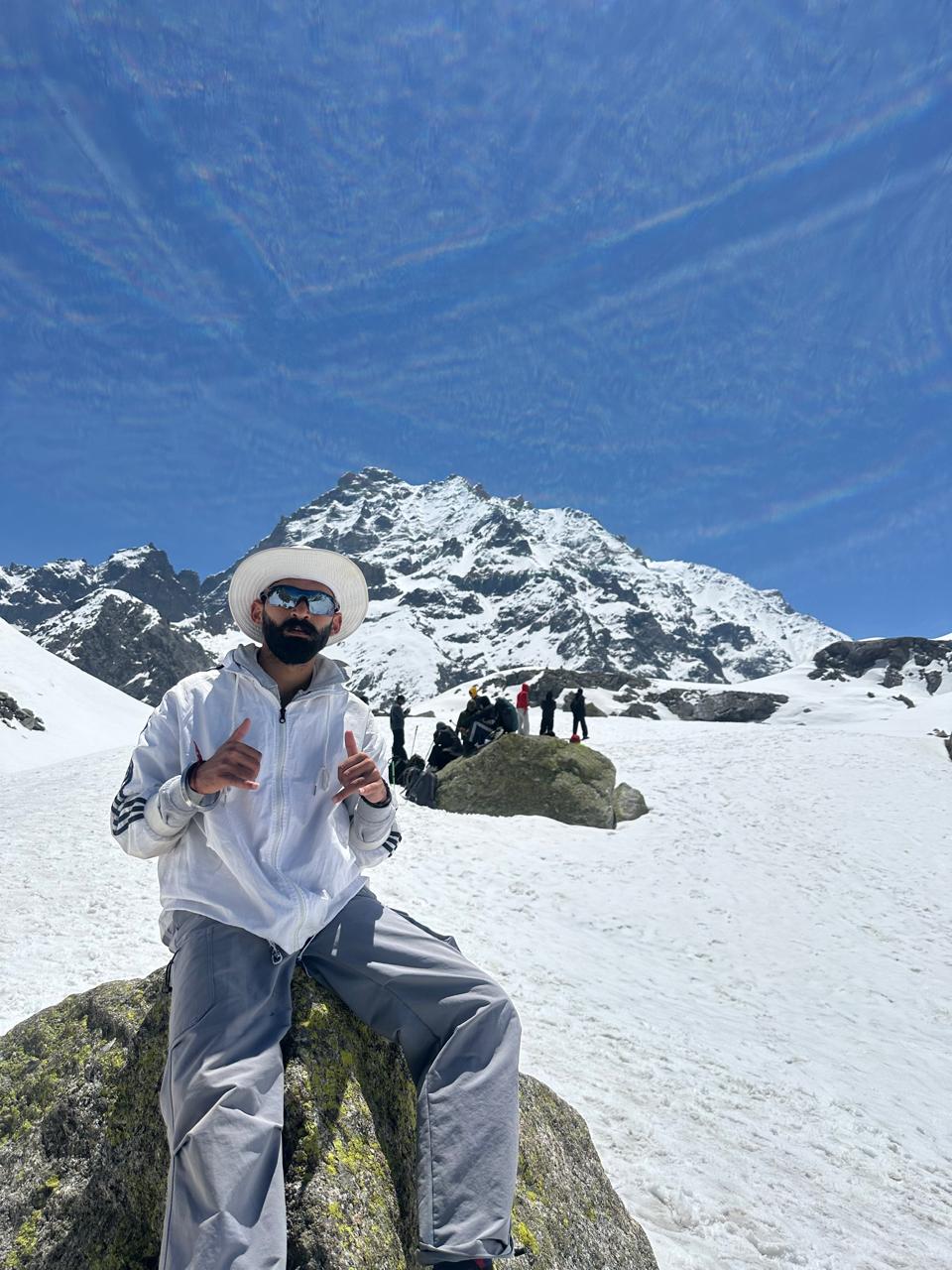
Akhil Deruwan
NIM Uttarkashi certified · 9 yrs experience
Akhil grew up in the foothills of the Garhwal Himalayas and has spent nearly a decade navigating its most demanding trails. He has led over 150 batches across Uttarakhand and Himachal Pradesh, with a strong focus on technical high-altitude routes and safety management. His calm under pressure and deep knowledge of local terrain make him a trusted leader for both beginner and advanced trekkers.
- Wilderness First Responder
- High Altitude Medicine
- Technical Route Navigation
- Search & Rescue
FAQ
Why Trek With Us
Travel Safe
Certified Team
Easy Cancellation
Well Equipped Campsite
Experienced Guide
No Hidden Charges